Supreme Court Asks Uddhav Thackeray Faction to Clarify When Political Dissent Becomes Defection in Shiv Sena Dispute
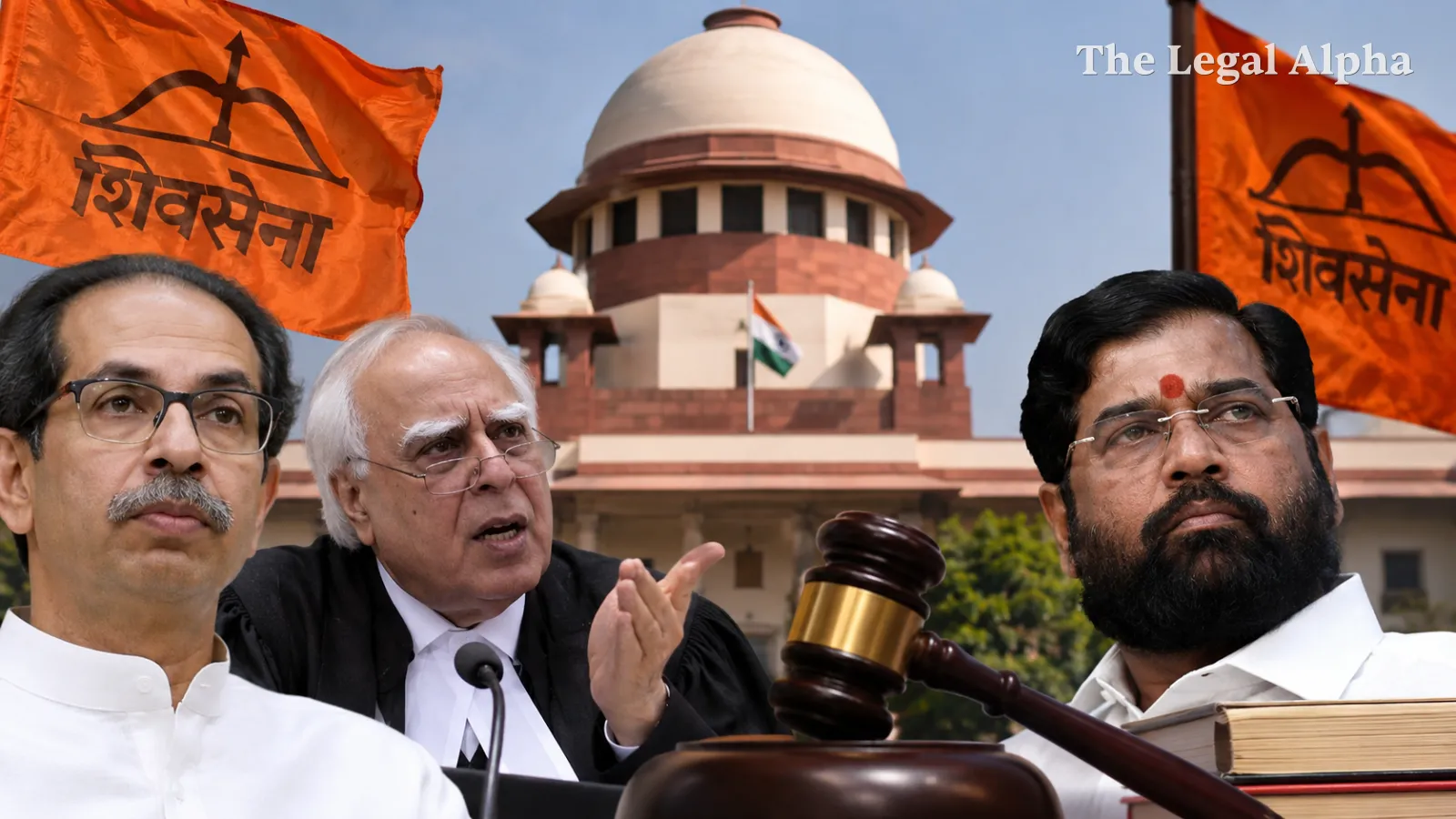
The Supreme Court has asked the Uddhav Thackeray-led faction of the Shiv Sena to explain the constitutional distinction between political dissent and defection under the Tenth Schedule of the Constitution. The question arose during the ongoing proceedings concerning the 2022 Shiv Sena split, the disqualification of Eknath Shinde-led MLAs and the Election Commission's decision to recognise the Shinde faction as the official Shiv Sena.
A Bench comprising Chief Justice Surya Kant and Justices Joymalya Bagchi and V. Mohana raised the issue while hearing arguments advanced by Senior Advocate Kapil Sibal, appearing for the Uddhav Thackeray faction.
The proceedings examine an important constitutional question: whether legislators who oppose their party's alliance with other political parties can claim to be expressing internal dissent while continuing to remain members of the original political party.
What Happened?
During the hearing, Kapil Sibal argued that the actions of Eknath Shinde and the legislators supporting him could not be characterised as ordinary political disagreement. He maintained that their conduct amounted to defection under the anti-defection framework.
The Chief Justice asked Sibal to explain the precise distinction between dissent and defection from the perspective of the Uddhav Thackeray faction.
The Bench noted that the Shinde faction's position was that its members had never left the Shiv Sena but had objected to the party's political alliance with the Congress and the Nationalist Congress Party (NCP).
Justice Joymalya Bagchi also examined the issue in the context of coalition governments, observing that the distinction could become complicated when legislators object to their party's participation in a particular political alliance.
Sibal, however, countered that the identity of the legislative party itself was central to the dispute.
Area of Law
Area of Law: Constitutional Law
Sub-topic: Anti-Defection Law, Political Party Identity and Election Symbol Disputes
Core Legal Issue
The central legal question is whether legislators who oppose their political party's alliance with other parties can legitimately claim that their actions constitute internal dissent rather than defection under the Tenth Schedule.
The proceedings also raise questions about the relationship between the identity of a political party and its legislative wing, particularly when rival groups claim to represent the same political organisation.
What Did the Supreme Court Observe?
The Supreme Court has not delivered a final ruling on the distinction between dissent and defection in the present proceedings.
Instead, the Bench asked the Uddhav Thackeray faction to explain its understanding of the two concepts at the next hearing.
The Chief Justice highlighted the opposing position that the Shinde faction continued to regard itself as part of the Shiv Sena while objecting to the party's alliance with the Congress and the NCP.
Justice Bagchi further indicated that the question of dissent and defection must be examined in light of the nature and structure of the government, particularly where a political party is part of a coalition.
Sibal maintained that the earlier Constitution Bench ruling in Subhash Desai v. Principal Secretary, Governor of Maharashtra supported the Thackeray faction's position.
The matter is scheduled to continue on Wednesday, when the Uddhav Thackeray faction is expected to address the Bench's questions.
Key Legal Points
-
Dissent and defection are distinct questions: The Court is examining whether opposition to a political alliance can be treated as internal disagreement or whether the conduct amounts to defection under the Constitution.
-
Coalition politics raises additional questions: The Bench highlighted the difficulties involved when legislators oppose their party's participation in a coalition government.
-
Legislative party identity remains important: The Thackeray faction disputes the Shinde group's claim that it could retain its identity within the Shiv Sena while challenging the party's political decisions.
-
Earlier Constitution Bench ruling is relevant: The judgment in Subhash Desai provides an important legal framework for examining the relationship between the Tenth Schedule proceedings and the Election Commission's decision on party identity.
-
No final determination has been made: The Supreme Court has sought further clarification from the Thackeray faction. The constitutional issues remain under consideration.
Relevant Law
Tenth Schedule of the Constitution of India
The Tenth Schedule contains the anti-defection provisions governing disqualification of elected representatives.
Paragraph 2 deals with disqualification on grounds of defection, including voluntarily giving up membership of a political party and voting or abstaining contrary to party directions, subject to the applicable exceptions.
Paragraph 4 provides an exception in cases involving a merger of a political party, subject to the constitutional requirements.
Election Symbols (Reservation and Allotment) Order, 1968
Paragraph 15 empowers the Election Commission of India to decide disputes between rival sections or groups of a recognised political party claiming to be that party.
Important Precedent
Subhash Desai v. Principal Secretary, Governor of Maharashtra (2023)
The Constitution Bench examined the constitutional issues arising from the Shiv Sena split, including the relationship between disqualification proceedings under the Tenth Schedule and the Election Commission's authority to decide disputes concerning party symbols.
Arguments of the Parties
Uddhav Thackeray Faction
Senior Advocate Kapil Sibal argued that the actions of the Shinde-led legislators could not be treated as mere dissent against a political alliance.
He maintained that accepting such a position would create difficulties for democratic functioning in coalition governments. He also relied on the Constitution Bench judgment in Subhash Desai to support his submissions.
Sibal further questioned how both rival factions could simultaneously claim to represent the Shiv Sena.
Eknath Shinde Faction
The position highlighted by the Bench was that the legislators continued to remain members of the Shiv Sena and their objection was directed against the alliance with the Congress and the NCP.
The dispute therefore involves whether opposition to an alliance can be separated from the question of allegiance to the political party itself.
Why Does It Matter?
The proceedings raise an important question for India's parliamentary democracy: how far can elected representatives disagree with their party's political decisions without attracting disqualification under the anti-defection law?
The distinction is particularly significant in coalition governments, where disagreements over alliances, government formation and political partnerships can become sources of internal conflict.
The Court's examination may also have implications for how political parties and their legislative wings are understood when rival groups claim control over the same organisation.
More broadly, the case highlights the need to balance internal democratic disagreement with the constitutional objective of preventing political defections.
Legal Takeaway
The distinction between political dissent and defection is central to the constitutional framework governing elected representatives. The Supreme Court has sought further clarification on this issue in the Shiv Sena dispute, but has not yet delivered a final determination. The outcome will be significant for understanding the operation of the Tenth Schedule in the context of coalition politics.
Sources
Primary Source: Subhash Desai v. Principal Secretary, Governor of Maharashtra, Supreme Court of India, Constitution Bench judgment dated May 11, 2023.
Additional Source: LiveLaw – Supreme Court hearing report dated November 20, 2026.