State Ordered to Pay ₹1.25 Lakh for Five-Day Secret Custody as Allahabad High Court Condemns Misuse of Police Power
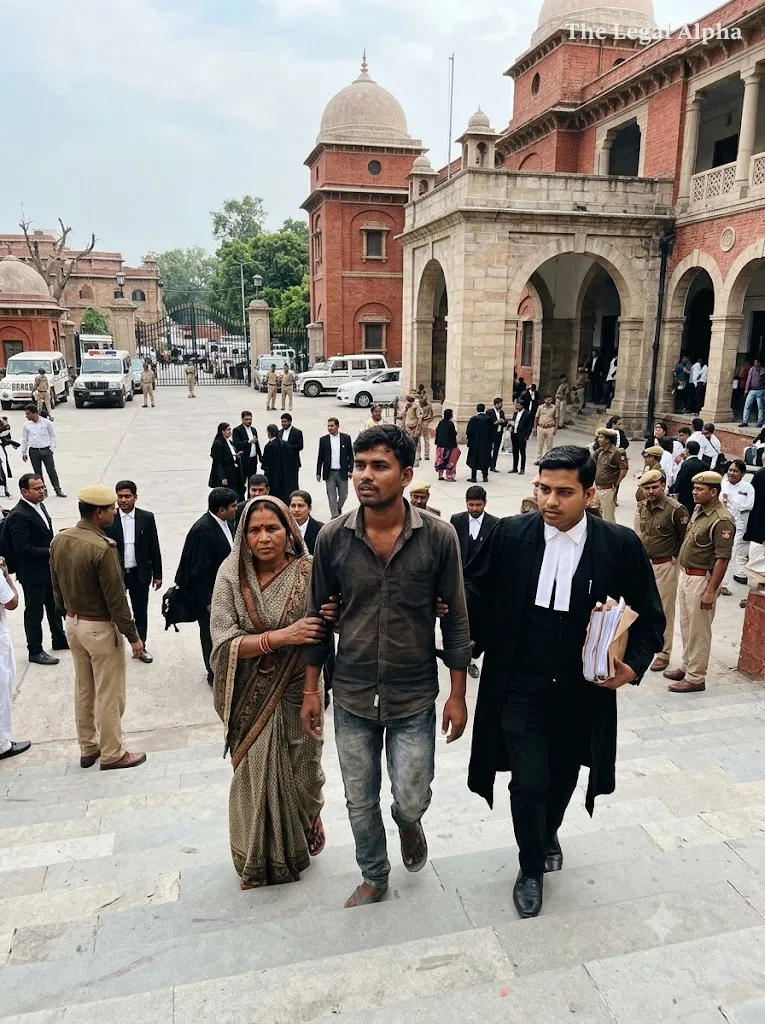
The Allahabad High Court intervened to secure the immediate release of a man held in unauthorized police custody for five days before his arrest was officially documented. Chandan Rajbhar had eloped with an 18-year-old woman, married her in Bihar, and relocated to Pune. Acting on an abduction complaint lodged by the woman's family under Section 87 of the Bharatiya Nyaya Sanhita (BNS), personnel from Salempur Police Station in Deoria tracked the couple to Maharashtra and brought them back to Uttar Pradesh.
Instead of presenting Rajbhar before a judicial magistrate within statutory timeframes, the investigating officer detained him inside the police station from August 28 until September 2, entering a fabricated date of arrest only after several days of off-the-record confinement. The detainee's family approached the High Court through a habeas corpus petition, prompting an inquiry that forced senior police administrators to concede the illegality of the officer's actions.
Legal Topic
Area of Law: Constitutional Law / Criminal Procedure
Sub-topic: Illegal Detention / Habeas Corpus & Public Law Damages
Core Legal Issue
The matter turned on whether holding a suspect in custody without preparing a contemporaneous arrest memo or presenting him before a judicial magistrate violates fundamental safeguards under Article 21 and Article 22(2) of the Constitution of India, and whether the High Court in exercise of writ jurisdiction can grant monetary compensation against the State for such unauthorized deprivation of liberty.
The Court was called upon to determine accountability when police officers falsify the timing of an arrest, evaluating whether public law remedies apply alongside disciplinary and criminal recovery against offending officials.
What Did the Court Decide?
A division bench comprising Justice Atul Sreedharan and Justice Achal Sachdev allowed the habeas corpus petition and ordered Rajbhar's immediate release, provided he was not required in any other lawful case.
The Court awarded Rajbhar ₹1,25,000 in compensation, calculated at the rate of ₹25,000 for each day of his five-day illegal confinement. It ruled that the State may recover this amount directly from the investigating officer or any other personnel found guilty of the misconduct upon conclusion of departmental inquiries. Furthermore, the bench directed that the harshest punishment be considered against the delinquent investigating officer while requesting that letters of commendation be entered into the service records of the supervising Circle Officer and Superintendent of Police for providing an unvarnished, truthful inquiry report. The Court clarified that these writ observations would not prejudice the underlying criminal trial.
Key Legal Points
-
Constitutional 24-Hour Mandate: The failure to produce an arrested person before the nearest magistrate within 24 hours of actual apprehension invalidates the detention and strips it of legal cover.
-
Per Diem Public Law Damages: The High Court reinforced the principle that unconstitutional detention warrants swift monetary compensation under writ jurisdiction, fixing a quantified per-day rate for arbitrary deprivation of personal liberty.
-
Personal Liability for Official Malfeasance: Public exchequer funds paid to victims of custodial abuse can be reclaimed from the errant police personnel, preventing sovereign coffers from shielding deliberate bad faith.
-
Sanctity of CCTV and Police Logs: Tampering with arrest timelines or maintaining "informal" lockup custody constitutes gross misconduct, warranting severe administrative and disciplinary sanctions.
Relevant Law
-
Article 21, Constitution of India: Protection of life and personal liberty, which can only be curtailed according to procedure established by law.
-
Article 22(2), Constitution of India: Mandatory requirement to produce every arrested individual before the nearest magistrate within twenty-four hours of arrest.
-
Article 226, Constitution of India: High Court writ jurisdiction to grant habeas corpus and award public law compensation for fundamental rights breaches.
-
Section 87, Bharatiya Nyaya Sanhita (BNS): Offence of kidnapping, abducting, or inducing a woman to compel her marriage.
-
D.K. Basu v. State of West Bengal (1997): Landmark guidelines on arrest procedures, documentation, and institutional accountability for custodial violations.
Arguments of the Parties
Petitioner
Counsel for the petitioners argued that Rajbhar had been taken into custody in Pune on the night of August 24–25 and brought to Salempur Police Station by August 28, yet his formal arrest was falsely recorded only on September 2. The petitioner submitted that keeping him in police lockup for five days without judicial remand was completely unauthorized, mala fide, and an assault on his constitutional liberty.
Respondent / State
The State initially relied on the case diary reflecting an arrest on September 2. However, after the High Court directed the production of station CCTV records, senior supervisory officers conducted a departmental inquiry. Based on the report submitted by the Circle Officer and endorsed by the Superintendent of Police, the State fairly conceded that the investigating officer had indeed detained the man off-the-record from August 28 to September 2 in complete disregard of legal procedure.
Why Does It Matter?
This ruling addresses the pervasive practice of "informal custody," where police officers detain suspects for interrogation while delaying formal arrest memos to bypass the statutory 24-hour magistrate production deadline. By awarding compensatory damages and permitting the State to recover the sum directly from the errant officer, the High Court introduced a concrete financial and professional deterrent against custodial overreach.
Equally significant is the bench’s approach to internal accountability. By commending senior officers for presenting an honest fact-finding report rather than closing ranks to protect a subordinate, the judgment sets a healthy precedent for transparency within police department hierarchies.
Legal Takeaway
Police custody that bypasses contemporaneous arrest logging and magistrate presentation is per se unconstitutional. High Courts possess the power to award immediate monetary compensation under writ jurisdiction for illegal detention and can saddle the rogue officers with personal financial liability.
Sources
Primary Source:
High Court of Judicature at Allahabad, Division Bench Order dated October 29, 2026, in Gyanti Devi and 2 Others v. State of U.P. and 3 Others (Habeas Corpus Writ Petition No. 1449 of 2026), coram: Atul Sreedharan & Achal Sachdev, JJ.
Additional Sources:
Inquiry Report of Circle Officer Rajesh Chaturvedi, Salempur, District Deoria (dated October 21, 2026); Departmental Disciplinary Communication by Superintendent of Police Abhijeet R. Shankar, Deoria; LiveLaw, Bar and Bench, and The Times of India case coverage.