Regulatory Framework Cannot Be Turned Into a Weapon for Routine Denial: Madras High Court Clears RSS Route Marches
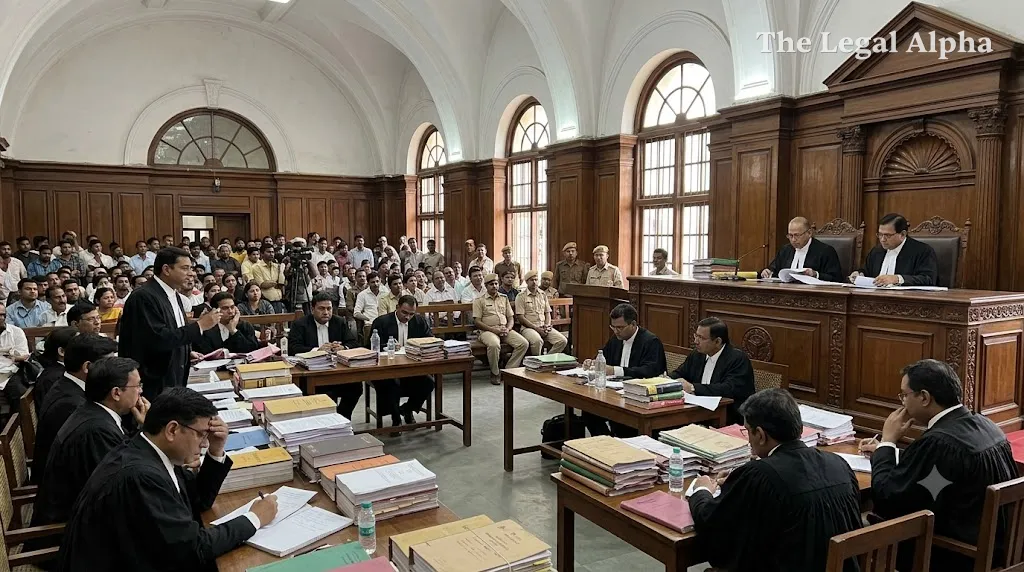
The Madras High Court sharply criticized the Tamil Nadu Police for routinely denying permission for Rashtriya Swayamsevak Sangh (RSS) route marches by misapplying regulatory guidelines established by the judiciary. Justice V. Lakshminarayanan observed that administrative guidelines designed to facilitate public processions were being repurposed by law enforcement as convenient grounds for blanket rejection.
The ruling came on a petition filed by V. G. Jagadeesan, the RSS northern Tamil Nadu secretary, after district police authorities repeatedly turned down applications seeking permission to hold route marches and public meetings across multiple locations in the State. With the State Advocate General agreeing during proceedings to permit the processions subject to local conditions, the High Court cleared the events across 128 locations.
Legal Topic
-
Area of Law: Constitutional and Administrative Law
-
Sub-topic: Freedom of Assembly / Exercise of Police Discretion in Public Order Permissions
Core Legal Issue
The legal question before the High Court was whether law enforcement authorities can lawfully deploy regulatory and court-sanctioned guidelines to impose blanket rejections on the constitutional right to assemble peacefully, rather than using those guidelines to facilitate and reasonably regulate the assembly.
The Court examined the boundaries of administrative discretion exercised by police under statutory assembly powers, focusing on whether recurring rejections on identical, mechanical grounds violate judicial precedents set by the High Court and the Supreme Court of India.
What Did the Court Decide?
Justice V. Lakshminarayanan permitted the RSS route marches to proceed across 128 designated locations in Tamil Nadu on October 25 and November 1.
The High Court held that the police must not act like "Procrustes" by fitting every application into a predetermined formula for refusal. Remarking that the police had used court guidelines like a scalpel meant for surgery to instead kill the patient, the Court directed the authorities to process applications with an orientation toward granting permission rather than searching for pretexts to deny them.
The Court recorded the State’s submission that district police authorities may propose reasonable route modifications based on local field conditions and directed the organizers to submit an undertaking affirming strict compliance with all lawful conditions.
Key Legal Points
-
Regulatory Purpose: Judicial guidelines for processions are intended to enable the orderly exercise of fundamental rights, not to serve as an administrative pretext for routine rejection.
-
Rejection of Blanket Discretion: Police authorities cannot repeatedly deploy boilerplate, mechanical objections that higher courts have previously evaluated and discarded.
-
Proportionality and Regulation: The role of the State in public assemblies is to regulate routes, timing, and conditions to maintain order, rather than extinguishing assembly rights altogether.
-
Conservation of Judicial Time: Recurring administrative refusals that disregard established precedents unduly consume judicial resources by forcing citizens to litigate annually for basic assembly permissions.
Relevant Law
-
Constitution of India:
-
Article 19(1)(b) (Right to assemble peaceably and without arms)
-
Article 19(2) (Reasonable restrictions on assembly in the interests of public order and sovereignty)
-
-
Police Regulatory Powers: Provisions regulating assemblies, processions, and licensing under the Tamil Nadu City Police Act, 1888 and the Tamil Nadu District Police Act, 1859.
-
Judicial Precedents: Supreme Court of India’s 2023 rulings affirming the right of the RSS to carry out route marches in Tamil Nadu subject to reasonable conditions.
Arguments of the Parties
Petitioner
The petitioner contended that the organization’s annual foundation day marches were being systematically blocked by the local police without valid legal justification. Counsel argued that although both the High Court and the Supreme Court had previously settled the law and established clear guidelines for these marches, district police continued to issue mechanical rejection orders based on repetitive and unsubstantiated law-and-order concerns.
State / Police
The State submitted that district police authorities are responsible for local law and order, which necessitates assessing local sensitivities, traffic management, and security risks in specific sensitive corridors. While defending the need for scrutiny, the Advocate General ultimately submitted that the State would not oppose the marches taking place on the scheduled dates, provided that district authorities retained the authority to adjust routes and enforce standard regulatory conditions.
Why Does It Matter?
This ruling directly curtails the administrative tendency of police departments to turn procedural guidelines into substantive barriers against fundamental assembly rights. In public law, statutory discretion granted to police to regulate marches is often misconstrued as an unfettered veto power.
By censuring the Tamil Nadu Police for recurring refusals, the High Court reinforced a crucial administrative principle: procedural benchmarks framed by constitutional courts cannot be wielded defensively by the executive to bypass judicial orders. The decision establishes a clear standard for future assembly applications across India, reminding law enforcement agencies that their constitutional duty is to manage and facilitate lawful public gatherings through reasonable conditions rather than through automatic prohibitions.
Legal Takeaway
Administrative guidelines governing public processions must be applied to facilitate lawful assembly with reasonable restrictions, not to engineer grounds for denial. Law enforcement agencies cannot rely on boilerplate objections to repeatedly override binding judicial precedents.
Sources
Primary Source:
-
V. G. Jagadeesan v. State of Tamil Nadu & Ors., Madras High Court (Order delivered by Justice V. Lakshminarayanan).
Additional Sources:
-
High Court Proceedings and Submissions recorded by the Advocate General of Tamil Nadu.
-
Supreme Court of India directives on route march regulations in Tamil Nadu (2023).