Public Interest Outweighs Isolated Grievance: Madras High Court Upholds Railways' 10 PM to 6 AM Sleeping Window
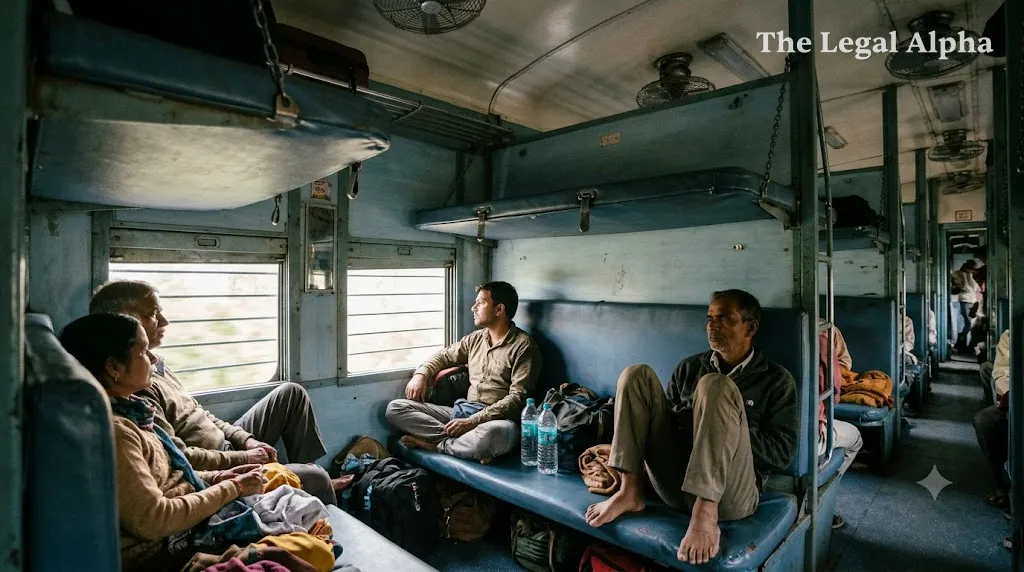
The Madras High Court declined to invalidate the Indian Railways policy restricting sleeping hours in reserved coaches between 10:00 PM and 6:00 AM.
A Division Bench comprising Chief Justice Sushrut Arvind Dharmadhikari and Justice G. Arul Murugan heard an appeal brought by a Chennai resident who had challenged a single judge’s dismissal of his writ petition. The passenger contended that when travelling with his ailing wife, fellow passengers refused to allow her to continue resting on the lower berth past 6:00 AM, rendering the existing regulatory safeguards ineffective.
Dismissing the challenge, the High Court held that an isolated refusal by uncooperative co-passengers cannot provide constitutional or legal grounds to strike down an administrative rule crafted for the shared convenience of all travelling passengers.
Legal Topic
-
Area of Law: Administrative Law / Transport Law
-
Sub-topic: Judicial Review of Public Carrier Regulations / Passenger Amenities
Core Legal Issue
The legal question before the High Court was whether Paragraph 652(a) of the Indian Railway Commercial Manual Volume-I—which limits sleeping on berths in reserved accommodation coaches to the hours between 10:00 PM and 6:00 AM—is arbitrary, unreasonable, or liable to be struck down under Article 226 of the Constitution of India because co-passengers may disregard the medical exemptions recognized under the rules.
What Did the Court Decide?
The Division Bench upheld the validity of the regulatory framework and disposed of the appeal without interfering with the existing operational circular:
-
Dismissal of Challenge: The bench refused to strike down Paragraph 652(a) of the Indian Railway Commercial Manual Volume-I.
-
Public Interest Criterion: The court emphasized that the limitation of sleeping hours is specifically tailored to balance the competing rights of middle, upper, and lower berth occupants, ensuring all passengers have adequate seating accommodation during daytime hours.
-
Sufficiency of Inbuilt Exemptions: The court observed that Paragraph 652(d) already incorporates exceptions for sick passengers, persons with disabilities, and pregnant women.
-
Recourse to Onboard Redressal: If fellow passengers decline to cooperate with an ailing traveller, the aggrieved passenger must seek assistance from onboard railway staff, ticket checking personnel, the Railway Protection Force (RPF), or station officials, rather than petitioning the court to strike down a public interest regulation.
Key Legal Points
-
Balancing Collective Convenience vs. Individual Hardship: Delegated legislation and operational guidelines framed for public utilities must be tested against collective utility. An individual's adverse experience caused by uncooperative members of the public cannot render a broadly beneficial rule ultra vires.
-
Presumption of Regularity with Inbuilt Safeguards: When an administrative rule pairs a general restriction with reasonable humanitarian exemptions (such as for medical emergencies, pregnancy, or disability), it withstands the test of non-arbitrariness under Article 14 of the Constitution.
-
Exhaustion of Operational Remedies: Before challenging statutory rules in writ proceedings, a passenger experiencing difficulty during transport must utilize the statutory redressal and enforcement mechanisms available on the spot via designated public authority personnel.
Relevant Law
-
Regulation: Paragraph 652(a) & Paragraph 652(d), Indian Railway Commercial Manual (Volume-I).
-
Administrative Circular: Railway Board Commercial Circular issued in August 2017 revising sleeping hours in reserved coaches from 10:00 PM to 6:00 AM (previously 9:00 PM to 6:00 AM).
-
Constitutional Jurisdiction: Article 226 of the Constitution of India (Scope of High Court review over public utility management policies).
Arguments of the Parties
Appellant (S. Balasubramanian)
-
Counsel for the appellant argued that Paragraph 652(a) operates rigidly and harshly, citing an instance where his ailing wife was forced to vacate her sleeping berth at 6:00 AM due to uncooperative co-passengers.
-
The appellant submitted that the relaxation under Paragraph 652(d) is toothless in practice because it depends on the goodwill and cooperation of co-passengers, thereby violating the fundamental rights of sick travellers and necessitating the annulment of the restrictive sleeping hours entirely.
Respondent (Railway Administration)
-
Maintained that the 10:00 PM to 6:00 AM window was instituted through a formal 2017 circular to resolve persistent daytime disputes between passengers assigned lower berths and those assigned middle or upper berths.
-
Emphasized that reasonable medical and accessibility exemptions already exist under Paragraph 652(d), and onboard enforcement mechanisms exist to address non-compliance.
Why Does It Matter?
This ruling reinforces judicial deference to operational rules framed by public transport utilities. In mass transit systems such as the Indian Railways, space allocation inside reserved compartments is inherently shared: lower berths double as communal daytime seating for passengers allocated upper and middle berths.
By refusing to dismantle the 10:00 PM to 6:00 AM framework, the Madras High Court clarified that individual breaches of etiquette by private citizens do not convert a sensible administrative framework into an unconstitutional one. For commuters and authorities, the decision clarifies that passenger enforcement lies squarely with onboard ticket examiners and security personnel, rather than through piecemeal judicial dilution of operating manuals.
Legal Takeaway
An administrative regulation serving public utility cannot be invalidated under writ jurisdiction simply because private individuals fail to extend mutual courtesy during a single trip. Where policy rules already contain humanitarian exemptions, aggrieved parties must invoke onboard grievance machinery rather than seeking to quash the entire rule in court.
Sources
-
Primary Source: Order of the Division Bench of the Madras High Court (Chief Justice Sushrut Arvind Dharmadhikari and Justice G. Arul Murugan) in appeal arising from Single Bench Order dated February 11, S. Balasubramanian v. Union of India & Ors.
-
Statutory Reference: Paragraph 652, Indian Railway Commercial Manual (Volume-I); Ministry of Railways (Railway Board) Circular on Sleeping Accommodation Hours (August 2017).