Gujarat High Court Reserves Verdict on Somnath Corridor Land Acquisition and Heritage Demolition Dispute
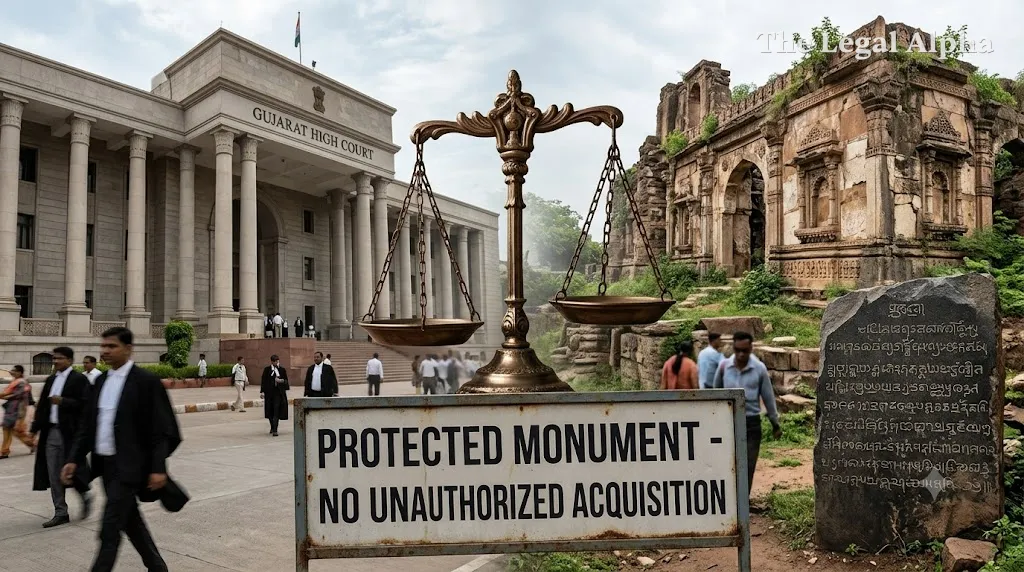
The Gujarat High Court heard concluding arguments and reserved its verdict in a dispute concerning the acquisition of land and the demolition of an ancient religious relic for the Somnath Temple Corridor project. Eight local Muslim residents and community representatives filed two writ petitions challenging the demolition of a 14th-century Persian inscription linked to the Pir Ahmedshah Dargah, as well as an associated historic gateway.
The petitioners contend that the Gir Somnath district administration unlawfully acquired the parcel, circumvented statutory trusts, and razed a centrally protected monument without mandatory clearance from the Archaeological Survey of India (ASI). The state administration opposed the petitions, asserting that the matter belongs before the Waqf Tribunal and challenging the maintainability of the writ pleas. Justice Devan Desai reserved orders following extensive hearings.
Legal Topic
-
Area of Law: Constitutional and Administrative Law / Heritage and Property Law
-
Sub-topic: Land Acquisition, Waqf Property Alienation, and Protection of Ancient Monuments
Core Legal Issue
The dispute centres on whether the state administration can legally acquire, reallocate, and clear land containing registered waqf properties and protected archaeological relics by obtaining consent exclusively from a provisionally appointed mutawalli (caretaker), without the sanction of the full governing trust or formal statutory permissions.
The court must also determine whether altering the character and user profile of a centuries-old Islamic shrine site for a larger pilgrimage corridor violates statutory bars under religious place protection laws, and whether writ jurisdiction can be bypassed in favor of alternative remedies such as the Waqf Tribunal when core statutory competence is questioned.
What Did the Court Decide?
Justice Devan Desai of the Gujarat High Court concluded the hearing of both petitions and reserved judgment. The court made no final determination on the legality of the land transfer or the demolition.
The court’s upcoming ruling will decide:
-
Whether the petitions are maintainable under Article 226 of the Constitution or must be relegated to the Waqf Tribunal.
-
The validity of the land transfer carried out through the provisionally appointed mutawalli.
-
The legal consequences of razing an archaeological structure without prior ASI clearance.
Key Legal Points
-
Restrictions on Alienating Waqf Assets: The petition invokes statutory prohibitions under the Waqf Act that limit the unilateral alienation, transfer, or sale of waqf land without comprehensive institutional approvals.
-
Statutory Heritage Protections: Under the Ancient Monuments and Archaeological Sites and Remains framework, designated historic sites and inscriptions cannot be altered, demolished, or cleared without explicit authorization from the Archaeological Survey of India.
-
Preservation of Religious Character: The challenge relies on statutory protections that prohibit changing the religious character of places of worship as they existed at independence.
-
Doctrine of Alternate Remedy vs. Fundamental Jurisdiction: The bench examined whether challenges to unauthorized state acquisitions involving waqf properties require exhaustion of tribunal remedies or warrant direct High Court intervention under writ jurisdiction.
Relevant Law
-
The Waqf Act, 1995: Provisions governing the management, custody, restrictions on alienation, and transfer of waqf property, alongside Section 83 regarding the jurisdiction of the Waqf Tribunal.
-
Ancient Monuments and Archaeological Sites and Remains Act, 1958 (and Ancient Monuments Preservation Act, 1904): Statutory mandates requiring central preservation and preventing unauthorized alterations or demolitions of protected antiquities and inscriptions.
-
Places of Worship (Special Provisions) Act, 1991: Statutory provisions barring the conversion of any place of worship and mandating the maintenance of religious identity.
-
Constitution of India: Articles 226 (powers of High Courts to issue writs), 25, and 26 (freedom of religion and management of religious affairs).
Arguments of the Parties
Petitioners
-
Argued that the 14th-century Persian inscription of Pir Ahmedshah Dargah and its gateway held protected status under the custody of the ASI, making their destruction an illegal act flagged directly by an ASI notice issued to the district collector.
-
Submitted that the District Collector arbitrarily appointed a provisional mutawalli who unilaterally signed a no-objection certificate and resolution permitting land acquisition without consulting the consolidated trust.
-
Stated that the Gujarat State Waqf Board lacked authority to validate an outright transfer in contravention of statutory bars on selling waqf properties.
-
Asserted that transforming an ancient Islamic site for the corridor infringes the Places of Worship (Special Provisions) Act, 1991.
State Government
-
Questioned the locus standi of the eight resident petitioners to challenge executive actions and trust land transfers.
-
Maintained that the writ petitions are not maintainable due to the availability of an efficacious alternative forum under the Waqf Tribunal.
-
Argued that no active, protected structural shrine existed on the acquired parcel, asserting the site merely contained an edict rather than an operational place of worship.
Why Does It Matter?
This case highlights the recurring legal friction between major state infrastructure development and the statutory safeguards protecting historic, religious, and waqf properties. By addressing whether a single administrator or provisionally designated caretaker can effectively clear the alienation of trust-held community land, the judgment will clarify the limits of administrative shortcuts in state land assembly.
Furthermore, the High Court’s ruling will provide guidance on whether executive authorities can be held directly liable under archaeological conservation statutes when infrastructure demolition overtakes heritage assets. It also examines the boundaries between specialized tribunal jurisdictions and the constitutional writ powers of High Courts when fundamental procedural violations are alleged.
Legal Takeaway
Administrative necessity and public corridor projects do not bypass mandatory statutory regimes governing ancient monuments and waqf alienations. Where state land acquisitions rely on unilateral consents from temporary caretakers to bypass governing trusts, the actions remain vulnerable to constitutional review despite statutory tribunal remedies.
Sources
-
Primary Source: High Court of Gujarat, Hearing Proceedings in Petitions regarding Somnath Temple Corridor Land Acquisition and Demolition, Coram: Justice Devan Desai (Order Reserved on November 3, 2026).
-
Additional Sources: The Times of India, "Somnath corridor: Residents challenge demolition of dargah relic, land acquisition" (Reported November 3, 2026); Archaeological Survey of India communication records referenced in court submissions.