Constitutional Safeguards Apply Equally to Accused Police Officers: Madras High Court Orders Immediate Release Over Procedural Violations

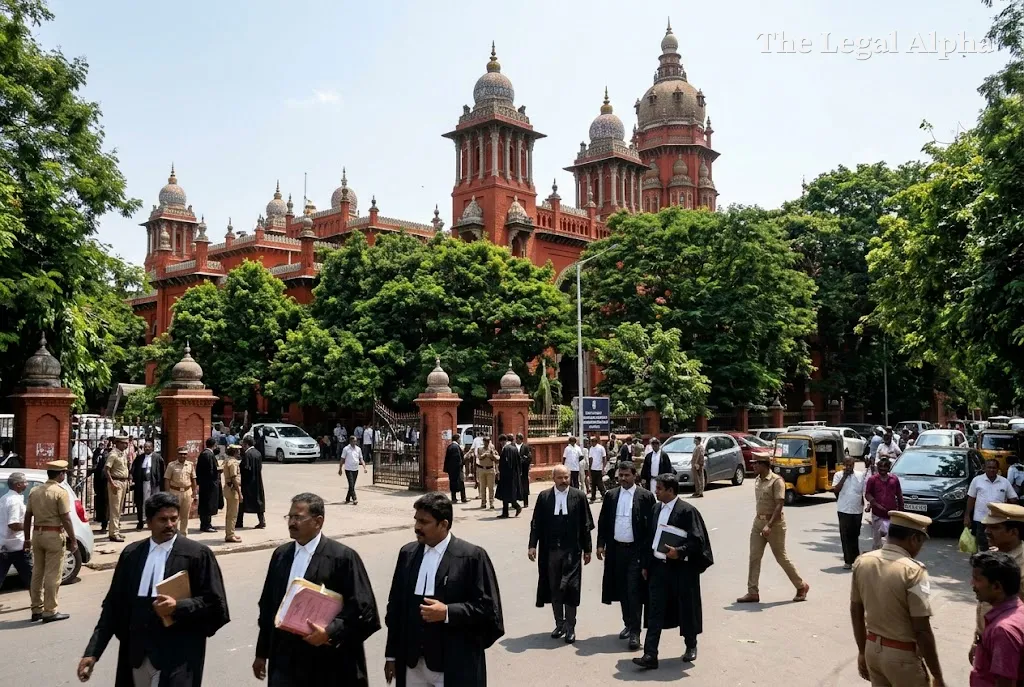
The Madurai Bench of the Madras High Court ordered the immediate, unconditional release of a suspended Tamil Nadu police inspector after finding his arrest and remand constitutionally invalid. The inspector, Sugumaran, was taken into custody by the Crime Branch-Criminal Investigation Department (CB-CID) on October 9, 2026, in connection with allegations stemming from a ₹24-crore financial settlement and extortion complaint involving hospital partners in Thanjavur.
His wife approached the High Court via a habeas corpus writ petition after the subordinate court remanded him to judicial custody and subsequently dismissed his bail application. The High Court intervened swiftly, ruling that even law enforcement personnel facing serious allegations of misconduct or illicit mediation cannot be deprived of mandatory constitutional protections during an arrest.
Legal Topic
-
Area of Law: Constitutional Law / Criminal Procedure
-
Sub-topic: Fundamental Rights / Procedural Safeguards in Arrest and Remand
Core Legal Issue
The principal question before the Court was whether non-compliance with the statutory and constitutional requirements to communicate the grounds of arrest to an accused—and the failure of a magistrate to ascertain such compliance before authorizing custody—renders the arrest and subsequent judicial remand void ab initio, warranting unconditional release through a writ of habeas corpus.
The Bench was also tasked with determining whether individuals accused of running extra-constitutional arbitration (colloquially termed Katta Panchayat) or abuse of official position forfeit the baseline procedural shields guaranteed under Articles 21 and 22 of the Constitution of India.
What Did the Court Decide?
A Division Bench comprising Justice G.R. Swaminathan and Dr. Justice P. Murugan allowed the habeas corpus petition, declaring the inspector's arrest, custody, and subsequent judicial remand completely unlawful.
The Court directed his immediate release without imposing bail conditions, making it clear that its order was not an enlargement on bail but an unconditional discharge from an unlawful detention. The Bench observed that fundamental rights under Articles 21 and 22 are non-negotiable and cannot be waived. While the Court refused to interfere with the merits of the ongoing investigation or quash the FIR itself—leaving substantive challenges to regular proceedings—it held that unlawful deprivation of personal liberty cannot be tolerated for even a single minute.
Key Legal Points
-
Inviolability of Fundamental Rights: Constitutional protections against arbitrary arrest apply uniformly across the board; they cannot be diluted even if the accused is a serving police official accused of extortion or extra-legal dispute settlement.
-
Mandatory Notice of Arrest Grounds: Failure to furnish written grounds of arrest to an accused person prior to or at the time of detention violates Article 22(1) and statutory safeguards under Section 35 of the Bharatiya Nagarik Suraksha Sanhita (BNSS), rendering the arrest unconstitutional.
-
Remand Scrutiny is Mandatory, Not Mechanical: Magisterial remand is not an administrative formality; a magistrate must independently record satisfaction that the arresting agency communicated specific grounds of arrest.
-
Maintainability of Habeas Corpus: While habeas corpus is generally unavailable against a remand order issued by a competent court, an exception applies where the remand order itself suffers from a patent lack of jurisdiction or gross illegality.
-
Release Distinct from Bail: A judicial direction terminating detention due to procedural and constitutional invalidity constitutes unconditional release rather than the exercise of discretionary bail.
Relevant Law
-
Constitution of India:
-
Article 21 (Protection of life and personal liberty)
-
Article 22(1) (Right to be informed of the grounds of arrest without delay and right to legal counsel)
-
Article 226 (Power of High Courts to issue writs, including habeas corpus)
-
-
Bharatiya Nagarik Suraksha Sanhita, 2023 (BNSS):
-
Section 35 (Procedures, notices, and safeguards regarding arrest)
-
-
Judicial Precedents:
-
Vihaan Kumar v. State of Haryana (2025) (Mandatory furnishing of grounds of arrest)
-
Mihir Rajesh Shah v. State of Maharashtra (2026) (Nullification of arrest and subsequent remand for failure to supply written grounds)
-
Arguments of the Parties
Petitioner
Counsel for the petitioner argued that the investigating agency executed the arrest in total defiance of mandatory procedural safeguards. The petitioner submitted that the police had failed to supply written grounds of arrest upon detaining the officer. Furthermore, it was contended that the jurisdictional magistrate failed to examine whether these constitutional preconditions had been satisfied prior to signing the remand order, rendering the officer's continued confinement completely without legal authority.
State / Investigating Agency
The State contended that the officer faced grave criminal allegations, including running unlawful extra-constitutional kangaroo courts and extortion in a large commercial transaction. It argued that the petition for habeas corpus was not maintainable because the accused was being held under a formal judicial remand order passed by a competent criminal court. The prosecution maintained that any objection concerning grounds of arrest ought to have been raised before the trial magistrate during the remand proceedings rather than in a writ petition.
Why Does It Matter?
This ruling reinforces the constitutional baseline that procedural fairness in criminal law is substantive justice, not a mere technicality. By applying this principle to an accused law enforcement official, the High Court emphasized that statutory safeguards must never operate selectively.
The decision serves as an institutional reminder to both police authorities and subordinate magistracies across the country:
-
For Investigating Agencies: Compliance with arrest protocols—specifically serving written grounds under the BNSS and constitutional provisions—is strictly non-discretionary. Investigating officers cannot bypass documented protocols regardless of how high-profile or egregious the alleged offense is.
-
For Subordinate Magistrates: Remand benches cannot act as passive rubber stamps for police custody requests; failure to scrutinize statutory compliance at the threshold exposes remand orders to immediate invalidation.
-
For Constitutional Jurisprudence: The judgment clarifies that High Courts will not hesitate to issue writs of habeas corpus against judicial remand orders where fundamental procedural rights have been blatantly violated.
Legal Takeaway
Due process under Articles 21 and 22 of the Constitution admits no exceptions, irrespective of the gravity of the allegations or the identity of the accused. Whenever the mandatory duty to communicate the grounds of arrest is breached, both the arrest and the resulting remand are void, entitling the individual to immediate, unconditional release.
Sources
Primary Source:
-
Madras High Court (Madurai Bench) – Innisai v. The State of Tamil Nadu & Ors., Habeas Corpus Petition (MD) No. 1359 of 2026, Order dated October 23, 2026 (Coram: G.R. Swaminathan and Dr. P. Murugan, JJ.).
Additional Sources:
-
High Court certified records and proceedings reported in legal repositories, October 2026.
-
Case reports from The Indian Express, Times of India, and Law Trend, October 2026.