Kerala High Court Overturns Interim Order Permitting Suspended Sanskrit University Students to Sit for Semester Exams
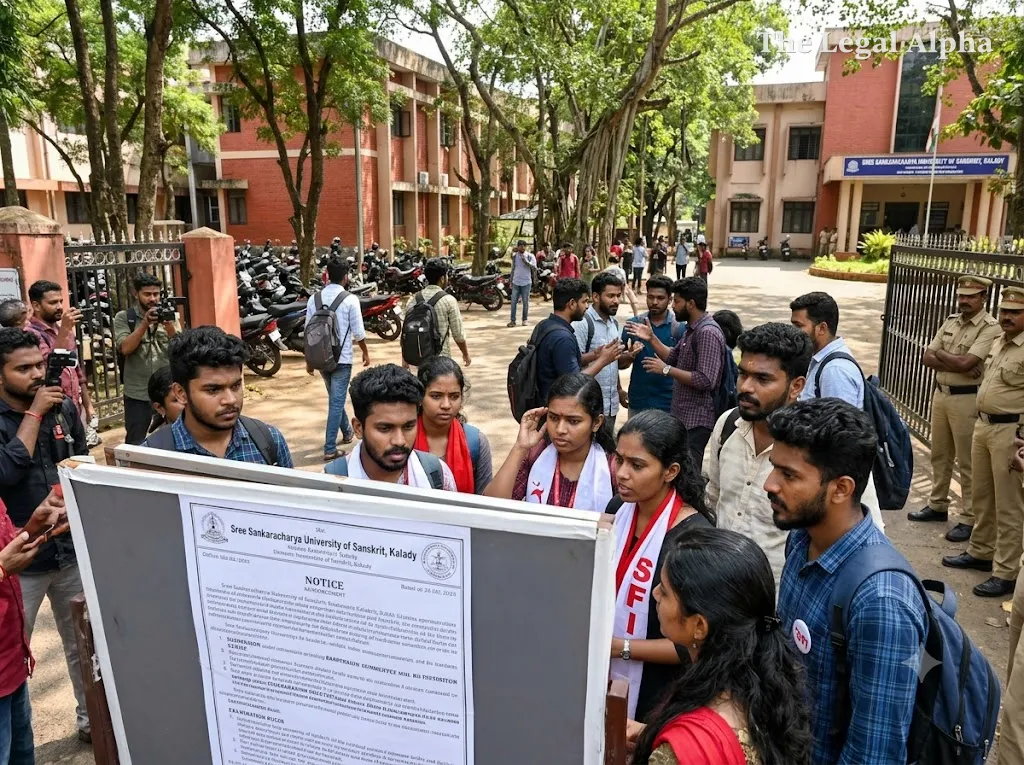
A Division Bench of the Kerala High Court set aside an interim direction that had permitted 16 suspended students from the Sree Sankaracharya University of Sanskrit (SSUS) in Kalady to pay their exam fees and appear for semester examinations.
The students, affiliated with the Students’ Federation of India (SFI), had been placed under disciplinary suspension following an agitation on August 13 during a Syndicate meeting. The demonstration involved staging a mock funeral of the Vice-Chancellor, alongside allegations of physical obstruction and attempted damage to the official vehicle. While the students approached the court against the prolonged suspension, a Single Judge initially granted them interim relief to take their upcoming semester exams. The university challenged this directive via an intra-court appeal, which the Division Bench allowed on the eve of the exams, effectively barring the suspended students from participating.
Legal Topic
Area of Law: Education Law / Administrative Law
Sub-topic: Disciplinary Proceedings / Academic Eligibility and Judicial Review of Interim Relief
Core Legal Issue
The core issue was whether a writ court, through an interlocutory order, can direct an academic institution to permit suspended students facing serious disciplinary charges to sit for examinations when statutory prerequisites—specifically mandatory minimum attendance and completion of internal assessments—have not been met.
A secondary procedural question concerned whether an interim order passed without granting adequate opportunity to the university’s standing counsel to obtain formal instructions could stand when it fundamentally impacts the institution's disciplinary autonomy.
What Did the Court / Authority Decide?
The Division Bench allowed the university's appeal and revoked the interim order that had granted the students permission to write their examinations.
The court accepted the university's contention that the interim direction significantly affected the administrative and academic authority of the university and was maintainable as an intra-court appeal. The Bench clarified that its observations were confined solely to deciding the maintainability and merits of the appeal against the interim order, leaving the final adjudication on the substantive writ petition and the prolonged nature of the disciplinary inquiry open before the Single Judge.
Key Legal Points
-
Academic prerequisites, such as prescribed attendance thresholds and internal assessment evaluations, remain mandatory statutory conditions for exam eligibility that cannot ordinarily be dispensed with via discretionary interim relief.
-
An interlocutory direction that substantially impairs an educational institution's regulatory and disciplinary authority affects vital rights and is amenable to challenge before an appellate Division Bench.
-
Disciplinary jurisdiction over campus misconduct rests primarily with university authorities, and judicial intervention at an interlocutory stage must respect procedural fairness toward the institution, including hearing its counsel on compliance criteria.
-
Interim orders cannot effectively grant the final relief or bypass statutory course regulations while disciplinary inquiries remain sub judice.
Relevant Law
-
Sree Sankaracharya University of Sanskrit Act and underlying University Statutes (governing student discipline, minimum attendance requirements, and internal examination rules)
-
Article 226 of the Constitution of India (writ jurisdiction and parameters for granting interlocutory relief)
-
Section 5 of the Kerala High Court Act, 1958 (maintainability of intra-court appeals against interlocutory orders affecting substantial rights)
Arguments of the Parties
University's Position: Counsel for the university submitted that the students stood suspended under pending disciplinary proceedings for grave acts of campus unrest, intimidation, and vandalism. It was argued that the students lacked the mandatory attendance prescribed by university regulations and had not completed their internal evaluations, making them legally ineligible to sit for the semester examinations. Furthermore, the university contended that the Single Judge issued the interim directive without giving the standing counsel an adequate opportunity to obtain instructions.
Students' Position: The students contended that the university had kept disciplinary proceedings indefinitely stalled despite conducting inquiry hearings in late September, effectively denying them their academic rights through prolonged suspension. They submitted that their lack of attendance was the direct result of an exclusionary suspension rather than voluntary absenteeism. They argued that being barred from semester tests would cause irreparable academic loss and violate their fundamental rights.
Why Does It Matter?
This ruling underscores the judiciary’s reluctance to dilute mandatory academic criteria—such as attendance and continuous assessment—even when students face interim disqualifications arising from pending disciplinary actions. It reinforces the procedural autonomy of universities to maintain campus discipline without facing pre-emptive judicial bypasses that allow suspended students into exam halls before internal inquiries formally conclude.
For tertiary education institutions across India, the decision clarifies that statutory examination criteria cannot be circumvented through urgent equitable writs, setting a firm standard for cases involving student union agitations and institutional disciplinary oversight.
Legal Takeaway
Interim judicial relief cannot override mandatory academic eligibility standards like minimum attendance and internal coursework, even where students face prolonged suspension pending an inquiry. Courts will avoid short-circuiting institutional disciplinary procedures unless gross illegality or a definitive statutory violation is established on the merits.
Sources
Primary Source:
-
High Court of Kerala, Division Bench Order in intra-court appeal concerning Sree Sankaracharya University of Sanskrit v. Suspended Students (Arising out of W.P.(C) Interlocutory Proceedings, November 2026)
Additional Sources:
-
Press Trust of India (PTI) Legal Bureau Reportage
-
High Court Proceedings & Campus Disciplinary Records, SSUS Kalady