Private Professional Institutions Cannot Impose Mid-Course Fee Hikes Without Exceptional Justification, Rules Supreme Court
The Supreme Court of India held that unaided private professional institutions cannot alter or escalate their fee structure midstream after students have secured admission, barring strictly exceptional and unforeseen operational circumstances.
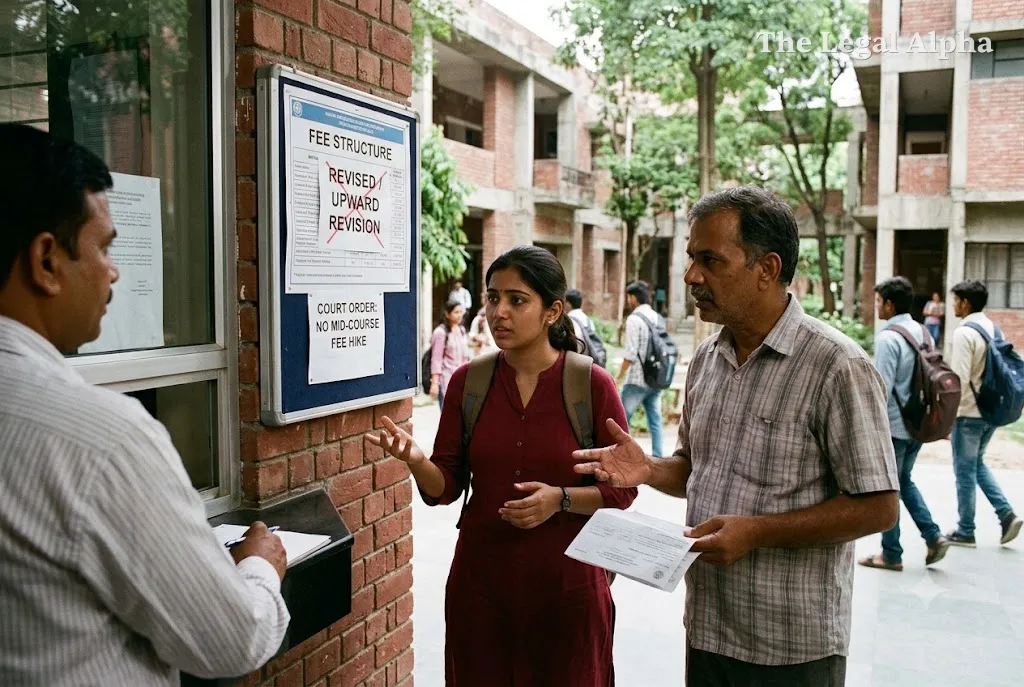
A Division Bench comprising Justice P.S. Narasimha and Justice Alok Aradhe delivered the verdict while reviewing appeals arising out of fee revisions enforced by self-financing technical institutes in West Bengal, specifically Dr. B.C. Roy Engineering College. The dispute originated when the institution introduced an upward fee revision along with a new development levy—amounting to an overall hike of roughly 37.5%—on enrolled undergraduate engineering students who had already taken admission under an earlier prospectus. The apex court held that candidates and their families are entitled to complete financial predictability before enrolling, rather than being saddled with unexpected fiscal burdens once coursework begins.
Legal Topic
Area of Law: Education Law / Constitutional Law
Sub-topic: Fee Regulation in Self-Financing Institutions / Protection Against Arbitrary Commercialisation
Core Legal Issue
The primary legal controversy centered on whether private, self-financing professional colleges possess the authority to revise notified fee structures mid-course, especially when admission prospectuses contain disclaimer clauses reserving the institution's right to modify charges following statutory or governmental revisions.
At the intersection of institutional autonomy and student rights, the court addressed whether retrospective or midstream alterations conflict with legitimate expectations, transparency mandates under education frameworks, and settled judicial bars against unauthorized fee increases.
What Did the Court / Authority Decide?
The Supreme Court quashed the 37.5% fee hike applied to the affected engineering batch and upheld the substantive relief granted by the Calcutta High Court's Division Bench protecting enrolled students from mid-course financial escalations.
The bench ruled that:
-
The institution cannot compel students admitted prior to the state notification to remit the inflated sums; any enhanced fees already realized must be adjusted against subsequent semesters or refunded to the students.
-
Institutions and statutory authorities must publish the total cumulative fee payable for the entire duration of a degree programme prior to admissions, preventing mid-stream increases unless extraordinary, unanticipated institutional expenditures arise.
-
Regulatory authorities governing professional courses must immediately formulate and implement structured mechanisms to safeguard certainty in course fee schedules before counseling cycles commence.
Key Legal Points
-
Principle of Financial Certainty: Students and families entering professional programmes are entitled to evaluate their comprehensive financial exposure upfront, as unpredictability impairs academic stability and career planning.
-
Conditional Autonomy vs. Contractual Predictability: While unaided colleges retain autonomy under established jurisprudence to propose rational fee schemes to ensure viability, boilerplate disclaimer clauses in an information brochure cannot override the requirement of advance regulatory disclosure.
-
Stringent Standard for Mid-Stream Variations: Mid-tenure revisions cannot be deployed routinely and are permissible exclusively in rare, proven eventualities—such as abrupt and verifiable increases in necessary institutional overheads.
-
Regulatory Compliance Obligation: State fee fixation bodies and central technical authorities bear a statutory duty to notify binding schedules ahead of academic sessions rather than issuing revisions that disrupt ongoing terms.
Relevant Law
-
National Education Policy (NEP) 2020 (provisions directing institutional fee transparency and curbing commercialization)
-
AICTE (Grant of Approvals for Technical Institutions) Regulations
-
Precedents on Fee Fixation: T.M.A. Pai Foundation v. State of Karnataka (2002) and Islamic Academy of Education v. State of Karnataka (2003) (establishing institutional non-profiteering principles and the regulatory supervision of education fees)
Arguments of the Parties
Petitioner / Educational Institution
The institution contended that the fee adjustment was carried out in accordance with revised limits officially notified by the State Fee Committee. It submitted that the admission brochure expressly reserved the college's entitlement to align tuition and developmental fees with forthcoming government directives, thereby legally placing applicants on prior notice.
Respondents / Students & State Bodies
The student cohort submitted that once admissions conclude on a designated fee matrix, unilateral post-admission hikes alter the essential conditions of enrollment to their detriment. They argued that educational commitments, often underwritten by bank loans and family savings, become unsustainable when fees are increased retrospectively without statutory emergency grounds.
Why Does It Matter?
Professional higher education across disciplines like engineering and medicine commands substantially steeper capital outlays than conventional non-technical courses. For most middle-class households, admissions are financed through multi-year education loans and strict budget allocations. Allowing universities to alter fees after enrolment leaves students with an unfair choice: abandon their studies halfway through or absorb unexpected financial strain.
Beyond the immediate dispute, this ruling provides clear operational boundaries for private universities, educational trusts, and state fee regulatory committees across India. Colleges must treat prospective fee structures as binding baseline contracts throughout a student's degree course, preventing private managements from relying on generic brochure disclaimers to raise costs mid-stream.
Legal Takeaway
Unaided professional institutions must declare the full, all-inclusive cost of a degree before admitting candidates. Mid-course fee increases are impermissible unless backed by verifiable, extraordinary expenditure hikes, ensuring that unilateral prospectus disclaimers cannot be used to impose retroactive financial burdens on enrolled students.
Sources
Primary Source:
-
Supreme Court of India, Judgment delivered by the Bench of Justice P.S. Narasimha and Justice Alok Aradhe (arising out of Calcutta High Court proceedings concerning Dr. B.C. Roy Engineering College, October 2026)
Additional Sources:
-
High Court at Calcutta, Division Bench Order (Appellate Civil Jurisdiction, March 2026)
-
Regulations of the All India Council for Technical Education (AICTE)
-
Ministry of Education, National Education Policy (NEP) 2020 Guidelines on Fee Transparency