Petitioner Challenges Election Commission's Unanimity Claim in Supreme Court Over Electoral Roll Revision
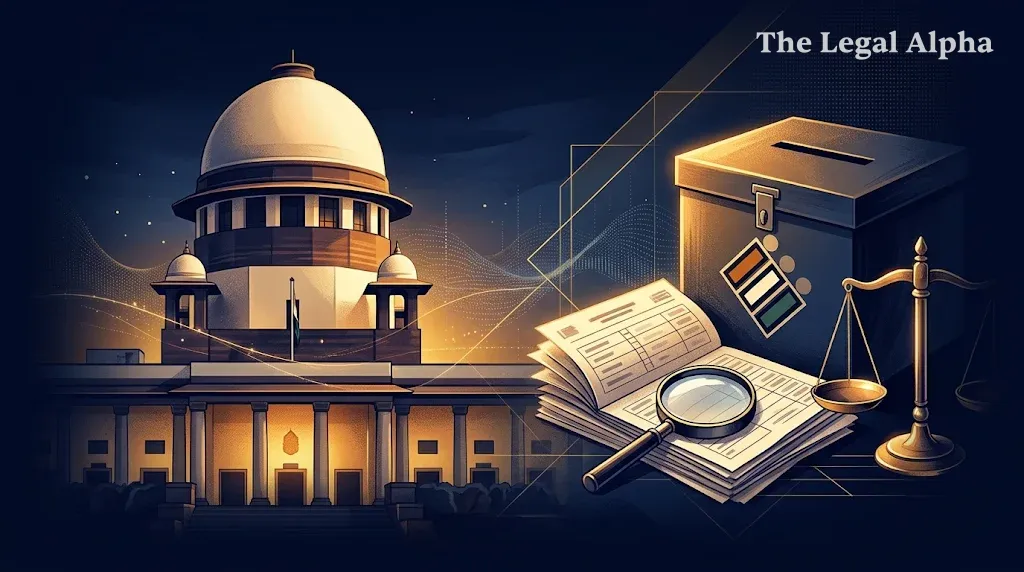
A legal challenge against the internal decision-making of the Election Commission of India (ECI) has escalated in the Supreme Court. Petitioner Rakesh Kumar Singh filed a rejoinder affidavit disputing the poll body's defense regarding how it conducted the Special Intensive Revision (SIR) of electoral rolls.
Singh's writ petition (Rakesh Kumar Singh v. Union of India, W.P.(C) No. 1246/2026) alleges that Chief Election Commissioner Gyanesh Kumar made key administrative and procedural decisions regarding the SIR exercise unilaterally, bypassing the two other Election Commissioners. While the ECI filed affidavits stating that all decisions were unanimous, the petitioner informed the Court ahead of a scheduled November 17, 2026 hearing that the Commission has failed to attach any official records—such as meeting minutes, file notings, or circulation sheets—to back up its claim.
Legal Topic
Area of Law: Constitutional and Election Law
Sub-topic: Institutional Governance / Electoral Roll Administration
Core Legal Issue
The central question before the Supreme Court is whether the Election Commission complied with statutory rules requiring collective decision-making by all three Election Commissioners when altering electoral registration procedures during the Special Intensive Revision.
Specifically, the Court is examining whether an assertion of unanimity in an affidavit satisfies statutory governance mandates without contemporaneous institutional records, and whether subsequent administrative fixes can legally validate actions that may have lacked formal authorization at the time they were taken.
What Did the Court / Authority Decide?
No final ruling has been issued yet. The proceedings are currently at the pleading stage before the Supreme Court, with the petitioner filing a formal rejoinder in response to the ECI's counter and supplementary affidavits.
What remains pending is the petitioner’s request for the Supreme Court to direct the ECI to produce original institutional records—including agendas, electronic approvals, and resolutions—covering SIR orders issued between June 2025 and July 2026, as well as records relating to appeals filed in West Bengal and IT oversight allocations.
Key Legal Points
-
Proof of Collective Decision-Making: Under Section 18 of the Chief Election Commissioner and Other Election Commissioners (Appointment, Conditions of Service and Term of Office) Act, 2023, the Commission is mandated to transact business collectively. The petitioner argues that a post-facto claim of unanimity in court pleadings cannot substitute for contemporaneous records proving all three members participated in the decision.
-
Limits of Delegated Authority: Routine administrative delegation under election statutes cannot be used by individual officers or divisions to alter statutory voter registration frameworks or bypass the collective authority of the three-member Commission.
-
De Facto Amendment of Statutory Forms: Incorporating mandatory historical mapping requirements (such as details of parents or grandparents) into the online Form 6 portal effectively alters a statutory form prescribed under the Registration of Electors Rules, 1960, regardless of whether the poll body labels the addition as a separate administrative declaration.
-
Non-Retroactive Effect of Corrective Measures: Administrative steps taken after a legal challenge is filed—such as separating a declaration from an online form or setting up compliance review committees—do not cure the lack of statutory authority at the time the original directives were enforced.
Relevant Law
-
The Chief Election Commissioner and Other Election Commissioners (Appointment, Conditions of Service and Term of Office) Act, 2023: Specifically Section 18, which governs the transaction of business and collective decision-making by the Commission.
-
The Representation of the People Act, 1951: Section 19A, relating to the delegation of functions by the Election Commission.
-
The Representation of the People Act, 1950: Section 31, concerning penalties for making false declarations in connection with electoral rolls.
-
The Registration of Electors Rules, 1960: Prescribes the statutory format and requirements for Form 6 (application for inclusion of name in the electoral roll).
Arguments of the Parties
Petitioner
The petitioner submitted through Advocate-on-Record Mudit Gupta that the ECI's affidavits contain implicit admissions of procedural lapses—such as IT modules being deployed without Commission approval and officials reallocating internal work—while offering zero documentary proof of collective approval. He argued that the mandatory online SIR declaration obstructed eligible citizens from registering, citing 97 eligible voters in Goa who could not complete applications on the ECINet portal, and contended that officers in West Bengal filed appeals against electoral roll exclusions without Commission authorization.
Respondent (Election Commission of India)
In its earlier counter and supplementary affidavits, the ECI maintained that the SIR exercise was conducted lawfully and that all decisions were backed by the unanimous consent of the Commission. Regarding the online Form 6 process, the poll body stated that the SIR declaration was a separate document rather than an amendment to the statutory form, noting that it had already separated the two in the online portal from October 21, 2026, and issued subsequent clarifications to protect previously enrolled voters from prosecution under Section 31 of the 1950 Act.
Why Does It Matter?
This dispute tests the internal checks and balances within India's premier electoral body following the enactment of the 2023 law governing the Election Commission. Because the ECI operates as a multi-member constitutional authority, how it documents and approves major policy or software changes directly affects the transparency and accountability of election administration.
On a practical level, the case highlights how digital interfaces—like mandatory fields on an online portal—can create substantive barriers to voting rights. If technical updates or unapproved administrative declarations prevent eligible citizens from submitting registration forms, procedural lapses inside the Commission translate directly into disenfranchisement on the ground.
Legal Takeaway
Multi-member statutory bodies cannot rely on general assurances of consensus to defend major policy or procedural shifts; they must maintain clear, contemporaneous records showing collective approval. Furthermore, administrative agencies cannot use software design or post-litigation fixes to bypass formal statutory procedures governing citizen rights.
Sources
Primary Source:
Rejoinder Affidavit filed by Petitioner Rakesh Kumar Singh before the Supreme Court of India in Rakesh Kumar Singh v. Union of India (W.P.(C) No. 1246/2026).
Additional Sources:
-
Counter Affidavit and Supplementary Affidavit filed by the Election Commission of India in W.P.(C) No. 1246/2026.
-
Office Orders and Press Notes issued by the Election Commission of India (dated September 26, October 14, October 21, November 3, November 4, and November 6, 2026).