Supreme Court Orders Reinstatement Of CRPF Constable, Finds Removal From Service Disproportionate
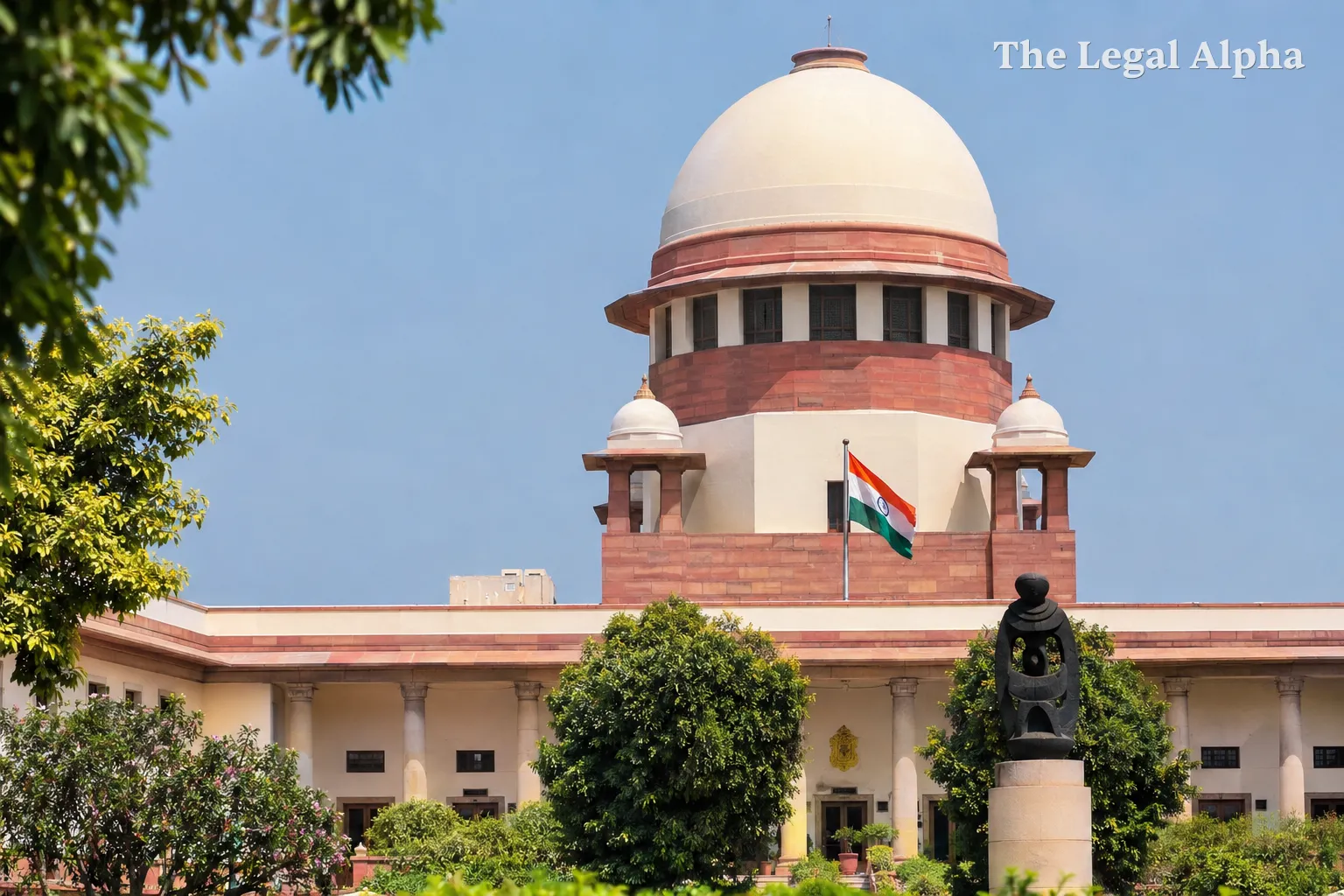
The Supreme Court of India has set aside the removal of a Central Reserve Police Force (CRPF) constable who was dismissed from service after overstaying his sanctioned leave by 99 days. The Court held that removal from service was grossly disproportionate in the circumstances of the case.
A Bench comprising Justice Satish Chandra Sharma and Justice Nongmeikapam Kotiswar Singh allowed the appeal filed by Mithilesh Kumar Pathak against the Union of India. The Court directed the authorities to reinstate him immediately, pay 50% of his back wages for the period of removal and grant all other consequential benefits.
The judgment was delivered on November 16, 2026, in Civil Appeal No. 4411 of 2011.
Background Of The Dispute
Pathak was serving as a constable in the 54th Battalion of the CRPF, posted at Anantnag, Jammu and Kashmir.
He was granted casual leave from September 21, 2000, to October 12, 2000, because of his wife's illness. However, he failed to resume duty on October 13, 2000, and eventually returned on January 19, 2001, resulting in an overstay of 99 days.
The authorities had sent him two registered letters directing him to report for duty, but he did not respond.
In his explanation, Pathak stated that he had himself suffered from infective hepatitis while staying in his village in Bihar. He submitted medical prescriptions, pathological reports, medicine purchase receipts and a fitness certificate to support his explanation.
He further stated that his illness, the absence of postal facilities in his village and his wife's inability to read or write had prevented him from responding to the official communications.
Why Was The Constable Removed From Service?
The departmental inquiry found him guilty of unauthorised absence and failure to comply with official directions.
The Enquiry Officer rejected his medical documents, primarily because they did not contain indoor or outdoor patient registration numbers. The officer also questioned the documents because certain prescriptions and medicine bills appeared to have been written using the same pen.
On this basis, the medical records were suspected of being fabricated.
The Commandant subsequently ordered his removal from service through an order dated March 29, 2001, with effect from March 31, 2001.
His departmental appeal and revision were also rejected.
Patna High Court Took Different Views
Pathak challenged the removal before the Patna High Court.
On April 13, 2007, a Single Judge allowed his writ petition, finding that the rejection of the medical documents was based on conjectures and assumptions rather than proper verification.
The disciplinary, appellate and revisional orders were consequently quashed.
However, the Union of India challenged this decision before a Division Bench. On May 5, 2010, the Division Bench reversed the Single Judge's decision and restored the removal order.
The Division Bench reasoned that the Single Judge had exceeded the permissible limits of judicial review by reassessing the departmental evidence. It also emphasised the importance of discipline in a uniformed force deployed in a sensitive area.
Pathak subsequently approached the Supreme Court.
Core Legal Issue
The principal question before the Supreme Court was whether the Patna High Court's Division Bench was justified in overturning the Single Judge's decision and restoring the penalty of removal from service.
The Court also examined whether the departmental authorities could reject medical evidence as fabricated merely because of similarities in handwriting or ink and the absence of hospital registration numbers, without independently verifying the documents.
Another important issue was whether removal from service was a proportionate punishment for the 99-day overstay, considering the employee's explanation and the circumstances surrounding his absence.
What Did The Supreme Court Decide?
The Supreme Court held that unauthorised absence and wilful absence are not necessarily synonymous.
It explained that the circumstances in which an employee remains absent, the explanation provided and the supporting evidence must be considered before determining the nature and seriousness of the misconduct.
The Court clarified that illness or circumstances beyond an employee's control may be relevant while assessing unauthorised absence, although they do not automatically excuse the entire period.
Rejection Of Medical Documents Based On Assumptions
The Bench found that the medical documents had been rejected without adequate verification.
It observed that no verification from the treating doctor, medical establishment or pharmacy supported the inference that the documents were fabricated.
The Court held that similarities in handwriting or ink, without supporting material connecting them to fabrication, could not reasonably justify rejecting the medical evidence.
It further explained that the absence of patient registration numbers and the circumstances surrounding the doctor's treatment could warrant clarification, but these factors alone did not establish that treatment had never been received or that the documents were forged.
Removal From Service Held Grossly Disproportionate
The Supreme Court acknowledged that CRPF personnel belong to a disciplined force and must comply with official orders and reporting requirements, particularly when posted in sensitive areas.
It also considered the employee's previous instances of overstaying leave, including periods of 71 days in 1994 and 175 days in 1999, as well as his failure to maintain communication with his superiors.
Nevertheless, the Court concluded that the punishment of removal from service was unduly harsh in the circumstances.
It held that even after considering his previous conduct and failure to communicate, removal from service for the 99-day overstay was grossly disproportionate.
Key Legal Points
-
Unauthorised absence and wilful absence: Absence without prior permission does not automatically establish wilful misconduct. The employee's circumstances and supporting explanation must be examined.
-
Verification of medical evidence: Departmental authorities cannot reasonably declare medical documents fabricated solely on the basis of similarities in handwriting or ink without supporting verification.
-
Judicial review: Courts may interfere with disciplinary findings where conclusions are arbitrary, unreasonable or unsupported by proper material.
-
Proportionality of punishment: Disciplinary penalties must correspond to the seriousness of the misconduct and the relevant circumstances of the individual case.
-
Discipline in uniformed forces: The requirement of strict discipline remains important, but it does not remove the obligation to impose fair and proportionate punishment.
Relevant Laws And Judicial Precedents
CRPF Rules, 1955
The appellant relied on Rule 27(c)(4) of the CRPF Rules, 1955, arguing that the departmental inquiry had not complied with the prescribed procedural requirements concerning his opportunity to submit a written statement and present evidence in his defence.
Article 226 Of The Constitution Of India
Article 226 empowers High Courts to exercise judicial review over administrative and disciplinary decisions.
The judgment reiterates that judicial review is not ordinarily an opportunity to reassess departmental evidence as an appellate authority. However, intervention may be justified where findings are arbitrary or legally unsustainable.
State of Andhra Pradesh v. S. Sree Rama Rao (1963)
The Supreme Court referred to this precedent while explaining the limits of judicial interference in departmental inquiries.
It recognised that judicial intervention may be justified where a departmental conclusion is so arbitrary or unreasonable that no reasonable person could have reached it.
B.C. Chaturvedi v. Union of India (1995)
The Court also relied on this important judgment concerning judicial review of disciplinary punishment.
The precedent recognises that where punishment shocks the conscience of the reviewing court, appropriate relief may be granted, including reconsideration or, in exceptional cases, modification of the punishment itself.
Arguments Presented Before The Supreme Court
Appellant's Arguments
Pathak argued that the departmental authorities had wrongly rejected his medical documents without making any genuine attempt to verify their authenticity.
He submitted that similarities in handwriting or ink and the absence of hospital registration numbers could not independently establish fabrication.
He also argued that his previous instances of overstay had already been dealt with separately and should not be used to reject his explanation in the present proceedings.
Additionally, he challenged the proportionality of his removal and raised concerns regarding compliance with Rule 27(c)(4) of the CRPF Rules, 1955.
Union Of India's Arguments
The Union of India maintained that the appellant was a member of a disciplined force posted in a sensitive area and had remained absent for 99 days without permission.
It argued that he had ignored two official communications directing him to report for duty and that his previous instances of prolonged absence demonstrated repeated disregard for service discipline.
The respondents also defended the departmental inquiry, arguing that the Single Judge had exceeded the limits of judicial review by substituting his own assessment of the evidence.
Why Does This Judgment Matter?
The ruling reinforces an important principle in service jurisprudence: disciplinary authorities must consider the circumstances surrounding an employee's absence rather than treating every instance of unauthorised absence as wilful misconduct.
The decision does not mean that medical grounds automatically excuse unauthorised absence or that members of uniformed forces can disregard reporting requirements.
Instead, it emphasises that disciplinary findings must be supported by proper evidence and that punishment must be proportionate to the misconduct.
For government departments and disciplinary authorities, the judgment highlights the importance of verifying supporting documents before rejecting them as fabricated.
It also provides guidance to courts reviewing disciplinary penalties, particularly where the punishment appears excessive in relation to the circumstances established during the inquiry.
Final Outcome And Directions
Allowing the appeal, the Supreme Court set aside the Patna High Court Division Bench judgment dated May 5, 2010, and restored the Single Judge's order dated April 13, 2007.
The Court directed the authorities to:
-
Reinstate Mithilesh Kumar Pathak with immediate effect.
-
Pay him 50% of the back wages for the period between his removal and reinstatement.
-
Grant him all other consequential benefits.
The appeal was accordingly allowed, and any pending applications were disposed of.
Legal Takeaway
The Supreme Court has reiterated that unauthorised absence cannot automatically be treated as wilful misconduct, particularly when an employee provides an explanation supported by medical evidence. At the same time, disciplinary authorities retain the power to enforce service discipline, provided their findings are based on proper evidence and the punishment imposed is proportionate to the misconduct.
Sources
Primary Source:
Supreme Court of India, Mithilesh Kumar Pathak v. Union of India & Ors., Civil Appeal No. 4411 of 2011, 2026 INSC 1219, judgment dated November 16, 2026.
Additional judicial precedents cited in the judgment:
-
State of Andhra Pradesh v. S. Sree Rama Rao (1963).
-
B.C. Chaturvedi v. Union of India (1995).