Madras High Court Transfers Isha Yoga Centre Missing Volunteer Investigation To CB-CID
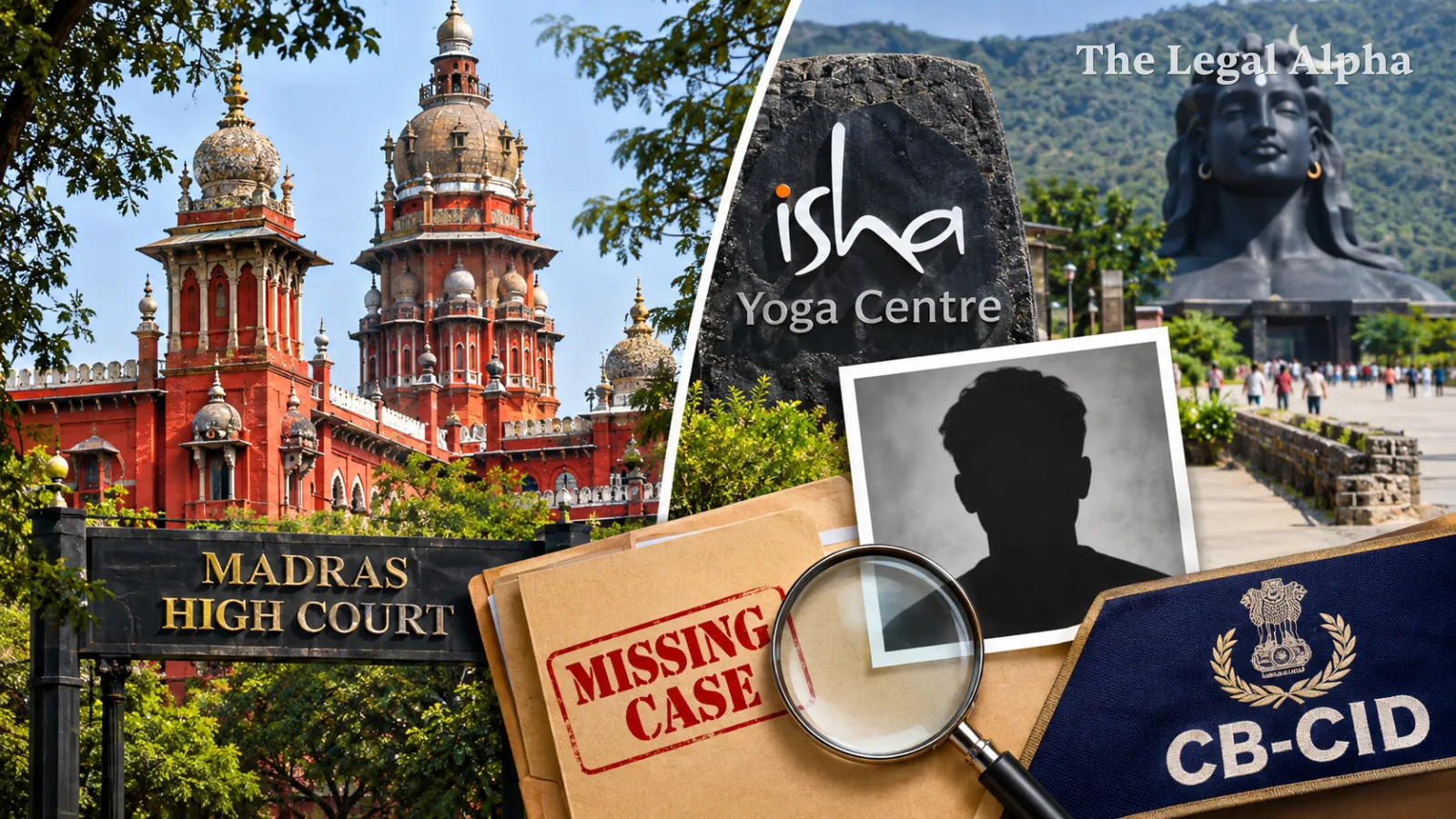
The Madras High Court has ordered the transfer of the investigation into the disappearance of Ganesan, a volunteer associated with the Isha Yoga Centre in Coimbatore, to the Crime Branch-Criminal Investigation Department (CB-CID). The decision came after the Court found that the local police had failed to make progress despite earlier judicial directions and an undertaking to complete the investigation.
Justice G.K. Ilanthiraiyan passed the order on October 27, 2026, in Thirumalai v. Superintendent of Police, Coimbatore, Criminal Original Petition No. 9233 of 2026.
Legal Topic
Area of Law: Criminal Law
Sub-topic: Criminal Investigation / Missing Persons / Habeas Corpus
Core Legal Issue
The central issue before the High Court was whether an investigation into a missing-person case should remain with the local police when they had failed to comply with earlier directions to expedite the investigation and submit a final report.
The Court was required to consider whether transferring the investigation to a specialised police agency was necessary to ensure a proper and fair investigation.
What Did the Madras High Court Decide?
The High Court allowed the petition filed by Thirumalai and ordered the transfer of the investigation registered as Crime No. 26 of 2023 at Alandurai Police Station to the CB-CID, Coimbatore.
The Court noted that the police had earlier undertaken, through a status report filed on June 9, 2026, to complete the investigation and submit a final report within three months. However, the investigating officer had failed to take the necessary steps even after giving this assurance.
Consequently, Justice Ilanthiraiyan withdrew the entire case records from the local police station and transferred them to the CB-CID.
The Court further directed the CB-CID to conduct a proper and fair investigation and submit its final report within 12 weeks from the date of receiving the complete case diary.
The criminal original petition was disposed of in accordance with these directions.
Key Legal Points
-
Failure to comply with judicial directions: The Court took note of the local police's failure to complete the investigation despite an earlier High Court direction.
-
Transfer of investigation: The Court considered the continued lack of progress sufficient to transfer the matter to the CB-CID.
-
Fair investigation: The specialised investigating agency was specifically directed to conduct a proper and fair investigation.
-
Time-bound directions: The CB-CID must submit its final report within 12 weeks of receiving the complete case diary.
-
Accountability of investigating authorities: The order highlights the importance of police authorities honouring undertakings made before constitutional courts.
Relevant Legal Provisions
Article 226 of the Constitution of India: Provides High Courts with the power to issue writs, including habeas corpus, for the enforcement of fundamental rights and other legal purposes.
Habeas Corpus: A judicial remedy through which a person can seek the production of an individual alleged to be unlawfully detained or whose whereabouts raise concerns requiring judicial examination.
The present transfer order does not expressly interpret any statutory provision. Its focus is on the need to ensure an effective investigation.
Arguments Of The Parties
Petitioner's Position
Thirumalai, represented by Advocate S.K.D. Rajasekar, sought the transfer of the investigation from the Alandurai Police Station to the CB-CID.
The petition arose from the disappearance of his brother, Ganesan, and the failure of the local police to complete the investigation despite earlier directions of the High Court.
Respondents' Position
Additional Public Prosecutor A. Amarnath appeared for the police authorities.
The police had previously submitted a status report undertaking to complete the investigation and file a final report within three months. However, the Court found that the promised progress had not materialised.
The order does not record detailed arguments from the respondents on the merits of the transfer request
Why Does The Decision Matter?
The ruling highlights the responsibility of investigating agencies to act promptly when dealing with missing-person complaints, particularly where family members approach the courts seeking judicial intervention.
It also demonstrates that an assurance given by investigating authorities before a High Court cannot remain unfulfilled without consequences. When an investigation remains stalled despite judicial directions, the Court can intervene to ensure that the matter receives appropriate attention.
For families of missing persons, the decision reinforces the importance of judicial oversight in cases where investigations fail to produce meaningful results.
The transfer also places responsibility on the CB-CID to complete the investigation within the specific period prescribed by the Court.
Legal Takeaway
The Madras High Court's decision reinforces that prolonged investigative inaction, particularly after judicial directions and formal assurances, can justify transferring a criminal investigation to a specialised agency. The primary objective remains ensuring a fair, effective and time-bound investigation rather than allowing a missing-person case to remain unresolved.
Sources
Primary Source: Thirumalai v. Superintendent of Police, Coimbatore, Crl. O.P. No. 9233 of 2026, Madras High Court, order dated October 27, 2026.
Additional Sources: