Madras High Court Grants Interim Personality Rights Protection to CSK Superfan Saravanan Hari Against Blinkit
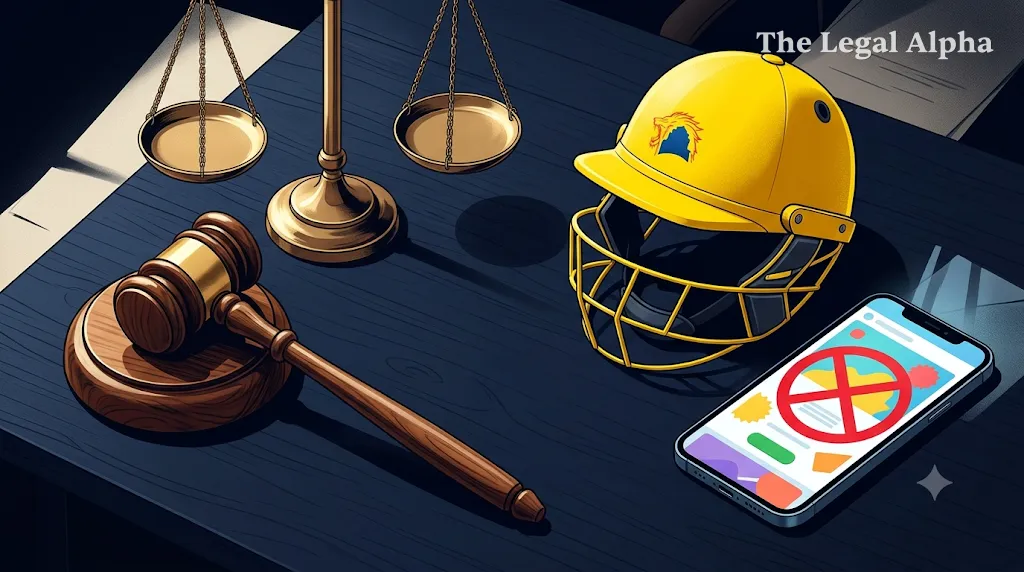
The Madras High Court has issued an interim injunction restraining quick-commerce platform Blinkit, media publisher Bennett, Coleman & Company Limited (The Times of India), and unknown third parties from commercially exploiting the distinctive public persona of well-known Chennai Super Kings (CSK) supporter Saravanan Hari without his prior written consent.
Justice P.B. Balaji passed the order in a commercial civil suit filed by Saravanan Hari. The dispute stems from a full-page Blinkit promotional campaign published in the Chennai edition of The Sunday Times of India on March 23, 2025. Alongside cricket-themed graphics and the tagline "The men in yellow always deliver," the advertisement featured an illustration of a yellow-painted cricket fan sporting curly hair, a thick moustache, and the text "THALA 7" across his torso while gesturing with both thumbs up.
Arguing that this caricature directly replicated the signature appearance he has cultivated in cricket stadiums since 2013, Hari approached the court seeking ₹1.01 crore in damages and injunctive relief. The ruling is notable because Indian personality rights litigation has historically revolved around mainstream film stars, athletes, and public figures, whereas this order extends temporary protection to a non-celebrity sports fan who built a commercially recognisable identity.
Legal Topic
Area of Law: Intellectual Property Law / Constitutional Law
Sub-topic: Personality Rights, Right to Publicity, and Commercial Misappropriation
Core Legal Issue
The central question before the Madras High Court was whether a private individual who is not a conventional celebrity can claim enforceable personality and publicity rights over a distinctive, self-curated public appearance—and whether an advertiser's use of a stylized cartoon illustration replicating those combined traits constitutes unauthorized commercial exploitation.
What Did the Court Decide?
Justice P.B. Balaji granted temporary injunctive relief in favour of Saravanan Hari, barring Blinkit, The Times of India, and unnamed third parties (via a John Doe order) from using his image, pose, or likeness for commercial gain without written authorization.
-
Interim Injunction Granted: The court rejected Blinkit's preliminary defence that the illustrated character was purely fictional, observing that Hari's popular stadium pose and visual attributes had been reproduced in the advertisement.
-
Recognition Beyond Conventional Celebrities: Justice Balaji observed that while Hari may not hold the mainstream celebrity status of figures like Amitabh Bachchan, Rajinikanth, Sachin Tendulkar, or M.S. Dhoni, he has nonetheless carved out a distinct public niche through his recurring, recognizable stadium persona.
-
Pending Determination: The order is strictly interim in nature. Substantial claims—including Hari's demand for ₹1.01 crore in damages, a permanent declaration of proprietary rights over his persona, rendition of accounts, surrender of artwork, and the exact liability of the newspaper publisher—remain pending for full adjudication. The matter is scheduled for further hearing on December 14, 2026.
Key Legal Points
-
Democratization of Personality Rights: Constitutional and common law protections against the unauthorized commercial use of one's identity are not restricted to A-list celebrities; any individual whose distinct visual persona carries public recognition and commercial value can seek judicial protection.
-
Caricatures and Illustrations Can Infringe Likeness: Replacing a photograph with a cartoon or stylized drawing does not insulate an advertiser from liability if the cumulative visual cues (paint, wig, torso lettering, pose, and contextual cricket references) unmistakably evoke a real person.
-
Protection Against False Endorsement: Unauthorized commercial depictions risk misleading consumers into believing an individual has endorsed a brand or is affiliated with its customer service operations.
-
Scope of John Doe Relief: By extending the restraint to unknown parties, the interim order addresses broader concerns regarding unauthorized digital and AI-driven replication of an individual's likeness.
Relevant Law
-
Article 21 of the Constitution of India: Guarantees the right to life and personal liberty, which Indian jurisprudence interprets as encompassing the right to privacy and autonomy over one's personal identity and likeness.
-
Common Law Tort of Passing Off: Protects individuals against misrepresentation in the course of trade that falsely suggests an endorsement or commercial association.
-
Order XXXIX, Rules 1 and 2 of the Code of Civil Procedure, 1908: Governs the grant of temporary injunctions to prevent ongoing injury pending the final disposal of a civil suit.
Arguments of the Parties
Plaintiff (Saravanan Hari)
Hari submitted that since 2013, he has consistently appeared at CSK matches worldwide wearing yellow face and body paint, red lipstick, a curly wig, a thick moustache, dark eyebrows, torso lettering honoring M.S. Dhoni, and a signature double thumbs-up pose. Relying on media coverage, brand collaborations, recognition by Dhoni, and a cameo in the Tamil film GOAT, he contended that his persona possesses independent commercial value. He argued that Blinkit's cartoon misled readers into assuming he endorsed the platform—prompting acquaintances to inquire about a brand tie-up and dissatisfied Blinkit users to approach him with delivery complaints.
Defendants (Blinkit and Bennett, Coleman & Co. Ltd.)
In its prior response to Hari's legal notice and before the court, Blinkit denied any infringement, contending that the characters illustrated in the newspaper campaign were entirely fictional and bore no connection to the plaintiff. Blinkit also stated that, as a gesture of goodwill, it would refrain from using the character in future campaigns. Separately, Bennett, Coleman & Company Limited (The Times of India) disclaimed liability, arguing that the creative content belonged solely to the advertiser and that the newspaper's role was restricted to selling publication space.
Why Does It Matter?
For brands, advertising agencies, and creative teams, this order serves as a clear warning against relying on "lookalike" illustrations or stylized caricatures during topical marketing campaigns—especially around major sporting events like the Indian Premier League. Using visual shorthand inspired by viral internet personalities, superfans, or micro-influencers without securing formal releases carries tangible litigation risk, even if no actual photograph is used.
From a doctrinal standpoint, the Madras High Court's approach signals an evolving understanding of publicity rights in India. In an era where social media creators and everyday individuals can build recognizable public identities independent of traditional film or sports stardom, courts appear increasingly willing to safeguard personal branding against uncompensated corporate exploitation.
Legal Takeaway
You do not need to be a conventional celebrity to own your public image. If an individual has cultivated a distinct, recognizable persona with commercial value, businesses cannot bypass consent requirements by turning that likeness into a cartoon or promotional mascot.
Sources
Primary Source:
Interim Order dated November 16, 2026, passed by Justice P.B. Balaji of the Madras High Court in Saravanan Hari v. Blinkit & Ors., O.A. No. 1229 of 2026 and A. Nos. 4827 & 4828 of 2026 in C.S. (Comm. Div.) No. 303 of 2026.
Additional Sources:
-
Bar & Bench, "Madras High Court bars Blinkit from using CSK fan Saravanan Hari's persona without consent" (November 16, 2026).
-
LiveLaw, "Madras High Court Protects CSK Fan's Personality Rights, Restrains Blinkit From Using Image/Pose Resembling Him" (November 17, 2026).