Past Daily-Wage Status Cannot Deprive Regularised Staff of Earned Annual Increment: Supreme Court Rules Against Gujarat Government
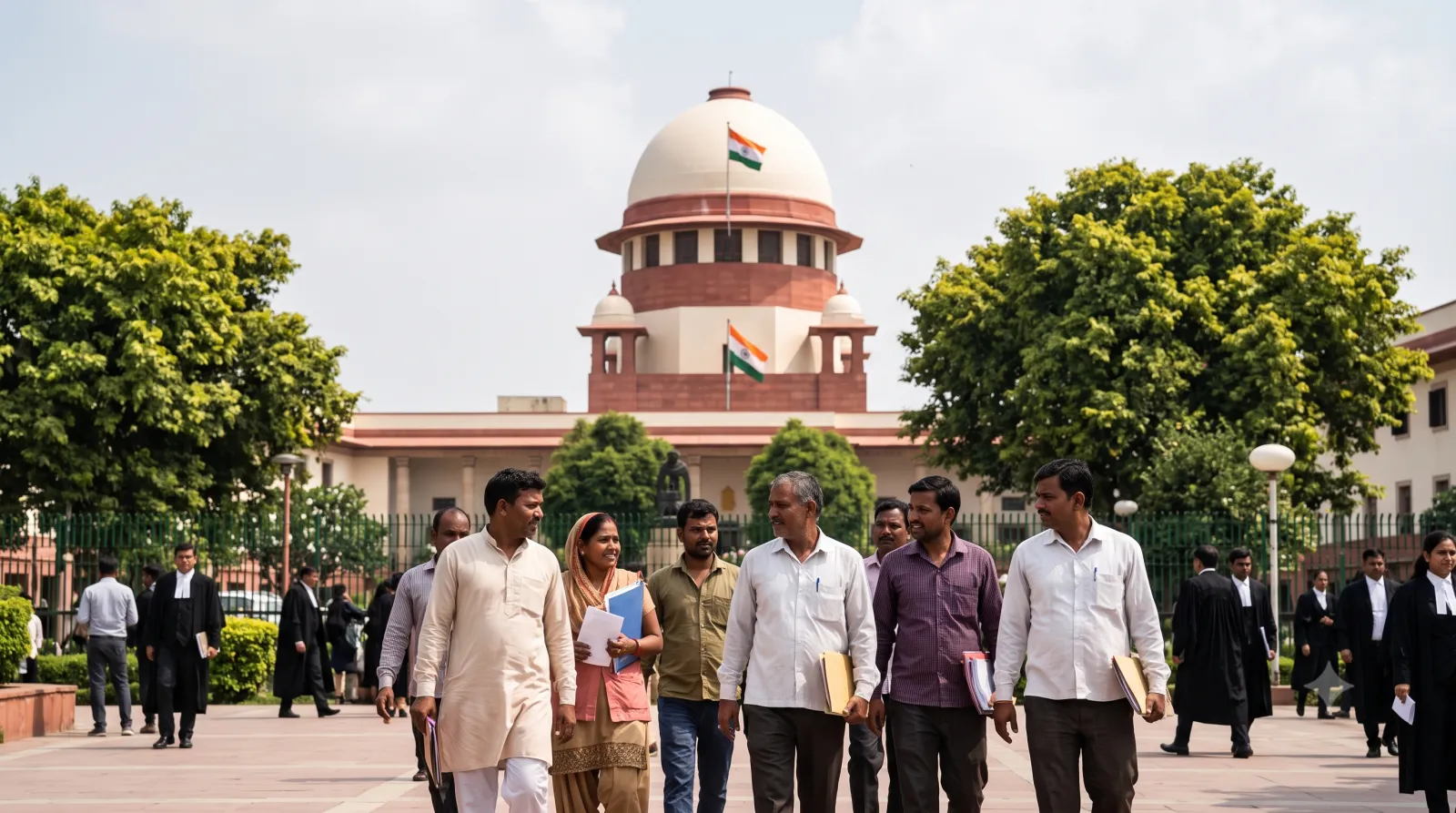
The Supreme Court of India has ruled that government employees who were regularized after working as daily wagers cannot be denied their earned annual increments or consequential pensionary benefits merely because of their original daily-wage status.
A division bench comprising Justice Sanjay Kumar and Justice Sanjeev Sachdeva allowed a batch of civil appeals filed by retired skilled workers of the Gujarat Irrigation Department against the State of Gujarat. The workers, who had rendered over three decades of public service, retired on June 30 of their respective superannuation years after completing a full year of qualifying service. The State Government had refused to grant them the annual increment falling due on July 1, arguing that as former daily-wage employees regularized under government resolutions, they were not entitled to the same increment rules as regular recruits.
Overturning the Gujarat High Court's dismissal of their claims, the Supreme Court held that once daily-wage workers are conferred permanent status and treated as permanent employees for pension and retirement benefits, the state cannot discriminate against them by resurrecting their past daily-wage label. The Court directed the Gujarat government to calculate and disburse the revised pensionary arrears within 30 days, subject to 6% annual default interest.
Legal Topic
Area of Law: Service Law / Labour Jurisprudence
Sub-topic: Annual Increment on Superannuation / Equal Treatment of Regularised Daily-Wage Workers
Core Legal Issue
Can a state government withhold the final annual increment earned by an employee who completed a full year of satisfactory service prior to superannuation on June 30 solely because the employee was originally engaged as a daily-wage worker before being regularized into permanent service?
Furthermore, does denying an earned increment for past service rendered violate the doctrine of equality under Articles 14 and 16 when the employee has already been granted permanent status and pensionary parity under statutory or government resolutions?
What Did the Court Decide?
The Supreme Court allowed the appeal filed by Chhaganbhai Kohyabhai Pateliya and other retired workers, setting aside the judgment of the Gujarat High Court.
The bench held that the appellants, having completed full twelve months of service prior to their retirement on June 30, had earned the increment as a vested right for services already rendered, applying the principles affirmed in Director (Admn. and HR) KPTCL v. C.P. Mundinamani.
The Court ruled that because the workers filed their writ petition in 2022, they were entitled to enhanced pension by factoring in one increment for the three-year period immediately preceding the filing of their petition. The state authorities were ordered to release all computed arrears within 30 days, failing which interest at the rate of 6% per annum will apply from the date of default.
Key Legal Points
- The Supreme Court established that an employee's historic entry status as a daily-wage worker cannot serve as a valid legal ground to deny an earned annual increment once the employee has attained permanent, regularized status.
- The bench reaffirmed the settled principle that an annual increment is not a bonus or reward for future employment, but an earned entitlement for satisfactory service rendered during the preceding twelve months.
- The Court applied the doctrine established in Director (Admn. and HR) KPTCL v. C.P. Mundinamani, ruling that employees retiring on June 30 cannot be deprived of the annual increment falling due on July 1 after completing a full year of qualifying service.
- The bench held that because the workers approached the High Court in 2022, they were entitled to the benefit of the Supreme Court's modified directions granting revised pension arrears for the three years prior to the date of filing.
- The State of Gujarat was issued a strict 30-day compliance deadline to release all arrears, with a mandatory 6% per annum interest penalty for default.
Relevant Law
- Articles 14 and 16 of the Constitution of India: Equality before the law and equality of opportunity in matters of public employment.
- Article 226 of the Constitution of India: Writ jurisdiction of High Courts to redress arbitrary administrative decisions.
- Government Resolution (GR) dated 17 October 1988 (Government of Gujarat): Policy framework conferring regularized status, pay scales, and pensionary benefits on long-serving daily-wage employees.
- Director (Admn. and HR) KPTCL v. C.P. Mundinamani (2023) 12 SCC 344: Landmark Supreme Court ruling holding that employees superannuating on June 30 are entitled to the annual increment earned for the previous year.
Arguments of the Parties
Petitioner / Appellant (Chhaganbhai Kohyabhai Pateliya & Ors.):
The retired workers submitted that they had dedicated more than 30 years of continuous service to the Gujarat Irrigation Department and were formally conferred regular status under the State's 1988 resolution. Counsel argued that having rendered flawless service from July 1 of the preceding year to June 30 of their retirement year, the annual increment had accrued to them as an earned property right under Article 300A and service rules, which cannot be defeated simply because their formal superannuation took effect a day before the increment's nominal credit date of July 1.
Respondent / State of Gujarat:
Represented by Additional Solicitor General Archana Pathak Dave and Advocate-on-Record Deepanwita Priyanka, the State contended that the appellants were originally engaged as daily-rated laborers whose service conditions were governed strictly by executive resolutions rather than statutory recruitment rules. The State submitted that benefits under the 1988 resolution were welfare concessions that did not entitle former daily wagers to identical increment treatment as regular cadre employees upon retirement.
Why Does It Matter?
This judgment carries substantial practical significance for hundreds of thousands of regularized government workers, daily wagers, and municipal employees across India. State governments frequently attempt to curtail pensionary liabilities by creating artificial hierarchies between direct recruits and regularized daily-rated staff, depriving the latter of terminal increments and full pension parity.
By holding that original daily-wage status cannot be revived to deny retirement benefits earned through decades of hard labor, the Supreme Court reinforces the constitutional guarantee of equal pay and fair retirement benefits. The decision eliminates arbitrary pension deductions for working-class government staff, affirming that the right to an increment is earned through service, not granted at the whims of executive classification.
Legal Takeaway
The Supreme Court has firmly held that once daily-wage workers are regularized into permanent government service, their original daily-wage status cannot be cited to deny them annual increments earned for past service upon superannuation. Employees completing a full year of service prior to retirement on June 30 are entitled to an annual increment and consequential pension enhancement, which state authorities must compute and release without delay.
Sources
Primary Source: Judgment of the Supreme Court of India in Chhaganbhai Kohyabhai Pateliya & Ors. v. State of Gujarat & Ors. (Civil Appeal decided by Justice Sanjay Kumar and Justice Sanjeev Sachdeva, reported at 2026 LiveLaw (SC) 1020).
Additional Sources: LiveLaw Supreme Court Report; CourtBook Case Analysis.