Mandatory Attendance for Law Students: Supreme Court Reserves Verdict on BCI's Challenge to Delhi High Court Ruling
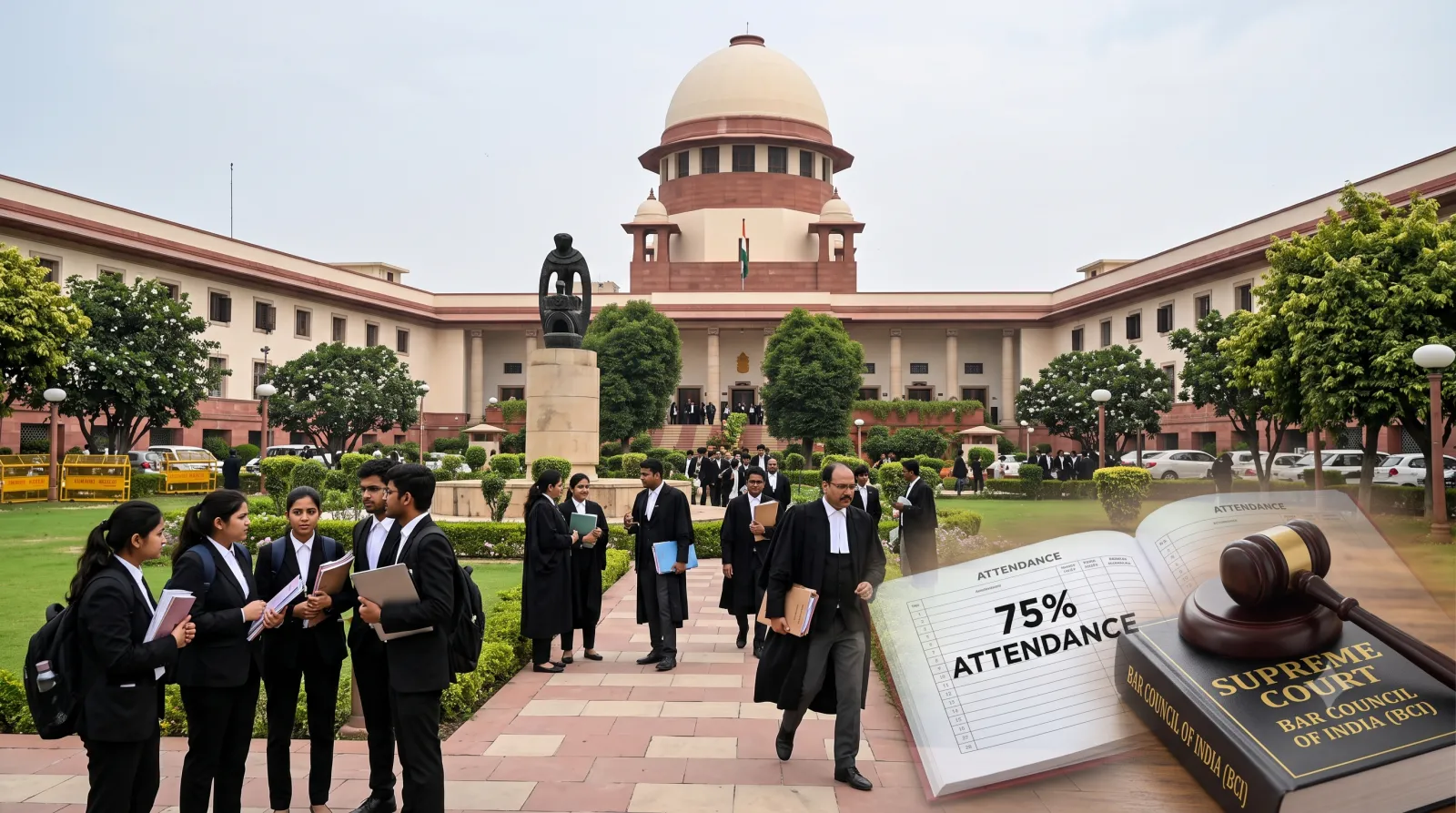
The Supreme Court of India has reserved its judgment on a critical regulatory dispute concerning whether law students can be debarred from writing semester examinations solely due to a shortage in mandatory classroom attendance.
A three-judge bench comprising Justice Vikram Nath, Justice Sandeep Mehta, and Justice Augustine George Masih heard extensive arguments on appeals preferred by the Bar Council of India (BCI) and the Narsee Monjee Institute of Management Studies (NMIMS). The appellants challenged a November 2025 judgment of the Delhi High Court, which held that universities cannot debar students from taking examinations or pursuing their academic careers purely on account of low attendance.
The statutory regulator and premier law schools argued before the apex court that legal training is a specialized professional discipline where interactive classroom pedagogy, moot courts, and ethics discussions cannot be bypassed. Conversely, student representatives contended that rigid attendance mandates ignore medical crises, internship obligations, and modern learning realities, often causing devastating academic loss. Reserving its verdict, the Supreme Court is set to deliver a definitive ruling on the regulatory boundaries of legal education in India.
Legal Topic
Area of Law: Education Law / Professional Regulatory Jurisprudence
Sub-topic: Bar Council of India Legal Education Rules / Mandatory Attendance Standards vs Student Rights
Core Legal Issue
Does the Bar Council of India possess exclusive statutory authority under the Advocates Act, 1961 to enforce mandatory minimum attendance thresholds (70% to 75%) as a non-negotiable prerequisite for appearing in LL.B. examinations?
Furthermore, did the High Court overstep its constitutional writ jurisdiction under Article 226 by diluting statutory attendance rules and restricting universities from debarring students with severe attendance deficits?
What Did the Court Decide?
The three-judge bench of the Supreme Court concluded oral hearings from all contesting parties and formally reserved its judgment.
While the bench previously granted interim relief permitting certain debarred students to sit for examinations without creating future equities, the Court will now authoritatively determine whether mandatory classroom attendance remains a binding statutory condition for legal degrees.
The impending judgment will settle the conflict between regulatory autonomy vested in the Bar Council of India and the equitable interventions exercised by constitutional courts to protect students from academic forfeiture.
Key Legal Points
- The Supreme Court concluded final hearings and reserved its verdict on appeals challenging the Delhi High Court's ruling that restricted law schools from debarring students for low attendance.
- The Bar Council of India defended Rule 12 of the Rules of Legal Education, 2008, asserting that professional legal advocacy requires physical clinical training and cannot be reduced to a distance-learning model.
- Participating universities argued that dismantling mandatory attendance norms creates institutional indiscipline and prevents faculties from verifying continuous academic engagement.
- Counsel for students highlighted that mechanistic biometric attendance systems penalize students undergoing medical emergencies, family distress, or participating in institutional moot courts and internships.
- The apex court's forthcoming judgment will authoritatively define whether High Courts can dilute professional education regulations under Article 226 of the Constitution.
Relevant Law
- Section 7(1)(h) and Section 49(1)(af) of the Advocates Act, 1961: Statutory powers of the Bar Council of India to promote and lay down standards of legal education.
- Rule 12 of the Bar Council of India Rules of Legal Education, 2008: Mandatory requirement of 70% attendance in each subject (condonable up to 65% in exceptional circumstances).
- Article 226 of the Constitution of India: High Court writ jurisdiction to review arbitrary academic actions.
- Article 19(1)(g) of the Constitution of India: Right to practice any profession, trade, or occupation subject to reasonable professional qualifications.
Arguments of the Parties
Appellants (Bar Council of India & NMIMS):
Senior counsel appearing for the BCI and university administrations submitted that the Advocates Act empowers the regulatory body to prescribe professional training standards to maintain the quality of the Indian Bar. They argued that legal education is fundamentally distinct from general academic degrees, requiring active classroom debates, clinical legal education, and professional ethics instruction that cannot be acquired through self-study. The appellants argued that the Delhi High Court's decision created a dangerous precedent that paralyzes university administration and dilutes the credibility of Indian law degrees internationally.
Respondents (Law Students):
Counsel representing student bodies and aggrieved scholars submitted that rigid attendance rules are frequently weaponized by university administrations in a mechanical and punitive manner. It was contended that debarring students over marginal shortages causes catastrophic loss of academic years and severe psychological distress. The respondents argued that modern professional legal education demands flexible accommodation for judicial clerkships, specialized internships, legal aid clinics, and verified health crises, advocating for evaluation based on academic competence rather than rigid attendance registers.
Why Does It Matter?
This case carries immense ramifications for over 1,700 law faculties, National Law Universities (NLUs), and hundreds of thousands of law students across the country. Tensions between rigid attendance mandates and student well-being have escalated nationwide, occasionally resulting in student protests and judicial intervention.
If the Supreme Court upholds the Bar Council's strict regulatory powers, universities will be mandated to strictly enforce physical attendance, closing the door on casual absenteeism and remote learning. Conversely, if the Court sustains the High Court's reasoning, it could trigger a nationwide reform toward modern pedagogical assessment, forcing regulators to strike a balanced compromise between institutional rigor and student flexibility.
Legal Takeaway
The Supreme Court has reserved its verdict on whether the Bar Council of India's mandatory 70% classroom attendance requirement for law students is non-negotiable. The forthcoming judgment will decide whether professional regulatory bodies retain absolute authority to enforce attendance standards or whether constitutional courts can intervene to shield students from debarment.
Sources
Primary Source: Judicial Proceedings of the Supreme Court of India in Bar Council of India v. Union of India & Ors. and connected appeals (Bench comprising Justice Vikram Nath, Justice Sandeep Mehta, and Justice Augustine George Masih, arguments concluded on October 6, 2026).
Additional Sources: LiveLaw Supreme Court Report; Bar & Bench Legal News Coverage.