NUSRL Ranchi Hosts National Moot Court Competition to Examine Emerging Consumer Protection Challenges
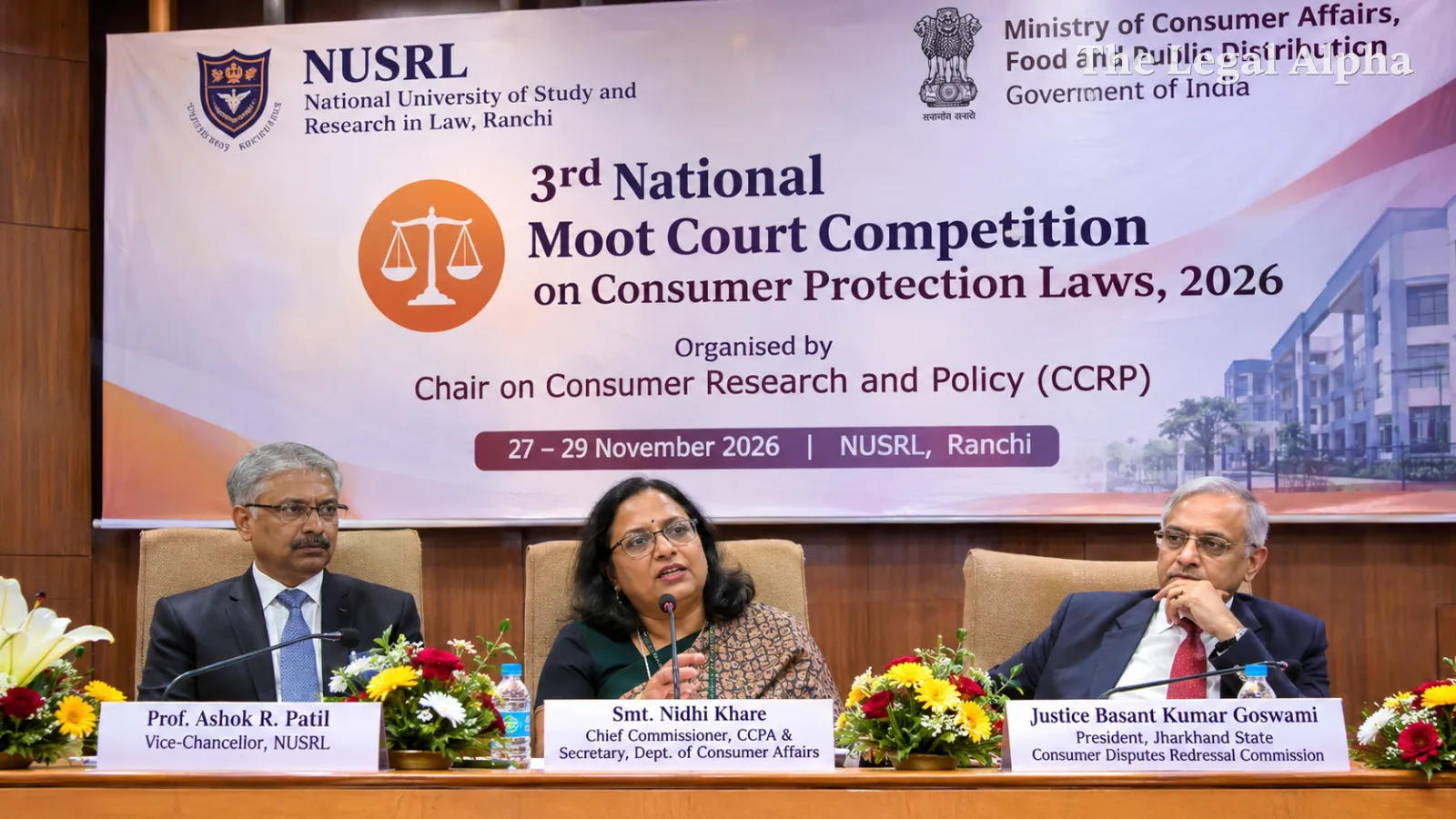
The National University of Study and Research in Law (NUSRL), Ranchi, is hosting its 3rd National Moot Court Competition on Consumer Protection Laws, 2026, from November 27 to 29, bringing together law students to examine emerging challenges in consumer rights and regulatory enforcement.
The competition is being organised by the University's Chair on Consumer Research and Policy (CCRP) under the aegis of the Union Ministry of Consumer Affairs, Food and Public Distribution.
The event was inaugurated on November 27, with Nidhi Khare, Chief Commissioner of the Central Consumer Protection Authority (CCPA) and Secretary, Department of Consumer Affairs, attending as the Chief Guest.
The inaugural session brought together senior legal and academic representatives, including Justice Basant Kumar Goswami, President of the Jharkhand State Consumer Disputes Redressal Commission, and Professor Ashok R. Patil, Vice-Chancellor of NUSRL Ranchi.
Emerging Consumer Protection Issues Take Centre Stage
Addressing students and faculty members, Nidhi Khare highlighted the changing nature of consumer exploitation in the digital marketplace.
She drew attention to several concerns, including unsafe and unregulated products, misleading advertisements, fabricated online reviews, unclear Buy Now, Pay Later (BNPL) credit arrangements and consumer data privacy.
She encouraged law students and researchers to examine not only individual consumer complaints but also commercial practices and business models that may create systematic risks for consumers.
The discussion also highlighted the importance of academic research in shaping regulatory policies. Referring to the Repairability Index initiative, Khare explained how research and institutional interventions can contribute to policy development.
Legal Topic
Area of Law: Consumer Protection Law
Sub-topic: Digital Consumer Rights, E-Commerce Regulation, Misleading Advertisements and Unfair Trade Practices.
Core Legal Issues
The discussions at the competition highlighted important questions concerning the protection of consumers in an increasingly digital economy.
These include whether existing consumer protection mechanisms adequately address misleading online promotions, fake reviews, unfair subscription practices and opaque digital credit arrangements.
Another important issue concerns the responsibility of online marketplaces and businesses to ensure product safety, transparency in commercial transactions and protection of consumer information.
Key Legal Developments and Discussions
-
Misleading Advertisements: The role of regulatory authorities in addressing deceptive promotional claims and protecting consumers from misleading commercial practices.
-
Online Marketplaces: Concerns over the sale of unsafe and unregulated products through e-commerce platforms.
-
Fake Online Reviews: The growing need to address fabricated consumer feedback that can influence purchasing decisions.
-
BNPL Transactions: Questions surrounding financial transparency and consumer awareness in Buy Now, Pay Later arrangements.
-
Collective Consumer Action: Students also raised questions about the possibility of collective proceedings to address consumer grievances.
Relevant Law
The discussions are connected with the following legal framework:
-
Consumer Protection Act, 2019: The principal legislation governing consumer rights, unfair trade practices, product liability and consumer dispute redressal.
-
Section 2(47): Defines unfair trade practices, including deceptive methods used to promote goods or services.
-
Section 10: Provides for the establishment of the Central Consumer Protection Authority.
-
Section 18: Deals with the powers and functions of the CCPA to protect consumer rights and address unfair trade practices.
-
Section 21: Empowers the CCPA to take action against false or misleading advertisements.
-
Section 94: Provides for measures to prevent unfair trade practices in e-commerce and direct selling.
The Consumer Protection (E-Commerce) Rules, 2020, also form an important part of the regulatory framework governing online consumer transactions.
What Did the Competition Organisers and Speakers Highlight?
This is an academic competition rather than a judicial proceeding. No court judgment or binding legal determination was announced as part of the reported event.
The discussions focused on strengthening consumer protection through legal education, regulatory awareness and research.
NUSRL Vice-Chancellor Professor Ashok R. Patil appreciated the CCPA's enforcement initiatives, including action concerning misleading advertisements in the coaching sector, adulteration in branded honey and products sold without mandatory ISI certification on e-commerce platforms.
Students also raised questions about promotional offers, subscription services, BNPL transactions, financial transparency and collective consumer action.
Competition Schedule and Final Rounds
The competition began on November 27 and is scheduled to conclude on November 29, 2026.
The preliminary rounds and quarter-finals took place on November 28. The top eight teams advanced to the quarter-final stage.
The final day's programme includes:
-
Semi-final rounds from 10:30 AM to 12:30 PM.
-
Announcement of semi-final results and memorial exchange at 12:45 PM.
-
Final round from 2:00 PM to 4:00 PM.
-
Valedictory and prize distribution ceremony from 5:00 PM to 7:30 PM.
The competition will bring the participating teams together for the final stage of the national-level advocacy exercise.
Why Does It Matter?
The competition highlights the growing importance of consumer protection in India's digital economy.
Online marketplaces, digital lending arrangements, subscription-based services and influencer-led promotions have created new challenges for consumers. Traditional consumer protection mechanisms must address these developments while ensuring transparency and accountability in commercial transactions.
The involvement of the CCPA also provides students with an opportunity to understand how consumer rights legislation operates beyond textbooks and courtroom arguments.
For future legal professionals, the event offers practical exposure to statutory interpretation, legal research, memorial drafting and oral advocacy. It also encourages universities to contribute to consumer policy through evidence-based research.
Legal Takeaway
Consumer protection is no longer limited to defective products or conventional marketplace disputes. Digital transactions, misleading advertisements, unfair commercial practices and consumer data privacy are increasingly important areas of legal concern.
The NUSRL competition underscores the role of legal education and research in developing a stronger consumer protection framework in India.
Sources
Primary Source:
Additional Source: