Indian Legal Weekly Round-Up: Major Court Rulings, Constitutional Questions and Legal Developments (November 16–22, 2026)
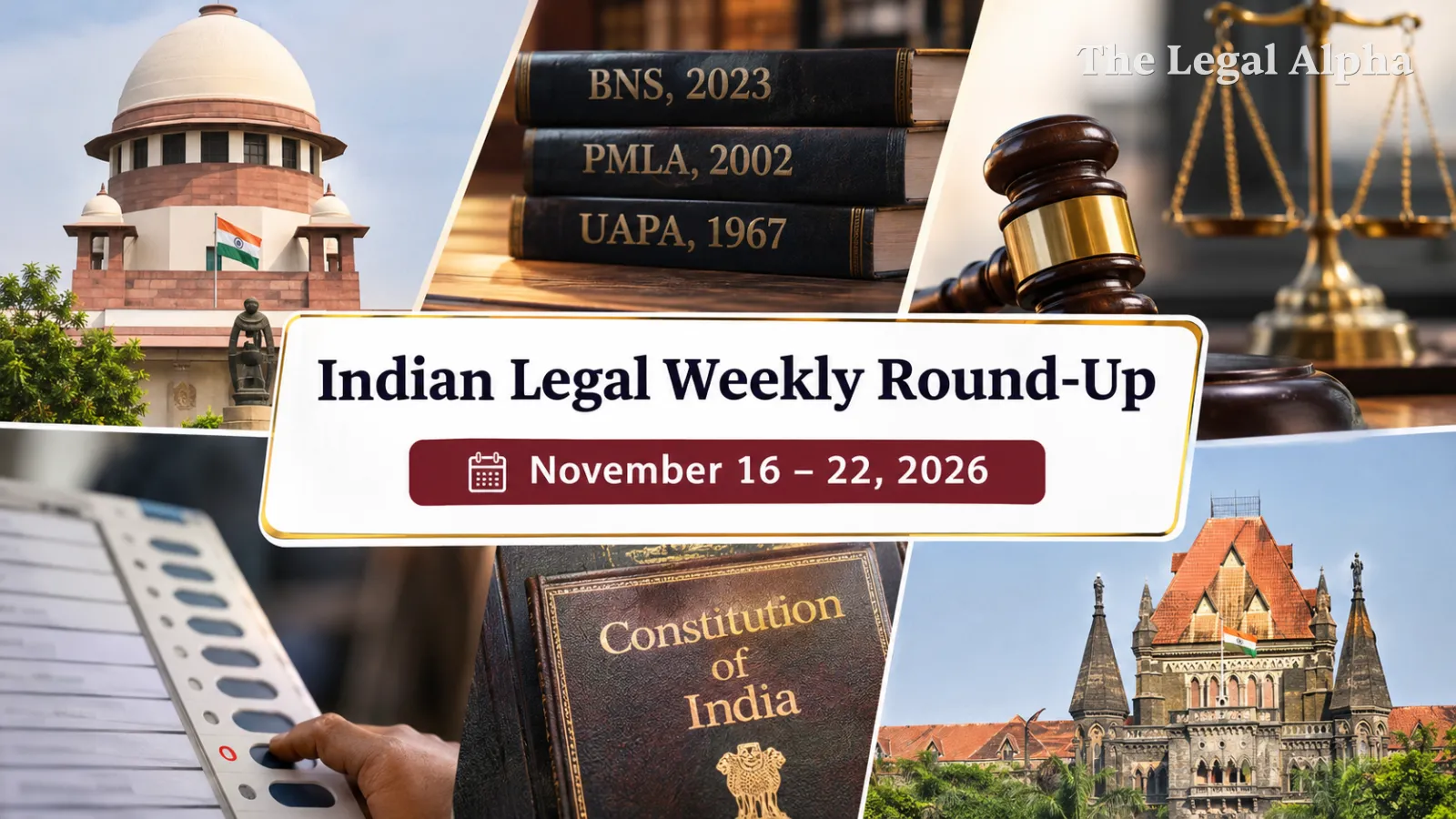
India's courts and legal authorities witnessed several significant developments during the week of November 16 to November 22, 2026. From religious freedom and electoral integrity to criminal law, women's rights, corruption investigations and national security, the developments brought several important legal questions into focus.
The Supreme Court, various High Courts and government authorities addressed matters involving constitutional protections, criminal proceedings, institutional accountability and the interpretation of existing legislation.
Here is a closer look at the major developments and their legal significance.
Supreme Court's Order on Karthigai Deepam Lighting at Thirupparankundram Hill
The Supreme Court permitted the lighting of the Karthigai Deepam at the disputed Deepathoon pillar near a Dargah on Thirupparankundram Hill in Madurai on November 24, 2026, as a one-time arrangement.
The Court stayed the relevant findings of the Madras High Court while clarifying that its direction should not be treated as recognition of any customary, religious or proprietary right over the disputed location.
The Tamil Nadu Government subsequently approached the Supreme Court through a review petition seeking a stay of the direction.
Legal significance: The development raises questions concerning religious practices, competing claims over disputed religious sites and the limits of interim judicial directions. The clarification that the order does not establish permanent rights is particularly important.
Supreme Court Lists Constitutional Challenge to Marital Rape Exception
The Supreme Court scheduled final hearings for December 9 or 10, 2026, in petitions challenging the marital rape exception under Section 63 of the Bharatiya Nyaya Sanhita, 2023.
The petitions question whether a husband should continue to receive immunity from criminal prosecution for non-consensual sexual intercourse with his adult wife.
The challenge places the relationship between marital status, individual consent and constitutional protections at the centre of the proceedings.
Legal significance: The proceedings raise fundamental questions concerning bodily autonomy, equality before the law, personal liberty and the scope of criminal protection available to married women. The constitutional challenge remains pending.
Supreme Court Directs Examination of Alleged Fraudulent Voter Deletions in Delhi
The Supreme Court directed the Election Commission of India and the Chief Electoral Officer of Delhi to examine allegations that fraudulent Form 7 applications had been submitted to remove eligible voters from electoral rolls in the Mustafabad area.
The allegations arose during the Special Intensive Revision (SIR) exercise. The Court asked the concerned authorities to examine the matter and take appropriate remedial measures in accordance with law.
Legal significance: The development highlights the importance of protecting the integrity of electoral rolls and ensuring that eligible citizens are not unlawfully deprived of their voting rights. It also places responsibility on election authorities to examine complaints involving potentially fraudulent deletion requests.
Delhi Court Orders Framing of Charges Against 14 Accused in NEET-UG 2026 Paper Leak Case
A Delhi court ordered the framing of charges against 14 accused in the NEET-UG 2026 paper leak case. The accused include three subject experts engaged by the National Testing Agency to translate examination papers.
The Central Bureau of Investigation alleged that confidential examination material had been leaked and circulated through a network involving the accused.
The court directed that the trial proceed on a day-to-day basis beginning November 25, 2026.
Legal significance: The proceedings highlight the criminal justice system's role in addressing examination fraud and protecting the credibility of competitive examinations. The order to frame charges marks a procedural development and should not be treated as a finding of guilt against the accused.
Supreme Court Declines to Interfere With Azam Khan's Interim Bail in Money Laundering Case
The Supreme Court declined to interfere with the Allahabad High Court's decision granting interim bail to Samajwadi Party leader Azam Khan in a money laundering investigation connected with alleged financial irregularities involving Mohammad Ali Jauhar University.
The Allahabad High Court had granted the relief after raising concerns about compliance with mandatory arrest safeguards under Article 22(1) of the Constitution and Section 19 of the Prevention of Money Laundering Act, 2002.
The Enforcement Directorate opposed the relief, maintaining that its officers had attempted to communicate the grounds of arrest but that Khan had refused to accept the documents.
The High Court found a prima facie basis to question whether the statutory safeguards had been properly followed and ordered interim release on furnishing the required bond and sureties. The relief was to continue until the next hearing, with the matter listed for December 10, 2026.
Legal significance: The development reinforces the importance of procedural safeguards during arrests under special criminal legislation. Investigating agencies must comply with statutory requirements, regardless of the nature or seriousness of the allegations.
Calcutta High Court Initiates Criminal Contempt Proceedings Against Abhishek Banerjee
The Calcutta High Court initiated suo motu criminal contempt proceedings against Trinamool Congress MP Abhishek Banerjee over remarks allegedly questioning the political impartiality of members of the judiciary.
Justice Krishna Rao issued a show-cause notice directing Banerjee to explain within 15 days why he should not face punishment for criminal contempt.
The controversy arose from an interview in which Banerjee allegedly suggested that certain judges were politically aligned with the Bharatiya Janata Party.
The proceedings remain at the notice stage. The Court has not declared Banerjee guilty of contempt or imposed any punishment. The matter was listed for December 8, 2026.
Separately, the Court directed the West Bengal Government's security review committee to reconsider Banerjee's security arrangements within two weeks.
Legal significance: The proceedings bring into focus the balance between freedom of speech and the legal protection of judicial authority and public confidence in the independence of courts.
Supreme Court Consolidates Proceedings in 2025 Red Fort Blast Investigation
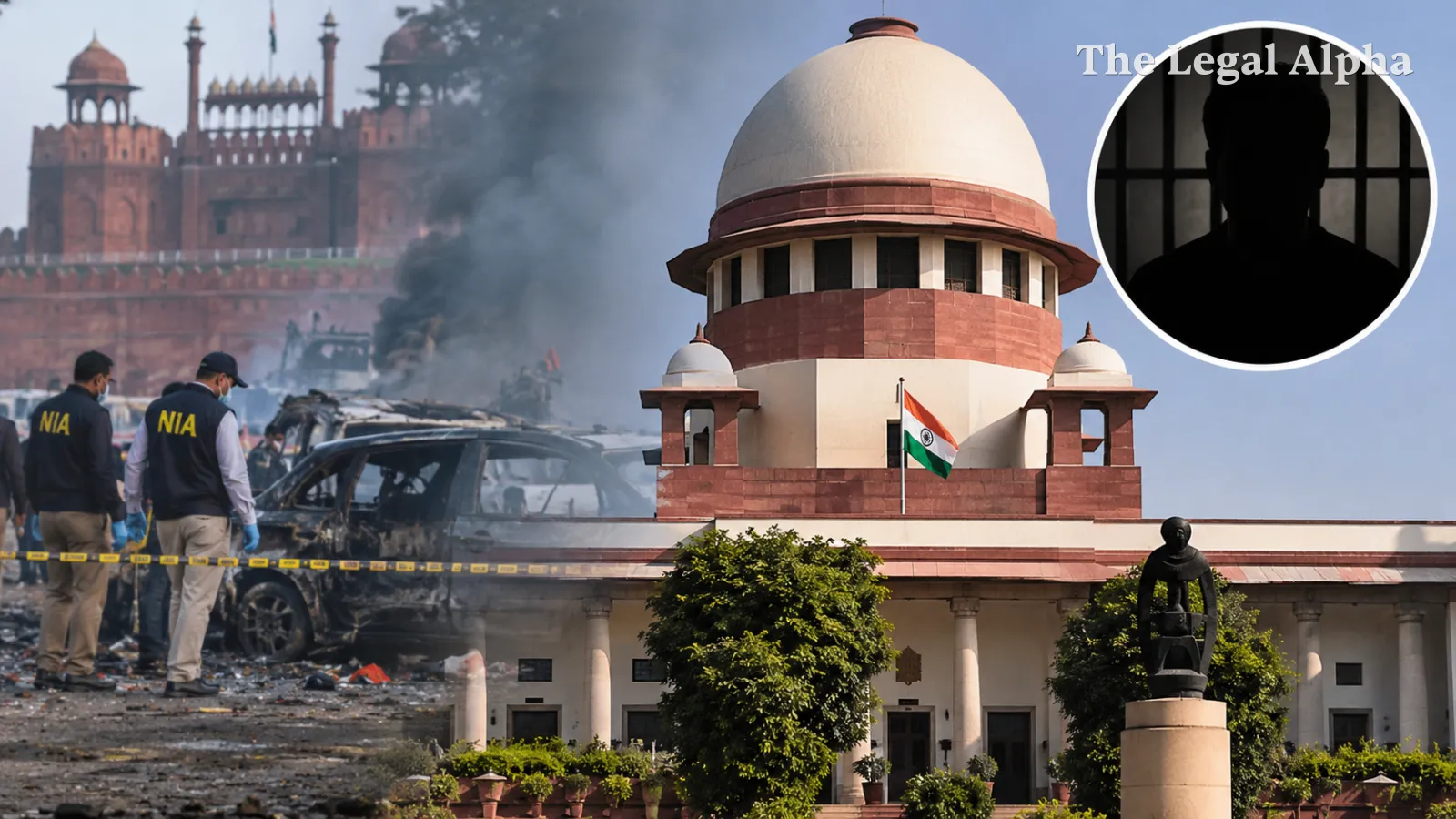
The Supreme Court permitted the transfer of two cases registered in Jammu and Kashmir and Haryana in connection with the November 2025 Red Fort blast to a Special Court of the National Investigation Agency in Delhi.
The Court also allowed three FIRs connected with the alleged wider conspiracy to be clubbed together, enabling the matters to proceed before the Special NIA Court at Patiala House Courts.
The National Investigation Agency had sought the transfer on the ground that the investigations concerned interconnected allegations and that a common trial would facilitate the examination of related evidence.
The Supreme Court accepted the agency's request in Union of India v. Arif Nisar @ Sahil & Ors.
Legal significance: The decision addresses the procedural difficulties arising when connected criminal investigations extend across multiple states. Consolidating proceedings before one court can facilitate coordinated examination of evidence and reduce the complications associated with separate trials.
Bombay High Court Quashes Prosecution Sanction Against Former ICICI Bank CEO Chanda Kochhar
The Bombay High Court quashed the prosecution sanction issued by the ICICI Bank Board of Directors against former Managing Director and CEO Chanda Kochhar in the alleged ICICI-Videocon loan case.
The Court held that the Board was not the legally competent authority to grant the required sanction under Section 19 of the Prevention of Corruption Act, 1988. According to the Court, the relevant statutory authority was the Reserve Bank of India.
Justice Milind N. Jadhav also found that the Board had failed to independently examine the investigative material before granting sanction.
The Court relied on provisions of the Banking Regulation Act, 1949, including Sections 35-B and 36-AA, while examining the RBI's statutory powers concerning senior management appointments and removal in banking companies.
It consequently set aside the sanction order dated May 15, 2023, along with consequential proceedings founded upon it.
Legal significance: The ruling highlights that prosecution sanctions must come from the authority legally empowered to grant them. It also reinforces the requirement that a sanctioning authority independently examine relevant evidence rather than mechanically accepting an investigating agency's recommendation.
Delhi Court Seeks Police Report on Complaint Concerning Sonia Gandhi's Electoral Roll Entry
A Delhi court sought an Action Taken Report from the Delhi Police on a complaint seeking registration of an FIR against Congress leader Sonia Gandhi over her alleged inclusion in the New Delhi electoral roll in 1980.
The complainant alleged that her name appeared in the electoral records nearly three years before she acquired Indian citizenship in April 1983. The complaint further alleged that forged documents had been used for the earlier entry.
These allegations have not been established by any judicial finding.
The matter returned to the magistrate after a Sessions Court set aside an earlier order refusing to direct registration of an FIR, finding that the order lacked adequate reasons.
The magistrate subsequently sought the police report and listed the matter for November 28, 2026.
Legal significance: The proceedings highlight the procedural requirements governing applications for investigation under Section 175(3) of the Bharatiya Nagarik Suraksha Sanhita, 2023. They also demonstrate the importance of reasoned judicial orders when courts consider requests for criminal investigation.
Centre Extends UAPA Ban on Islamic Research Foundation for Another Five Years
The Ministry of Home Affairs extended the prohibition on Zakir Naik's Islamic Research Foundation (IRF), declaring the organisation an unlawful association for another five years under the Unlawful Activities (Prevention) Act, 1967.
The notification dated November 13, 2026, invoked Sections 3(1) and 3(3) of the UAPA.
The Central Government cited alleged activities involving the promotion of communal hatred, hostility between religious communities and conduct considered prejudicial to national security.
The notification also referred to the organisation's earlier declarations as an unlawful association in 2016 and 2021.
The latest prohibition will remain effective for five years from publication in the Official Gazette, subject to proceedings and orders under Section 4 of the Act.
Legal significance: The development demonstrates the statutory mechanism through which the Central Government can declare an organisation unlawful. The UAPA also provides for tribunal scrutiny of such declarations under its prescribed procedure.
Bombay High Court Recognises Transgender Women's Protection Under Sexual Harassment Law
The Bombay High Court held that a transgender person who identifies as a woman can seek protection under Section 75 of the Bharatiya Nyaya Sanhita, 2023, concerning sexual harassment.
The ruling came while dismissing a criminal revision petition filed by an accused challenging the rejection of his discharge application in a case involving allegations of harassment against a transgender woman.
The accused argued that the complainant could not invoke the relevant provision because she had obtained her transgender identity certificate after the alleged incident.
The High Court rejected the contention at the discharge stage, observing that the absence of an identity certificate at the relevant time would not, by itself, prevent the invocation of applicable penal provisions.
The Court relied on the principles recognised by the Supreme Court in National Legal Services Authority v. Union of India (2014), particularly the recognition of an individual's self-identified gender.
It held that the allegations and the question of consent would require examination during the trial. The decision therefore allowed the prosecution to proceed rather than determining the accused's guilt.
Legal significance: The ruling is important for the recognition of gender identity in the application of criminal law. It also highlights that procedural documentation should not automatically become a barrier to seeking legal protection where the applicable law recognises the person's identity.
Key Legal Issues Emerging From the Week
The developments collectively raise several important questions:
-
Constitutional rights: How should courts balance religious freedom, equality, personal liberty and freedom of speech?
-
Criminal procedure: What safeguards must investigating agencies follow when arresting individuals under special statutes?
-
Electoral integrity: What mechanisms are available to prevent fraudulent inclusion or deletion of names from electoral rolls?
-
Institutional accountability: Which authority has the statutory power to approve prosecution and exercise regulatory oversight?
-
Gender equality: How should criminal law protect transgender persons while recognising self-perceived gender identity?
Relevant Legal Provisions and Precedents
The following legal provisions and judicial principles are relevant to the developments covered:
|
Legislation / Provision |
Legal relevance |
|---|---|
|
Article 14, Constitution |
Equality before law |
|
Article 21, Constitution |
Right to life and personal liberty |
|
Article 22(1), Constitution |
Safeguards against arbitrary arrest |
|
Section 63, BNS, 2023 |
Definition of rape and statutory exception |
|
Section 75, BNS, 2023 |
Sexual harassment |
|
Section 19, PMLA, 2002 |
Powers of arrest by authorised ED officers |
|
Section 19, Prevention of Corruption Act, 1988 |
Previous sanction for prosecution |
|
Sections 3, 4 and 5, UAPA, 1967 |
Declaration and adjudication concerning unlawful associations |
|
Section 175(3), BNSS, 2023 |
Magistrate's power to order investigation |
|
Section 35-B, Banking Regulation Act, 1949 |
RBI approval concerning senior banking appointments |
An important precedent in the transgender rights proceedings is National Legal Services Authority v. Union of India (2014), which recognised the right to self-identify one's gender.
Why These Developments Matter
The week's developments demonstrate how different branches of Indian law intersect with constitutional rights, public administration and institutional responsibility.
The Supreme Court's consideration of the marital rape exception brings questions of consent, equality and bodily autonomy back into focus. Meanwhile, the electoral roll proceedings highlight the importance of maintaining accurate voter records and ensuring that complaints are examined through legally prescribed procedures.
The Azam Khan bail proceedings and the Chanda Kochhar prosecution sanction ruling offer important reminders that investigative agencies and prosecuting authorities must operate within the boundaries of statutory law.
Similarly, the transgender rights ruling highlights the continuing importance of interpreting criminal protections in light of constitutional principles and recognised gender identity.
The contempt proceedings against Abhishek Banerjee also demonstrate the legal consequences that may arise when public statements concerning judicial impartiality become the subject of contempt jurisdiction.
Taken together, these developments show that the administration of justice depends not only on the substantive law but also on procedural fairness, institutional competence and judicial accountability.
Legal Takeaway
The major legal developments between November 16 and November 22, 2026, underline the importance of constitutional safeguards and lawful institutional decision-making. Whether dealing with criminal investigations, electoral disputes, gender identity or regulatory powers, courts continue to examine whether public authorities have acted within the limits of their legal authority.
For citizens, businesses and legal professionals, the central lesson is that the rule of law requires both substantive justice and strict compliance with established legal procedures.
Sources
Primary Sources:
-
Supreme Court orders concerning Thirupparankundram Hill, electoral roll allegations and the Red Fort blast proceedings.
-
Allahabad High Court order in Mohd Azam Khan v. Directorate of Enforcement.
-
Calcutta High Court contempt proceedings concerning Abhishek Banerjee.
-
Bombay High Court judgment concerning Chanda Kochhar's prosecution sanction.
-
Bombay High Court judgment in Vishal S/o Sunil Ingle v. State of Maharashtra.
-
Ministry of Home Affairs Gazette notification dated November 13, 2026, concerning the Islamic Research Foundation.
Additional Sources: