Former CJI DY Chandrachud Calls for Human Oversight as AI Enters the Indian Judicial System
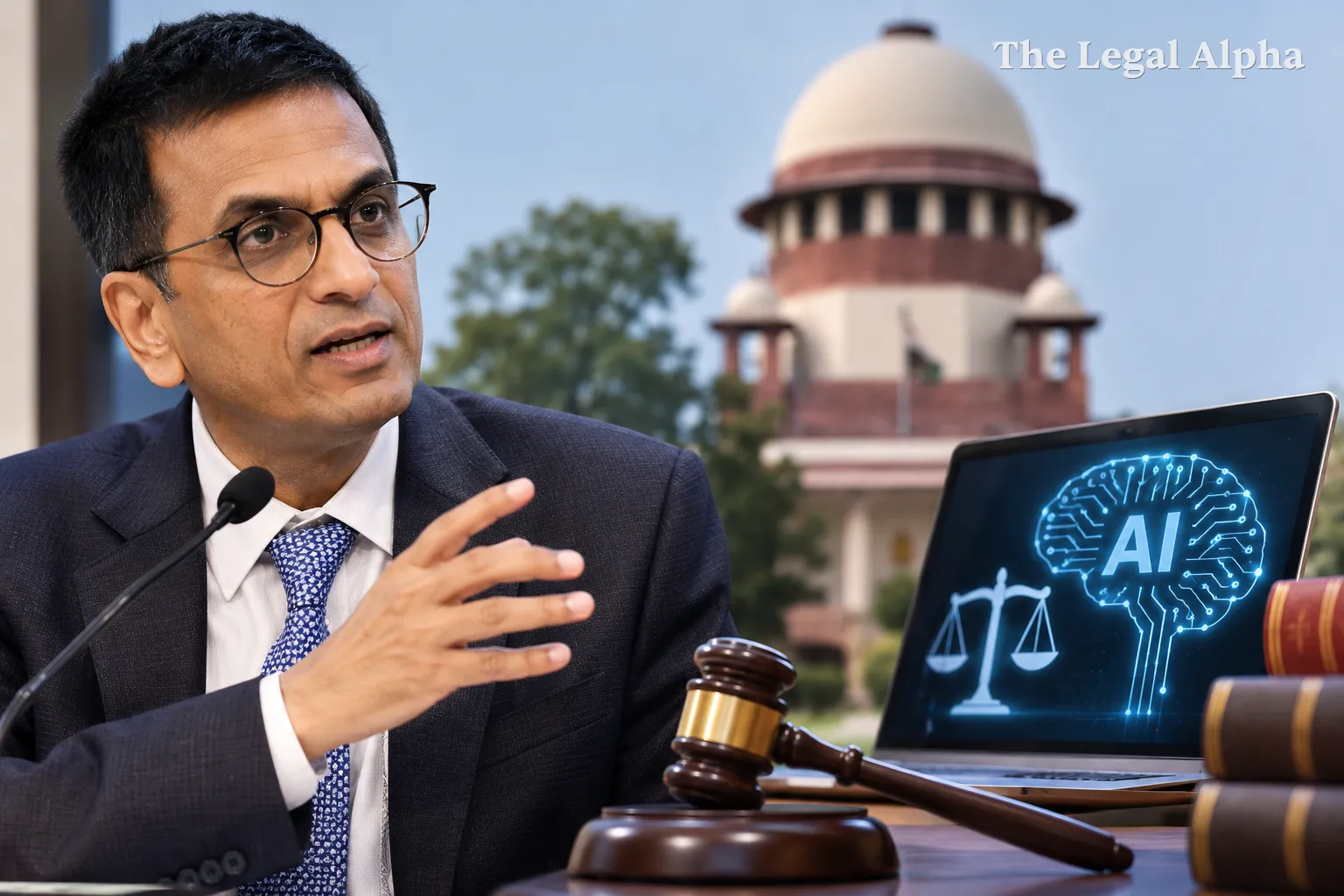
Artificial intelligence may help Indian courts reduce administrative delays, but it should never replace judicial reasoning or human responsibility. Former Chief Justice of India (CJI) D.Y. Chandrachud has emphasised that judges must remain in control of every judicial decision, even as courts explore the use of AI-powered technologies.
His remarks highlight an important question for the Indian legal system: how can courts benefit from artificial intelligence without compromising judicial independence, fairness and accountability?
What Happened?
Former CJI D.Y. Chandrachud made these observations at an event titled AI for All: AI Governance and Trust, the Case for Judicial Access and an Empowered India, held on Saturday.
He supported the use of AI for routine judicial and administrative functions, including transcription, translation, preparation of case listings, scrutiny of procedural defects and case management.
According to Chandrachud, these tasks consume considerable judicial time and can be handled more efficiently with technological assistance. This would allow judges to devote greater attention to deciding disputes and examining legal questions.
However, he maintained that the authority to deliver judgments and explain the reasoning behind them must remain exclusively with human judges.
Legal Topic
Area of Law: Constitutional Law and Judicial Administration
Sub-topic: Artificial Intelligence in the Judiciary, Judicial Independence and Accountability
Core Legal Issue
The central legal issue concerns the permissible extent of artificial intelligence in judicial proceedings. While AI can improve administrative efficiency and assist legal research, its use in evaluating evidence, determining credibility or influencing decisions affecting personal liberty raises serious concerns.
The broader question is whether technological assistance can be introduced into judicial institutions without weakening the principles of natural justice, judicial independence and the requirement that decisions must be supported by human reasoning.
What Did Former CJI DY Chandrachud Say?
Chandrachud drew a distinction between using AI as an administrative support system and allowing it to perform functions that require judicial judgment.
He emphasised that every judgment must be decided and signed by a human judge, who must remain responsible for the reasoning and conclusions recorded in it.
He also referred to instances where AI-generated legal material created serious problems in judicial proceedings. In one instance, a trial court in Andhra Pradesh relied on several non-existent Supreme Court judgments. In another, a tribunal's order referred to genuine Supreme Court decisions but attributed fabricated passages to them.
These examples highlighted the danger of relying on AI-generated legal citations without proper verification.
AI Must Not Replace Judicial Assessment
The former CJI referred to draft regulations prepared by the Supreme Court's AI Committee in June 2026.
The proposed framework seeks to regulate AI use across different levels of the judiciary, including the Supreme Court, High Courts, district courts and tribunals.
It identifies five guiding principles:
-
Human primacy in judicial decision-making.
-
Transparency in the use of artificial intelligence.
-
Accountability for AI-assisted processes.
-
Protection of sensitive data.
-
Preservation of judicial independence.
The proposed framework permits assistance in administrative and research-related functions but excludes AI-based assessment of an individual's bail risk and the determination of witness credibility.
Five Safeguards Suggested for AI Use in Courts
Chandrachud also outlined five important safeguards that should guide the integration of AI into the judicial system:
-
Judicial authority: Judges must retain the power to make and sign judgments, explain their reasoning and remain accountable for their decisions.
-
Protection of personal liberty: Decisions affecting an individual's liberty should not depend on algorithm-generated probability scores.
-
Transparency: Litigants should be informed whenever AI tools are used in proceedings concerning their cases.
-
Equal access to justice: Technological developments should benefit people who face difficulties accessing the justice system.
-
Data security: Judicial institutions should prioritise secure data infrastructure, including the development of domestic AI capabilities.
Relevant Legal Framework
The proposed regulatory framework and existing legal principles relevant to the discussion include:
-
Constitution of India: Articles 14 and 21, concerning equality before law and protection of life and personal liberty.
-
Digital Personal Data Protection Act, 2023: Relevant to the protection and processing of personal data.
-
Draft Regulations for Use of Artificial Intelligence (AI) in Courts, 2026: Proposed by the Supreme Court's AI Committee to govern responsible AI adoption in judicial institutions.
-
Principles of Natural Justice: Fairness, impartiality and the right to a fair hearing.
The Supreme Court published the draft regulations on June 3, 2026, inviting comments and suggestions from stakeholders and the general public. The proposed regulations are a draft framework and should not be treated as a final binding set of rules.
Concerns Over AI-Generated Legal Citations
One of the significant concerns raised by Chandrachud was the growing possibility of fabricated legal authorities appearing in court submissions.
AI systems can generate references to judgments that do not exist or attribute incorrect passages to genuine judicial decisions. Such errors can mislead courts and undermine the reliability of legal arguments.
He stressed that every machine-generated citation and translation must undergo human verification. A proper record should also be maintained of how AI tools are used.
This places an important responsibility on lawyers, legal researchers and judicial officers to verify AI-assisted legal material before relying on it.
Why Does It Matter?
The increasing use of artificial intelligence in India's judicial system presents an opportunity to improve efficiency and reduce procedural delays. Routine tasks such as transcription, translation and case management can potentially be completed faster, allowing judges to concentrate on substantive legal disputes.
However, judicial decision-making involves more than processing information. It requires an assessment of evidence, application of legal principles, consideration of individual circumstances and reasoned conclusions.
Allowing automated systems to influence questions involving bail, personal liberty or witness credibility could raise concerns about fairness, transparency and accountability.
The proposed Supreme Court framework attempts to address these concerns by establishing boundaries between technological assistance and judicial authority. Its success will depend on effective safeguards, proper training, independent audits and meaningful access to remedies when AI-generated errors affect litigants.
Legal Takeaway
Artificial intelligence can become a valuable tool for improving the efficiency of India's courts, but it cannot replace the independent application of judicial mind. The responsibility to evaluate evidence, interpret the law and deliver reasoned judgments must remain with human judges. Technological progress in the judiciary must strengthen access to justice without compromising fairness, judicial independence or individual rights.
Sources
Primary Source:
- Supreme Court of India – Notice dated June 3, 2026, inviting suggestions on the Draft Regulations for Use of Artificial Intelligence (AI) in Courts, 2026.
Additional Sources: