No Interim Shield for Hospitality Sector: Delhi High Court Affirms Ban on Compulsory Service Charges Remains Active
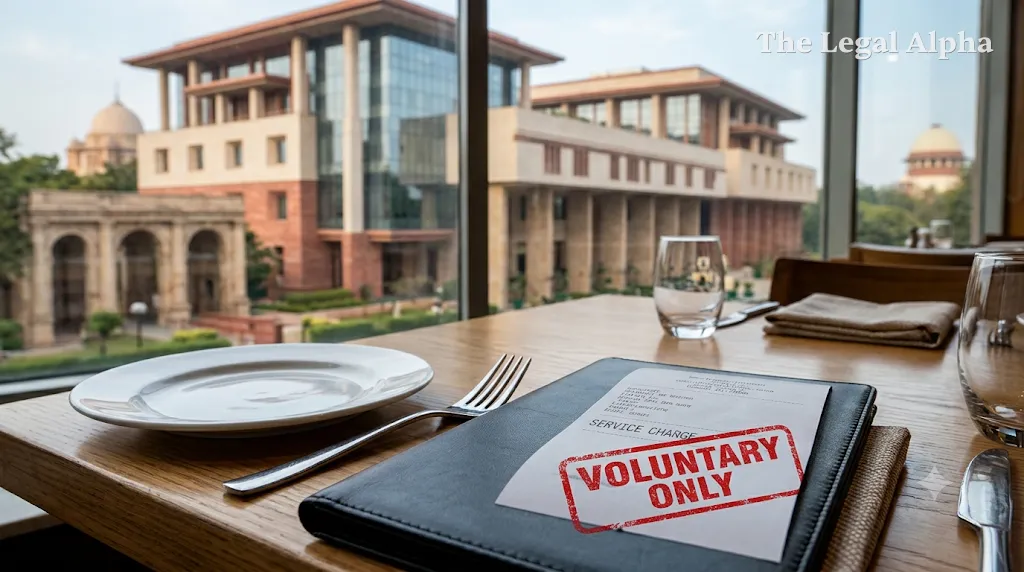
The Delhi High Court on Thursday, November 19, 2026, clarified that hotels and restaurants have no interim legal protection allowing them to collect mandatory service charges from diners. A Division Bench comprising Acting Chief Justice Nitin Wasudeo Sambre and Justice Sanjay Sharma confirmed that while the appeals filed by major hospitality bodies—the National Restaurant Association of India (NRAI) and the Federation of Hotel & Restaurant Associations of India (FHRAI)—have been admitted for hearing, the court has not stayed the earlier single-judge ruling.
The clarification came after Additional Solicitor General (ASG) Chetan Sharma, representing the Central government and the Central Consumer Protection Authority (CCPA), alerted the bench that several eateries were continuing to add compulsory service charges to customer bills despite a March 28, 2025 judgment declaring the practice unlawful. The Bench emphasized that the regulatory authority is fully empowered to act against non-compliant establishments.
Legal Topic
Area of Law: Consumer Protection Law Sub-topic: Unfair Trade Practices / Regulatory Jurisdiction
Core Legal Issue
The appeal before the Division Bench centers on two primary legal questions: whether automatically adding a disclosed service charge to a food bill constitutes an "unfair trade practice" under the Consumer Protection Act, 2019, and whether the Central Consumer Protection Authority possesses the statutory jurisdiction to regulate how hospitality establishments structure pricing and employee wage distributions.
Immediately, the court had to address whether the mere admission of an appeal by hospitality associations operated as an implied stay on the single judge's March 2025 directive banning compulsory service charges.
What Did the Court / Authority Decide?
The Division Bench clarified the procedural status of the ongoing litigation without altering the substantive rights of consumers:
-
No Interim Stay: The Bench unequivocally stated that no interim relief or stay order has been granted against the single judge's March 28, 2025 judgment. Consequently, the CCPA's July 4, 2022 guidelines prohibiting mandatory service charges remain fully enforceable.
-
Enforcement Authority Rests with CCPA: Responding to submissions that restaurants were flouting the ban, Acting Chief Justice Sambre noted that the "ball is in your court," clarifying that the CCPA does not require fresh judicial permission to take regulatory action against defaulting establishments.
-
Appeal Admitted for Final Hearing: While refusing interim relief, the Division Bench formally admitted the appeals filed by NRAI and FHRAI. The substantive challenge to the single judge's ruling remains pending for final adjudication.
Key Legal Points
-
No Automatic Addition by Default: Under the operative legal framework upheld by the single judge, restaurants and hotels cannot add a service charge automatically or by default to a consumer's invoice, even if the levy is printed on the menu or displayed on the premises.
-
Absence of Contractual Consent: The single judge had previously rejected the argument that a customer's decision to order food after seeing a menu notice creates a binding contract to pay a service charge, holding that coercive default billing undermines consumer choice.
-
Prohibition on Misleading Nomenclature: To prevent diners from confusing service charges with government-mandated taxes, restaurants were directed to refrain from using the term "service charge" and instead use transparent descriptions such as "voluntary contribution" or "staff welfare fund" if soliciting tips.
-
Jurisdictional Overlap Questioned: The pending appeal brings into focus the tension between consumer welfare regulations and traditional labour settlements, where service charges have historically been treated as part of staff remuneration.
Relevant Law
-
Consumer Protection Act, 2019: Specifically provisions governing "unfair trade practices" and the powers of the Central Consumer Protection Authority (CCPA) to issue guidelines preventing consumer exploitation.
-
CCPA Guidelines dated July 4, 2022: Guidelines to Prevent Unfair Trade Practices and Protection of Consumer Interest with Regard to Levy of Service Charge in Hotels and Restaurants, which bar default service charges and prohibit denying entry or service to diners who refuse to pay them.
-
Precedent Cited by Appellants: Management of Wenger & Co. v. Their Workmen (1964), relied upon by the NRAI to argue that service charges have long been judicially recognized in labour jurisprudence as a legitimate mechanism for employee compensation.
Arguments of the Parties
Appellants (NRAI & FHRAI) The restaurant and hotel associations contended that levying a service charge is an eight-decade-old global and domestic industry standard rather than an unfair trade practice. They argued that when the charge is transparently printed on menus and displayed at the venue before an order is placed, customers make an informed choice. Furthermore, the associations submitted that these funds are distributed among both front-of-house and kitchen staff under recognized labour settlements, raising the question of whether the issue falls under labour law rather than the CCPA's consumer protection mandate.
Respondent (Union of India & CCPA) Appearing for the government, ASG Chetan Sharma submitted that following the single judge's March 2025 judgment upholding the CCPA guidelines, mandatory service charges are strictly illegal. The government contended that establishments cannot use the pendency of an appeal as a shield to continue forcing consumers to pay default charges, which often result in diners paying GST on top of an involuntary levy.
Why Does It Matter?
The Delhi High Court's clarification closes a compliance loophole that some hospitality outlets had reportedly relied upon since filing their appeals. For consumers across India, the ruling reaffirms that any payment toward service or staff welfare remains strictly discretionary, and diners retain the legal right to have default charges removed from their bills without facing denial of service.
For businesses in the food and beverage sector, the order serves as an immediate compliance warning. Because the Division Bench declined to stay the March 2025 verdict and explicitly pointed out the CCPA's power to act, hotels and restaurants that continue to enforce compulsory service charges or use misleading billing terms risk regulatory penalties and consumer complaints while the appeals remain pending.
Legal Takeaway
Pending appeals before a higher bench do not automatically suspend a lower court's ruling unless an explicit stay is granted. Until the Division Bench decides otherwise, restaurants and hotels cannot force customers to pay a service charge—even if printed on the menu—and any contribution for service must remain entirely voluntary.
Sources
Primary Source:
-
Oral observations and proceedings before the Division Bench of the Delhi High Court (Acting Chief Justice Nitin Wasudeo Sambre and Justice Sanjay Sharma) in appeals challenging the Single Judge Judgment dated March 28, 2025, on CCPA Service Charge Guidelines.
Additional Sources:
-
Central Consumer Protection Authority (CCPA) Guidelines dated July 4, 2022.
-
Courtroom reporting from Bar & Bench, LiveLaw, and ANI (November 19, 2026).