Mohali Court Directs Attachment of Punjab Government Treasury Account Over Unpaid Land Compensation
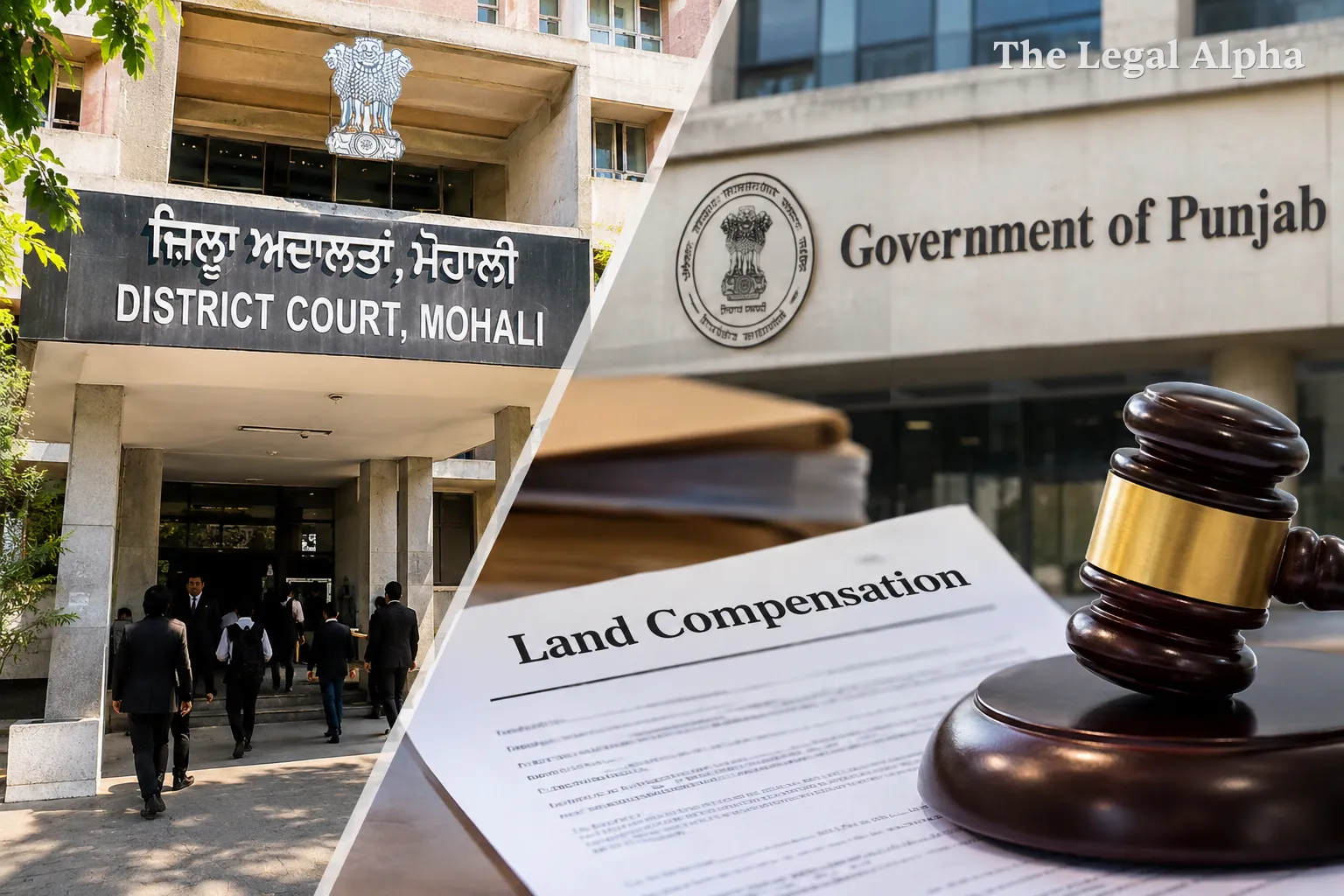
A Mohali court has ordered attachment proceedings against a Punjab Government treasury account after compensation allegedly remained unpaid for land acquired for infrastructure development in the state.
Additional District Judge Tejpartap Singh Randhawa issued the directions in execution proceedings involving Motiaz Royale Estate versus State of Punjab. The dispute concerns compensation for land acquired for the Togan–Boothgarh PR-4 Road project in 2013.
Under the November 16, 2026 order, attachment warrants were directed to be issued against government Head Account No. 2052. However, the court specifically excluded salary and pension payments from the attachment.
The court has also directed that the matter be placed before the National Lok Adalat scheduled for December 12, 2026.
Legal Topic
Area of Law: Civil Law
Sub-topic: Execution of Decrees / Land Acquisition Compensation / Attachment of Government Property
Core Legal Issue
The central legal question concerns the extent to which a court can use attachment proceedings to enforce an outstanding compensation award when the State or its development authority has allegedly failed to make the required payment.
The matter also raises questions about the enforcement of monetary awards against government authorities and the protection of essential public expenditure, particularly salaries and pensions.
What Did the Court Decide?
The Mohali court directed the issuance of attachment warrants against Punjab Government Head Account No. 2052 in the execution proceedings.
The order contains an important financial safeguard: funds earmarked for government employees' salaries and pensioners' payments are excluded from the attachment.
The direction is intended to facilitate recovery of the outstanding compensation. It should not be interpreted as a blanket freezing of every Punjab Government bank account or a complete suspension of government expenditure.
The matter has been listed for consideration before the National Lok Adalat on December 12, 2026.
Key Legal Points
-
Enforcement of compensation: Courts can use execution proceedings to enforce monetary awards when the judgment debtor fails to satisfy its obligations.
-
Attachment of government funds: The court has directed attachment proceedings against a specified government treasury account.
-
Protection of essential payments: Government employees' salaries and pension payments have been expressly excluded.
-
Land acquisition obligations: The dispute highlights the importance of timely payment of compensation for acquired land.
-
Judicial enforcement: The proceedings demonstrate the use of execution mechanisms to secure compliance with compensation obligations.
Relevant Law
Code of Civil Procedure, 1908
-
Section 60: Identifies property liable to attachment and sale in execution of a decree, while providing exemptions for specified categories, including certain pension payments.
-
Order XXI: Governs execution of decrees and orders, including attachment proceedings.
-
Order XXI Rule 46: Provides for attachment of debts and certain movable property not in the possession of the judgment debtor.
Right to Fair Compensation and Transparency in Land Acquisition, Rehabilitation and Resettlement Act, 2013
- Section 77: Requires the Collector to tender payment of awarded compensation to entitled persons or deposit it with the competent authority in specified circumstances.
These provisions provide the broader legal framework. The precise statutory provisions invoked in the November 16 attachment order have not been independently verified.
Arguments of the Parties
Applicant – Motiaz Royale Estate
The execution proceedings concern recovery of compensation allegedly remaining unpaid in connection with the acquisition of land for the PR-4 Road project and associated development works.
The applicant sought enforcement of its compensation entitlement through attachment proceedings.
Respondent – State of Punjab
The detailed submissions made by the State of Punjab in response to the latest attachment direction were not available in the reports reviewed.
Accordingly, no specific defence or argument is attributed to the State.
Why Does It Matter?
The Mohali court's direction highlights the legal consequences that government authorities may face when compensation obligations arising from land acquisition remain unsatisfied.
For landowners, the development demonstrates that obtaining a compensation award is not necessarily the end of the legal process. Where payment is not made, execution proceedings can become necessary to enforce the entitlement.
For government departments and development authorities such as GMADA, the matter underlines the importance of complying with compensation awards and court directions within the prescribed legal framework.
The exclusion of salaries and pensions also reflects the need to balance recovery of outstanding dues with the protection of essential public payments.
The case is particularly significant because it involves enforcement action against a specified government treasury account rather than merely another direction seeking payment.
Legal Takeaway
A compensation award must translate into actual payment to the persons legally entitled to receive it. Courts can employ execution proceedings, including attachment of eligible assets, to enforce outstanding monetary obligations. However, the scope of attachment and applicable statutory exemptions remain important considerations.
Sources
Primary Source:
- Mohali court order dated November 16, 2026, in Motiaz Royale Estate v. State of Punjab (reported order; full original order not independently obtained).
Additional Sources: