Material Shift From 'Attempt' to 'Completed Act' Cannot Ground Rape Conviction: Jammu & Kashmir High Court
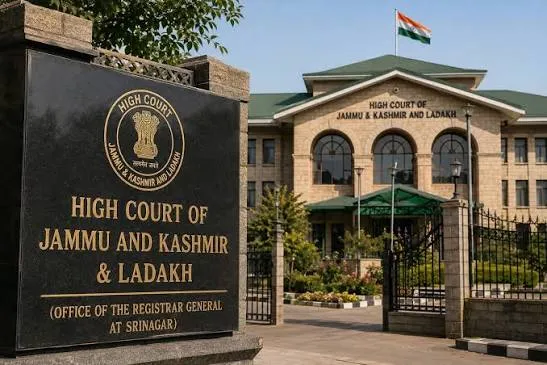
The High Court of Jammu & Kashmir and Ladakh has set aside the conviction and multi-year prison sentence of a Budgam resident accused of rape under the erstwhile Ranbir Penal Code.
The trial court—the Additional Sessions Judge (Fast Track), Budgam—had convicted the appellant, Mohammad Ashraf Ganie, in late 2023 in connection with a case that originated in 2007. Justice Sanjay Parihar, hearing the appeal at Srinagar, overturned the lower court's findings after determining that the prosecution's case suffered from fundamental contradictions. Central to the ruling was the fact that the initial police complaint described an alleged "attempt" at sexual assault, which subsequently expanded during the trial into an allegation of a completed act of sexual intercourse.
Considering this material escalation alongside the complete absence of forensic evidence and ambiguities surrounding the medical examination, the High Court held that the prosecution failed to cross the threshold of proof beyond reasonable doubt, requiring the appellant's immediate acquittal.
Legal Topic
-
Area of Law: Criminal Law / Law of Evidence
-
Sub-topic: Standard of Proof in Sexual Offences / Material Variance in Witness Testimony
Core Legal Issue
The primary legal issue before the High Court was whether an unresolved, substantial variance between the earliest recorded version of an incident—which alleged an attempt to commit sexual assault—and the subsequent trial narrative asserting a completed rape, coupled with a lack of forensic corroboration, creates a fatal degree of reasonable doubt.
A secondary question addressed by the court was whether the failure of an accused to substantiate a plea of alibi can be used affirmatively by the prosecution to cure deficiencies and gaps in its own evidence.
What Did the Court Decide?
Justice Sanjay Parihar allowed the appeal, quashed the conviction, and set aside the sentences previously imposed under Sections 376, 450, and 506 of the Ranbir Penal Code. The High Court directed that the appellant be set at liberty forthwith, provided he is not required in connection with any other proceedings.
The court observed that while criminal jurisprudence does not require independent eyewitness corroboration to sustain a conviction founded on the reliable testimony of a prosecutrix, such testimony must still inspire unequivocal confidence. When substantial discrepancies emerge regarding the very nature of the crime—specifically whether the act was attempted or fully carried out—the court cannot dismiss the divergence as an insignificant detail.
The High Court also clarified that the appellant's inability to establish his alibi did not supply missing proof to the prosecution's case. Finding that the evidence admitted two plausible views, the bench ruled that the view favourable to the accused must prevail as an entitlement of law rather than judicial leniency.
Key Legal Points
-
Fundamental Character of the Charge: The difference between an attempted sexual assault and a completed act of sexual intercourse is not a minor discrepancy or incidental detail; it alters the substratum of the accusation and goes to the root of the prosecution's case.
-
Independent Strength of the Prosecution: The prosecution must succeed on the intrinsic merit of its own evidence. Deficiencies or evidentiary voids in the State's narrative cannot be rectified or supplemented by weaknesses in the defence case.
-
Strict Assessment of Alibi: An accused individual's failure to establish a plea of alibi cannot be converted into substantive, affirmative evidence of guilt.
-
Standard of Benefit of Doubt: Extending the benefit of doubt to an accused is not a discretionary act of grace; it is the mandatory legal outcome whenever the prosecution falls short of establishing guilt beyond reasonable doubt.
Relevant Law
-
Ranbir Penal Code (RPC), 1889: Section 376 (Rape), Section 450 (House-trespass to commit an offence punishable with life imprisonment), and Section 506 (Criminal intimidation).
-
Indian Evidence Act principles: Appreciation of sole prosecutrix testimony, evidentiary burden concerning the plea of alibi, and the requirement of proof beyond reasonable doubt in criminal trials.
-
Judicial Precedent: Mohammad Ashraf Ganie v. Union Territory of Jammu & Kashmir, High Court of Jammu & Kashmir and Ladakh (2026).
Arguments of the Parties
Appellant
Counsel for Mohammad Ashraf Ganie argued that the trial court committed serious error by ignoring the glaring contradiction between the first information recorded in 2007 and the statements made during the trial. The defence submitted that the initial complaint had explicitly described an attempt, which was later escalated into a completed rape without credible explanation. Furthermore, the appellant pointed out that the prosecution produced no forensic or biological samples connecting him to the crime and that the medical examination suffered from unexplained delays and conflicting timelines.
Respondent / State
The Union Territory of Jammu & Kashmir maintained that the trial court's judgment was sound and that the testimony of the prosecutrix was sufficiently consistent on the core allegation of assault. The State argued that corroborating scientific evidence is not an absolute prerequisite to sustain a rape conviction under settled law, and contended that the appellant’s failure to substantiate his defence of alibi supported the trial court’s finding of guilt.
Why Does It Matter?
This ruling provides crucial clarity on the boundary between trivial testimonial discrepancies and fatal contradictions in sexual offence trials. While Indian courts have consistently reaffirmed that victims of sexual offences are not accomplices and that their testimony can sustain a conviction without corroboration, this judgment underscores that such evidence must remain coherent regarding the fundamental nature of the act.
The decision also acts as a vital safeguard against burden-shifting in criminal trials. By firmly reiterating that a failed alibi cannot be used as circumstantial proof of guilt, the High Court re-establishes the foundational rule of criminal law: the burden rests entirely on the State from start to finish, and the accused's constitutional presumption of innocence cannot be eroded by a flawed defence strategy.
Legal Takeaway
A material shift in the prosecution's narrative from an attempted assault to a completed act of rape strikes at the foundation of the case and cannot be dismissed as a minor oversight. In any criminal trial, the State must prove each essential element on the strength of its own evidence, and an unproven defence of alibi cannot bridge fatal gaps in the prosecution's proof.
Sources
Primary Source
-
High Court of Jammu & Kashmir and Ladakh at Srinagar, Judgment in Mohammad Ashraf Ganie v. Union Territory of Jammu & Kashmir, Criminal Appeal, delivered by Justice Sanjay Parihar (September 2026).
Additional Sources
-
Lower Court Record: Judgment and Sentencing Orders of the Additional Sessions Judge (Fast Track), Budgam (October–November 2023), arising out of FIR No. 309/2007, Police Station Budgam.