Madras High Court Issues Contempt Notices to Three Senior IAS Officers Over Tamil Nadu Public Library Book Procurement Irregularities
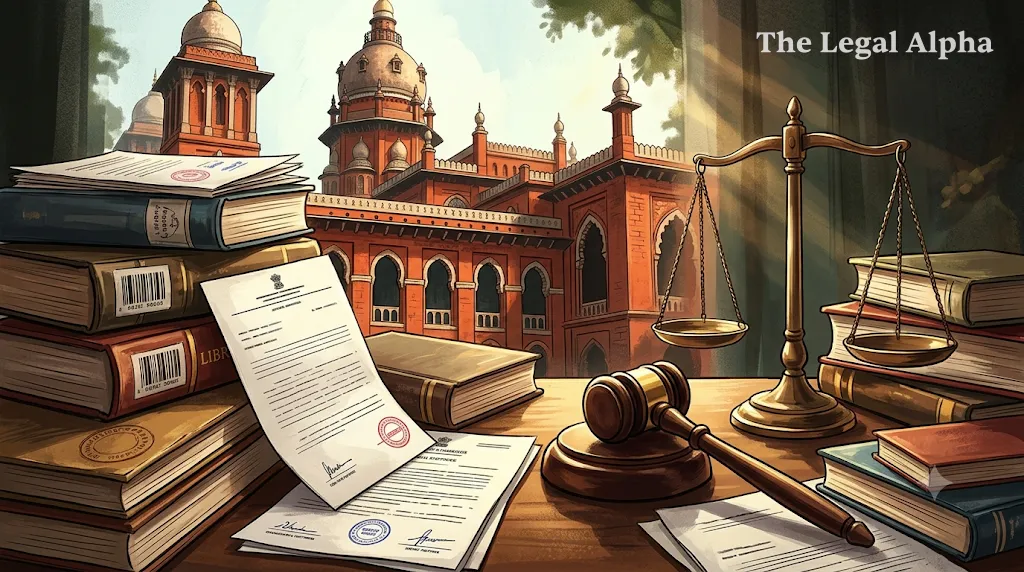
The Madurai Bench of the Madras High Court has issued statutory contempt notices to three senior Indian Administrative Service (IAS) officers in Tamil Nadu over alleged non-compliance with a 2024 judicial directive governing the purchase of books for public libraries. The notices were issued to B. Chandramohan (former Secretary, School Education Department), S. Jayanthi (former Director-in-Charge of Public Libraries), and M. Aarthi (Managing Director, Tamil Nadu Textbook and Educational Services Corporation).
A Division Bench comprising Justices G.R. Swaminathan and M.D. Sumathi passed the order while hearing a contempt petition (Ramasubbu v. K. Gopal and Others, Cont. P. (MD) No. 3763 of 2026) filed by activist V. Ramasubbu. The petition alleges that state officials willfully breached a June 19, 2024 High Court judgment that mandated strict transparency and verification protocols for library book purchases. The matter gained urgency following revelations of large-scale procurement of substandard, plagiarized, and AI-generated books under fabricated author names for state-run libraries.
Legal Topic
Area of Law: Administrative and Constitutional Law
Sub-topic: Civil Contempt of Court / Public Procurement Accountability
Core Legal Issue
The central question before the High Court is whether top-ranking administrative officials in Tamil Nadu committed civil contempt by failing to enforce court-mandated safeguards in public library book procurement, and to what extent senior bureaucratic heads bear direct accountability when institutional oversight mechanisms fail to prevent systemic irregularities.
Specifically, the Bench examined whether senior officials holding supervisory authority over the Directorate of Public Libraries and the Textbook Corporation can escape personal liability when binding judicial guidelines designed to prevent procurement fraud are bypassed.
What Did the Court / Authority Decide?
The Division Bench issued statutory notices to the three IAS officers, requiring them to explain their roles in the alleged non-implementation of the June 2024 order, and adjourned the matter for four weeks.
Key judicial directions and observations from the hearing include:
-
Administrative Responsibility at the Top: The Bench emphasized that senior officials at the helm of departments cannot evade accountability when court orders are violated, observing orally that someone in leadership must take responsibility for the breach.
-
Advise Against State Representation: The Court advised government law officers to refrain from appearing on behalf of former Public Libraries Director S. Jayanthi in the contempt proceedings, noting that contempt is a matter between the Court and the alleged contemnor.
-
Monitoring of Vigilance Probe: Taking note of a related matter pending before the Principal Seat in Chennai, the Bench requested Justice V. Lakshminarayanan (who holds the roster for Vigilance and Anti-Corruption cases in Chennai) to monitor the ongoing investigation by the Directorate of Vigilance and Anti-Corruption (DVAC) into the procurement scam.
-
Forthcoming Policy Overhaul: The Court recorded the State government's submission that a comprehensive, loophole-free book procurement policy will be issued within eight weeks and directed the government to produce relevant procurement records.
-
No Interference in Individual Suspensions: While noting that the State had already suspended five officials, the Court declined to examine the merits of individual departmental suspensions within the contempt proceedings, clarifying that suspended officials are free to challenge those actions through independent writ petitions.
The issuance of statutory notice is a procedural step requiring the named officers to respond; final findings on contempt liability remain pending.
Key Legal Points
-
Accountability of Supervisory Officials: Judicial orders directed at state departments impose an affirmative duty on senior administrative heads to ensure compliance; systemic failure at the implementation level can attract personal contempt scrutiny against top decision-makers.
-
Scope of Contempt Jurisdiction: The Court reiterated that contempt proceedings are strictly confined to examining whether binding judicial directions were disobeyed, rather than serving as a forum to adjudicate collateral service disputes such as departmental suspensions.
-
Separation of Defense in Contempt Matters: When prima facie allegations of administrative misconduct or disobedience of court orders arise against an individual officer, the Court underscored the propriety of state law officers distancing themselves from defending that individual.
-
Judicial Oversight of Anti-Corruption Probes: To ensure coordinated and effective scrutiny, a Division Bench may request a roster judge at the Principal Seat to supervise a specialized agency investigation (such as the DVAC) where connected proceedings exist.
Relevant Law
-
Contempt of Courts Act, 1971 (Section 2(b) and Section 12): Defines "civil contempt" as willful disobedience to any judgment, decree, direction, order, writ, or other process of a court, and prescribes the punishment thereof.
-
Article 215 of the Constitution of India: Empowers every High Court as a court of record with the authority to punish for contempt of itself.
-
Madras High Court Judgment dated June 19, 2024 in S. Krishnan v. The Secretary to Government, Department of Higher Education (W.P. (MD) No. 10150 of 2019): The underlying decision that directed the Tamil Nadu government to implement a transparent book procurement policy, publish shortlisted titles for public objection, and prevent irregularities in library purchases.
Arguments of the Parties
Petitioner
The petitioner, represented by Senior Counsel K.P.S. Palanivel Rajan, argued that despite explicit directions issued by the High Court in June 2024 to ensure transparency and public scrutiny in library book purchases, officials bypassed safeguards, resulting in the procurement of bogus and AI-generated books and the misuse of public funds.
Respondent / State
Represented by Additional Advocate General P.V. Balasubramanian and State Public Prosecutor R. John Sathyan, the State submitted that disciplinary action had already been initiated, with five officials placed under suspension. The State assured the Court that a comprehensive new procurement policy would be notified within eight weeks to plug existing loopholes, while acknowledging that contempt proceedings are fundamentally a matter between the Court and the alleged contemnors.
Other Appearing Parties
Counsel appearing for certain lower-level library officials contended that recommendations were forwarded from regional committees and that departmental action had been taken against them due to a misunderstanding of their limited coordinating role.
Why Does It Matter?
This development carries significant implications for public administration and government procurement across India. First, it signals judicial intolerance toward bureaucratic buck-passing when court-mandated transparency frameworks fail. By summoning senior IAS officers rather than limiting scrutiny to lower-rung clerks or librarians, the Madras High Court has reinforced the principle that administrative leadership entails direct responsibility for institutional compliance.
Second, the case highlights emerging vulnerabilities in public procurement—specifically the use of generative artificial intelligence and digital manipulation to produce fake publications for state contracts. The State's commitment to framing a new procurement policy within eight weeks, coupled with High Court-monitored DVAC scrutiny, is expected to reshape verification standards for publishers, authors, and selection committees supplying educational and library materials to government bodies.
Legal Takeaway
Senior government officials cannot treat judicial directives on administrative transparency as mere formalities delegated entirely to subordinates. When court-ordered safeguards are breached, top officials risk personal contempt proceedings, while the judiciary can simultaneously trigger policy reforms and monitored anti-corruption investigations to protect public funds.
Sources
Primary Source:
Orders passed by the Madurai Bench of the Madras High Court (Justices G.R. Swaminathan and M.D. Sumathi) in Ramasubbu v. K. Gopal, IAS and Others, Contempt Petition (MD) No. 3763 of 2026 (arising out of W.P. (MD) No. 10150 of 2019).
Additional Sources:
-
LiveLaw — Madras High Court Issues Contempt Notice To IAS Officers, Says People At Top Should Take Responsibility (November 20, 2026)
-
Bar & Bench — Public libraries scam: Madras High Court advises government lawyers against defending ex-Director (November 20, 2026)
-
The New Indian Express — HC issues contempt notice to three IAS officers in TN library book scam (November 21, 2026)
-
The Times of India — HC summons three IAS officers in bogus library books scam (November 21, 2026)