Madras High Court Directs Junior Vikatan To Remove EV Velu Caricature, Restrains Further Circulation
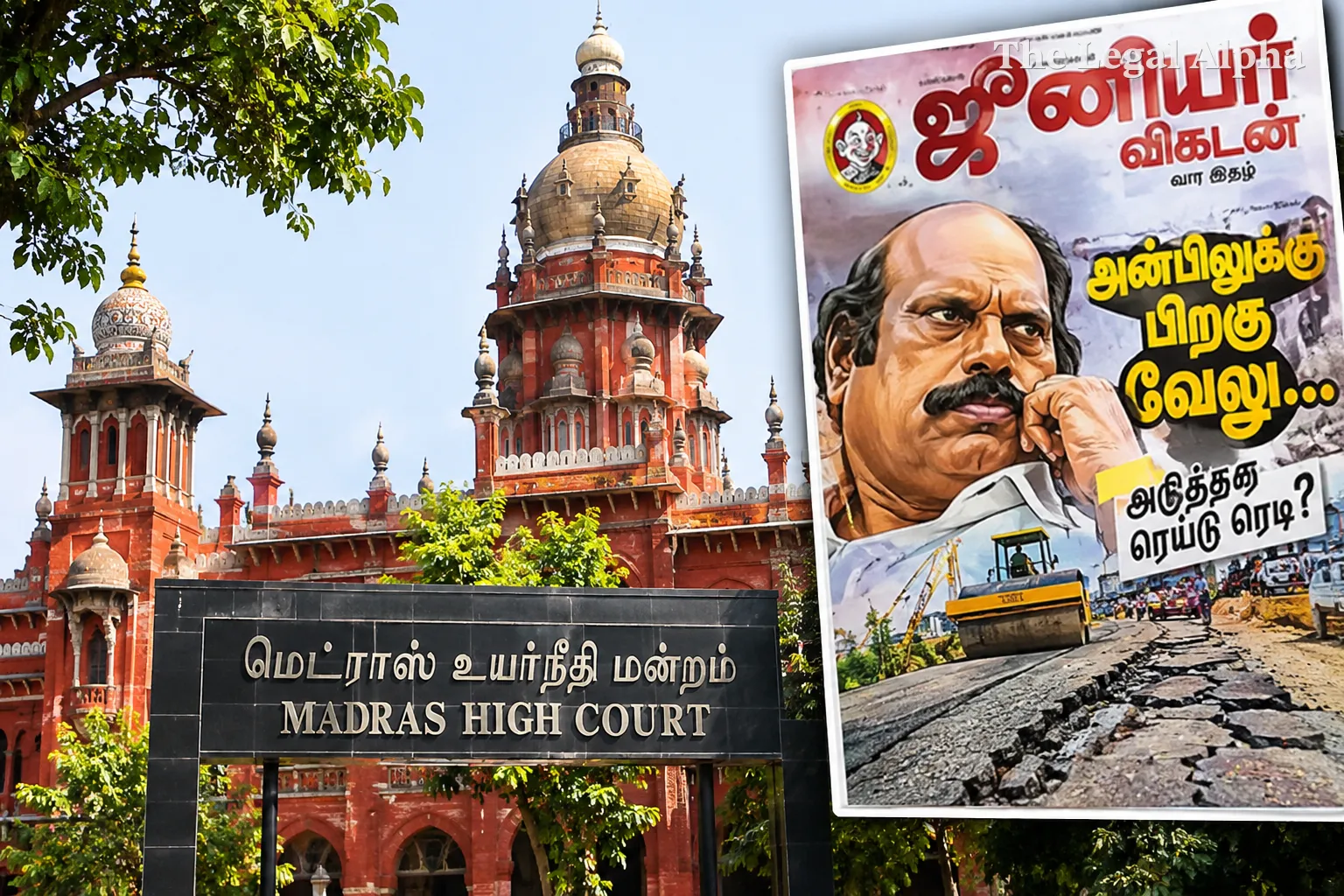
The Madras High Court has directed Tamil magazine Junior Vikatan to remove a caricature of DMK leader and former Tamil Nadu Minister EV Velu from its cover page, granting interim relief in a defamation dispute.
The order was passed by Justice Hemant Chandangoudar on applications filed by Velu against Ananda Vikatan, its editors and publishers. The dispute concerns a November 22 magazine cover featuring a caricature of Velu alongside an article titled “After Anbil, Velu… Next raid ready?”
The article referred to alleged irregularities involving ₹2,200 crore in highway patchwork projects and contracts worth more than ₹5,000 crore over five years. Velu alleged that the illustration and accompanying publication were intended to damage his reputation and create an impression of wrongdoing.
Legal Topic
Area of Law: Media Law and Defamation
Sub-topic: Civil Defamation, Reputation and Freedom of the Press
Core Legal Issue
The central legal question is whether a magazine's publication of a political caricature, viewed alongside allegations of financial irregularities, crosses the legal boundary between permissible journalistic criticism and defamatory representation.
The Court was required to consider whether continued publication and circulation of the disputed illustration could cause reputational prejudice to Velu while his defamation claims remained under consideration.
What Did the Court Decide?
The High Court granted interim relief in all four applications filed by Velu and directed the magazine to remove the disputed caricature.
The Court also restrained the publication and circulation of the contested illustration and cover through print and other platforms, pending further proceedings.
Justice Chandangoudar observed that, considering the nature of the allegations and the manner in which Velu had been depicted, his grievance required judicial consideration.
The interim order does not amount to a final finding that the publication is legally liable for defamation. The underlying dispute remains subject to further judicial consideration.
Key Legal Points
-
The Court found a prima facie basis for considering Velu's grievance concerning the manner in which he was depicted.
-
The disputed caricature must be removed pending further orders.
-
The interim injunction extends to printing, publishing, selling, distributing and displaying the disputed images across digital and physical platforms.
-
The Court also restrained portrayals suggesting that Velu had been proven guilty in the corruption investigations.
-
The order expressly preserves the right to publish genuine and accurate reports about court proceedings and ongoing investigations.
Relevant Law
Code of Civil Procedure, 1908
-
Order XXXIX Rule 3(a) and Rule 3(b): Procedural requirements governing the grant of temporary injunctions without prior notice to the opposite party.
-
Principles governing temporary injunctions, including prima facie case, balance of convenience and likelihood of irreparable injury.
Defamation Law
The dispute also concerns the protection of individual reputation against allegedly defamatory publications, balanced against freedom of speech and expression under Article 19(1)(a) of the Constitution.
Arguments of the Parties
EV Velu's Arguments
Velu argued that the caricature, when published alongside allegations of financial irregularities, created a damaging impression about his reputation.
His counsel submitted that continued circulation could cause serious reputational harm and sought removal of the illustration until the dispute was decided.
Ananda Vikatan's Arguments
The publication's counsel appeared before the Court and sought time to file its response to the applications. The publication also informed the Court that a caveat had been filed.
Why Does It Matter?
The order highlights the legal difficulties involved in balancing press freedom with the right to reputation, particularly when political reporting involves allegations of corruption or ongoing investigations.
For media organisations, the development underlines the importance of distinguishing between allegations under investigation and established findings of guilt.
At the same time, the Court's express protection for accurate reporting on investigations and judicial proceedings is significant. The interim restrictions should not be interpreted as a general prohibition on investigative journalism or political criticism.
The case will also be relevant to discussions about the use of caricatures and visual representations in political journalism.
Legal Takeaway
The Madras High Court has granted interim protection against the continued circulation of a disputed political caricature where the manner of depiction was found to warrant judicial consideration. However, the order is not a final determination of defamation liability and does not prevent accurate reporting on ongoing investigations.
Sources
Primary Source: Madras High Court interim order – the full order was not independently located for verification.
Additional Sources: