Madras High Court Clarifies When Corruption Investigations Against Public Officials Can Proceed Without Prior Sanction
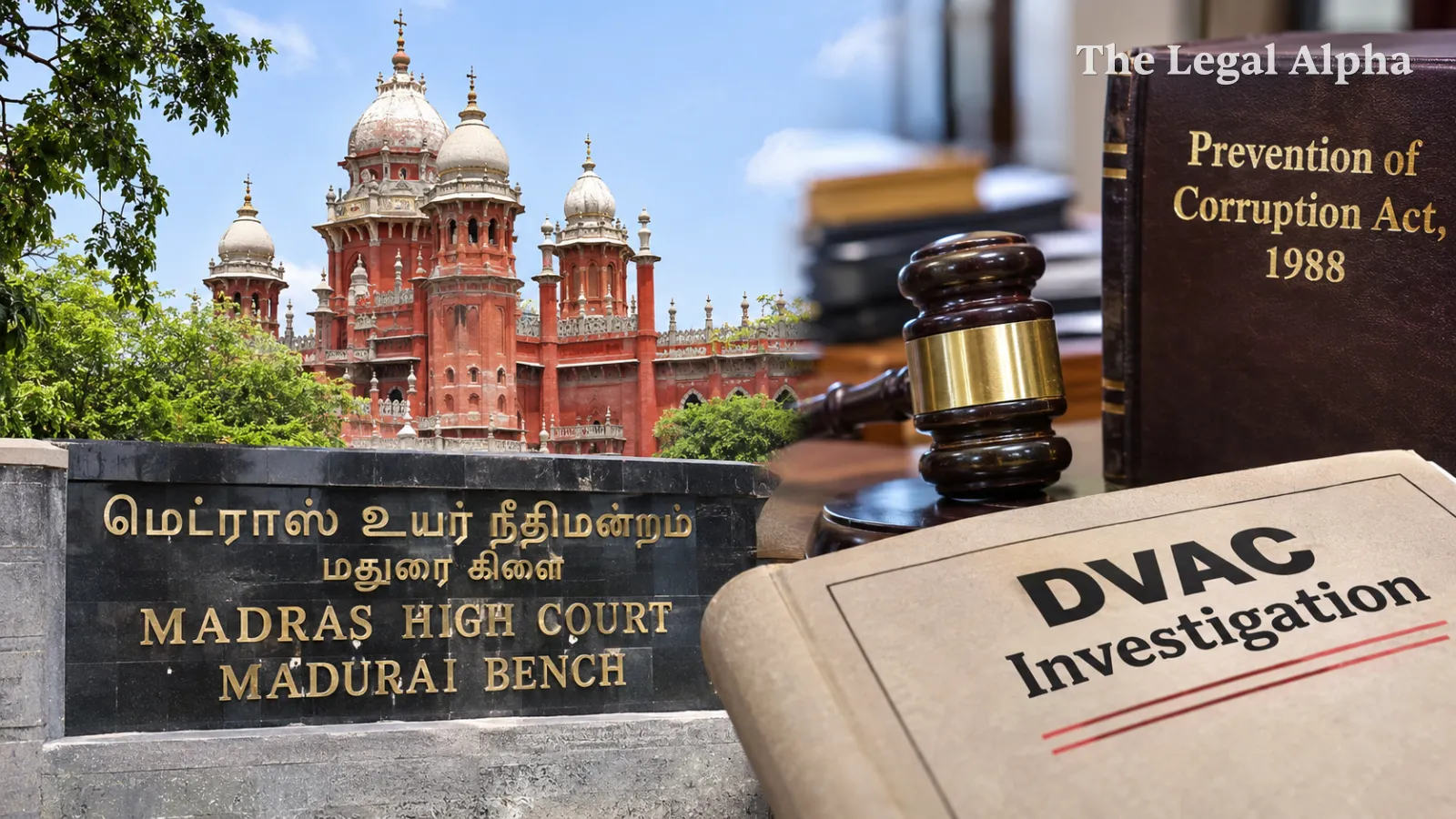
The Madurai Bench of the Madras High Court has ruled that the Directorate of Vigilance and Anti-Corruption (DVAC) can investigate alleged criminal acts by public servants without obtaining prior government approval when those acts are unrelated to decisions or recommendations made in the discharge of official duties.
The ruling came in a case concerning alleged irregularities in the tender process for the construction of a Chief Minister's Mini Stadium at Sengeerai in Pudukkottai district, Tamil Nadu.
A Division Bench comprising Justice P. Velmurugan and Justice K.K. Ramakrishnan quashed a Tamil Nadu government order dated September 25, 2026, which had refused permission to conduct a preliminary enquiry against five government officials.
The allegations concerned the use of allegedly fabricated machinery and equipment purchase receipts submitted by a contractor during the tender process. Officials responsible for examining the technical bid were alleged to have failed to verify the authenticity of those documents.
Legal Topic
Area of Law: Criminal Law and Anti-Corruption Law
Sub-topic: Prevention of Corruption Act, 1988 – Prior Approval for Investigation Against Public Servants
Core Legal Issue
The central legal question was whether Section 17-A of the Prevention of Corruption Act, 1988, requires prior government approval before investigating public servants even when the alleged conduct constitutes an independent criminal act rather than an action connected with the performance of their official duties.
The Court examined the distinction between decisions taken by public servants in the discharge of official functions and alleged criminal conduct that cannot be treated as part of legitimate official decision-making.
What Did the Court Decide?
The High Court held that prior approval under Section 17-A is not necessary where the alleged criminal conduct is unconnected with any decision or recommendation made by a public servant in the discharge of official duties.
The Bench relied on the Supreme Court's ruling in Tejaram v. State of Rajasthan while examining the scope of the statutory protection available to public servants.
The Court observed that accepting allegedly fabricated documents could constitute a criminal act independent of the officials' legitimate administrative responsibilities. Such conduct, therefore, could be investigated by the vigilance authorities without obtaining prior government approval.
The Bench also questioned the State Government's decision to refuse permission after relying on a report from the Commissioner of Rural Development without independently conducting an enquiry into the allegations.
The Court consequently:
-
Quashed the government order refusing permission for the preliminary enquiry.
-
Directed the Director of DVAC to proceed with the investigation without prior approval under Section 17-A.
-
Directed the concerned vigilance officials to conduct a preliminary enquiry.
-
Required the enquiry report to be filed within four weeks.
The matter was listed for further consideration on December 3, 2026.
The Court's ruling concerns the authority to investigate. It does not establish the criminal liability of the officials or determine whether the allegations are ultimately proved.
Key Legal Points
-
Section 17-A has limited application: Prior approval is necessary only when the alleged offence is connected with a decision or recommendation made by a public servant while performing official duties.
-
Independent criminal acts can be investigated: Conduct that is unrelated to legitimate official functions does not automatically receive protection under Section 17-A.
-
Fake documents raise separate criminal concerns: Alleged acceptance or use of fabricated documents cannot automatically be treated as an ordinary administrative decision.
-
Government refusal must have a proper basis: Authorities cannot disregard allegations without adequately examining the relevant facts.
-
Vigilance authorities can proceed: The DVAC has been directed to conduct the preliminary enquiry without obtaining prior government approval in this case.
Relevant Law
Prevention of Corruption Act, 1988
-
Section 17-A: Requires prior approval before an enquiry, inquiry or investigation into an alleged offence relatable to a recommendation made or decision taken by a public servant in the discharge of official functions or duties.
-
Section 19: Deals with previous sanction for prosecution of public servants for specified offences under the Act. This is distinct from approval for investigation under Section 17-A.
Important Judicial Precedent
Tejaram v. State of Rajasthan, 2026 INSC 1147, decided on October 16, 2026.
The Supreme Court clarified that Section 17-A does not provide blanket protection to public servants. An alleged criminal act must be connected with an official decision or recommendation for the prior-approval requirement to apply.
Arguments of the Parties
Directorate of Vigilance and Anti-Corruption (DVAC)
The vigilance authorities sought permission to conduct a preliminary enquiry against five officials over alleged irregularities in the tender process. Their concerns included the alleged failure to verify fabricated machinery purchase documents submitted by the contractor.
Tamil Nadu Government
The State Government declined permission for the preliminary enquiry, relying on a report from the Commissioner of Rural Development, which reportedly found no irregularities in the tender scrutiny process.
The High Court questioned the government's approach, observing that it had accepted the report without independently enquiring into the relevant facts.
Why Does It Matter?
The ruling is significant for the enforcement of anti-corruption laws and the accountability of public officials.
Section 17-A was introduced to protect public servants from unnecessary investigations arising from bona fide decisions taken in the discharge of official responsibilities. However, that protection cannot become a blanket shield against investigations into independent criminal conduct.
The decision reinforces the distinction between legitimate administrative decisions and alleged criminal acts committed under the cover of official authority.
For vigilance agencies, the ruling provides clarity on when an investigation can proceed without first obtaining government approval. For public servants, it reiterates that statutory protection is linked to the nature of the alleged conduct rather than merely their official position.
The ruling also highlights the importance of examining complaints independently instead of rejecting them solely on the basis of administrative reports.
Legal Takeaway
Section 17-A of the Prevention of Corruption Act does not grant public servants immunity from investigation for every alleged criminal act. Where the alleged offence has no connection with an official decision or recommendation, prior government approval is not required to investigate it. The distinction between administrative action and independent criminal conduct remains central to determining the applicability of this protection.
Sources
Primary Source:
- Tejaram v. State of Rajasthan, Supreme Court of India, 2026 INSC 1147, October 16, 2026. Read Supreme Court judgment.
Additional Sources: