Karnataka High Court Warns Against Misuse of Social Media, Refuses to Quash Criminal Cases
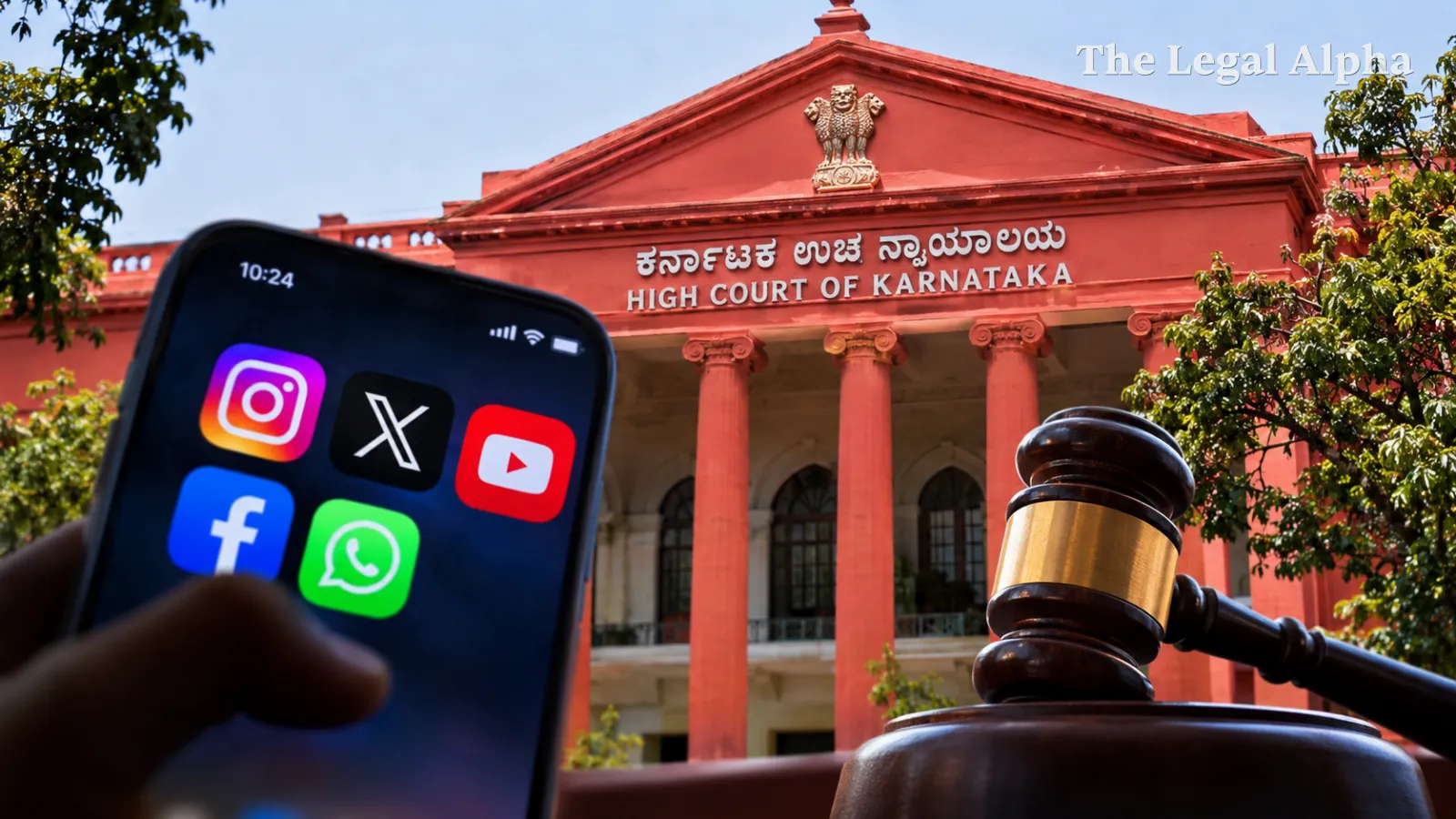
The Karnataka High Court has refused to quash criminal proceedings against individuals accused of using social media to circulate allegedly defamatory, fabricated and inflammatory content targeting a man, Thanusha M Shetty.
Justice Suraj Govindaraj observed that having a social media account does not give anyone unrestricted freedom to publish whatever they wish. The Court emphasised that online expression must remain within the constitutional limits of freedom of speech and expression under Article 19(1)(a).
The observations came while the Court was considering petitions filed by Shubha and another accused seeking the quashing of criminal proceedings arising from allegations of online harassment and threats.
Legal Topic
Area of Law: Criminal Law and Constitutional Law
Sub-topic: Freedom of Speech and Expression, Social Media Misuse, Defamation and Communal Enmity.
Core Legal Issue
The principal legal question before the High Court was whether criminal proceedings arising from allegedly defamatory and inflammatory social media publications should be quashed at the preliminary stage, particularly when the complaint disclosed allegations requiring investigation and trial.
The matter also raised the question of how the constitutional protection of free speech under Article 19(1)(a) applies to online publications alleged to contain threats, fabricated claims and material capable of promoting hostility between communities.
What Did the Karnataka High Court Decide?
The High Court declined to interfere with the criminal proceedings, holding that the allegations, if taken at face value, disclosed a matter requiring investigation and trial.
The Court made it clear that access to social media cannot be treated as unrestricted permission to publish any kind of material.
It observed that online messages must remain within the limits of constitutionally protected expression.
The Court also rejected the petitioners' contention that the criminal proceedings had been initiated out of vengeance because of their support for the Dharmasthala temple.
In a separate order passed on October 15, the Court also refused to quash another criminal case involving Shubha and Mohan over allegations of online defamation and harassment targeting Shetty.
The Court's decision at this stage does not establish the guilt of the accused. The allegations remain subject to investigation and trial.
Background of the Dispute
According to the complaint filed by Shetty, the accused allegedly circulated morphed images, fabricated material and false allegations about him through social media platforms.
The disputed publications reportedly included claims that Shetty had committed rape, forced an abortion, was involved in the Sowjanya murder case, insulted Hindu temples and committed offences under the Protection of Children from Sexual Offences (POCSO) Act.
The complaint further alleged that false claims about his religious identity were circulated to generate hostility against him.
The allegations also included an attempt to murder Shetty by running him over with an autorickshaw.
Arguments of the Parties
Petitioners / Accused
The petitioners argued that the criminal proceedings were motivated by vengeance because they supported the Dharmasthala temple. They sought the quashing of the FIRs and challenged the continuation of the criminal cases.
State / Respondent
The State opposed the petitions. The proceedings continued on the basis that the allegations disclosed potentially criminal conduct requiring investigation and judicial examination.
Key Legal Points
-
Freedom of speech has constitutional limits: Article 19(1)(a) does not provide unrestricted protection to every social media publication.
-
Online publications can attract criminal liability: Social media posts containing allegedly defamatory, threatening or inflammatory material may warrant criminal investigation.
-
Allegations must be examined through due process: Courts need not quash criminal proceedings when the allegations prima facie disclose an offence.
-
Quashing proceedings at an early stage: The High Court declined to terminate the cases before the allegations could be investigated and examined at trial.
-
Allegations are not proof of guilt: Refusal to quash an FIR does not amount to a finding that the accused have committed the alleged offences.
Relevant Legal Provisions
Article 19(1)(a) of the Constitution of India
Guarantees the fundamental right to freedom of speech and expression.
Article 19(2) of the Constitution of India
Permits reasonable restrictions on freedom of speech and expression on specified constitutional grounds, including defamation and public order.
Section 353(2) of the Bharatiya Nyaya Sanhita, 2023
This provision was invoked in the criminal proceedings concerning the alleged circulation of inflammatory material.
Section 62 of the Bharatiya Nyaya Sanhita, 2023
This provision was also invoked in the case involving the allegation of an attempt to commit an offence.
Why Does the Karnataka High Court's Decision Matter?
The development highlights the legal responsibilities associated with operating social media accounts. Digital platforms allow individuals to communicate opinions and share information widely, but the constitutional protection of expression does not automatically extend to material that satisfies the ingredients of a criminal offence.
The Court's observations are particularly relevant in cases involving allegations of fabricated content, online harassment and publications intended to create hostility.
At the same time, the decision should not be interpreted as permitting criminal prosecution merely because a social media post is critical, unpopular or offensive. The ingredients of the alleged offence must still be established in accordance with law.
For individuals and social media users, the case underlines the importance of distinguishing legitimate criticism and expression from conduct that may attract criminal consequences.
Legal Takeaway
The Karnataka High Court has reiterated that freedom of speech on social media remains subject to constitutional limitations and applicable criminal law. Having a social media account does not provide immunity from legal consequences, but allegations must still be established through a fair investigation and trial.
Sources
Primary Source:
- Shubha v. State of Karnataka — Karnataka High Court orders dated October 15, 2026. The underlying orders were not independently available for verification.
Additional Source:
- Bar & Bench – Social media handle not licence to post anything: Karnataka High Court.