Justice Yashwant Varma Tells Parliament Resignation Cannot Be Treated as Acceptance of Misconduct Charges
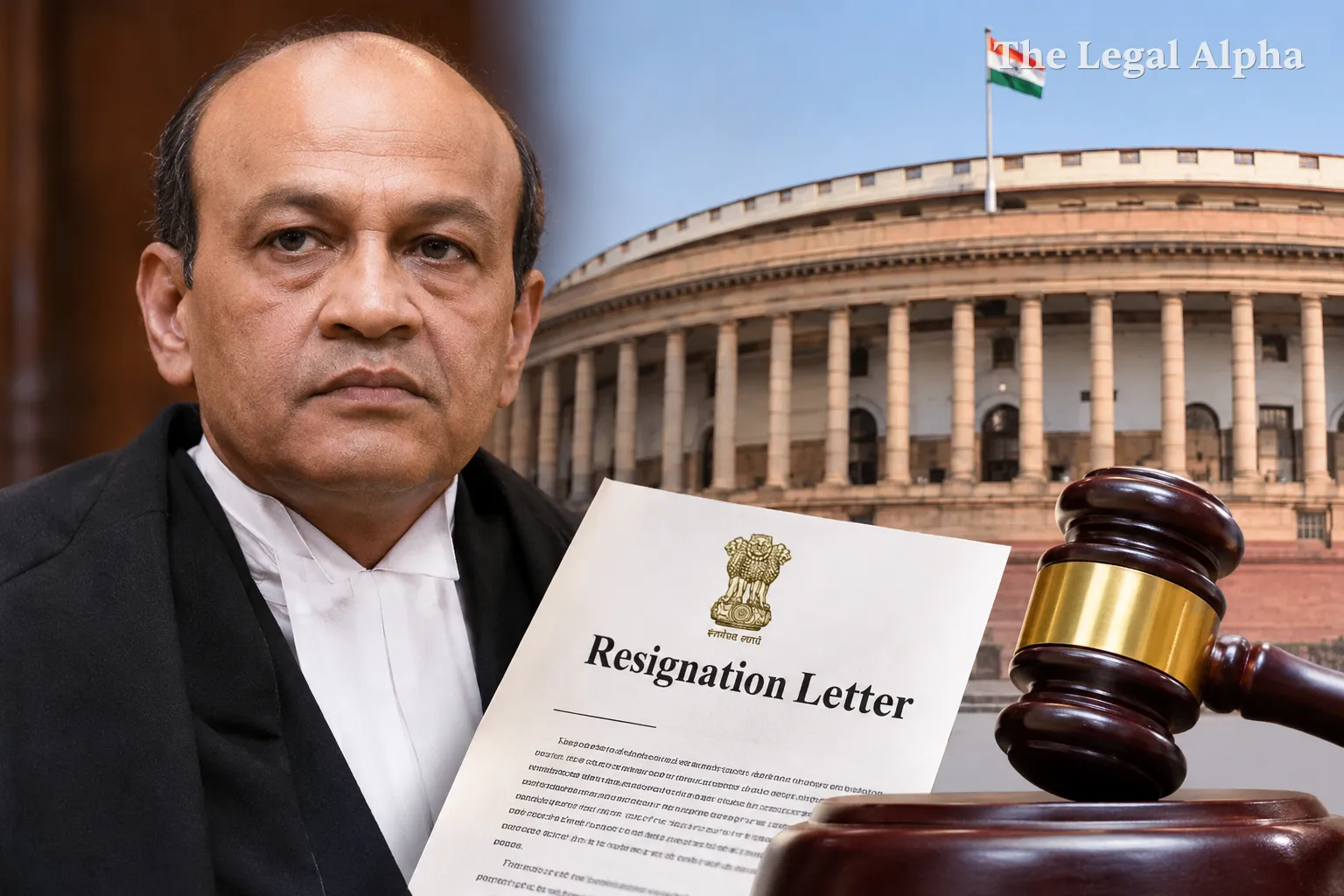
Justice Yashwant Varma has maintained that his resignation from judicial office should not be interpreted as an admission of wrongdoing in connection with the controversy over burnt currency notes discovered at his official residence in New Delhi.
In a letter dated September 10 addressed to Lok Sabha Secretary General Utpal Kumar Singh, Justice Varma argued that the proceedings initiated for his removal could no longer continue after his resignation on April 9, 2025. The letter was circulated among Members of Parliament on November 20, 2026.
Justice Varma has asserted that he remains innocent of the allegations and has reserved his right to challenge the findings of the inquiry committee. His position raises important constitutional questions concerning the relationship between judicial resignation and parliamentary proceedings for the removal of judges.
Legal Topic
Area of Law: Constitutional Law
Sub-topic: Removal of High Court Judges, Judicial Accountability and Resignation from Constitutional Office.
Core Legal Issue
The central legal question is whether Parliament can continue proceedings for the removal of a High Court judge after the judge has submitted a resignation with immediate effect.
A related question is whether resignation can legally be treated as acceptance of allegations or findings of misconduct made during an inquiry into judicial conduct.
Justice Varma relies on Article 217(1)(a) of the Constitution and the Supreme Court's decision in Union of India v. Gopal Chandra Mishra (1978) to support his contention that a High Court judge's resignation takes effect without requiring acceptance by another constitutional authority.
What Did the Inquiry Committee Find?
The three-member committee constituted under the Judges (Inquiry) Act, 1968, found all three charges against Justice Varma proved in its report, which was tabled in Parliament on August 12, 2026.
The findings concerned:
-
Unexplained currency: The committee found that substantial quantities of ₹500 currency notes were discovered within the official premises occupied by Justice Varma and that he failed to provide a satisfactory explanation regarding their presence, source and ownership.
-
Failure to preserve evidence: The committee found that the storeroom had not been properly secured and that the site was subsequently disturbed, resulting in the unexplained disappearance of currency notes.
-
Explanations during inquiry: The committee considered his explanations evasive, incomplete and misleading in effect, and found that his alternative theories were not supported by the material before it.
Importantly, the committee clarified that its findings concerning the cash did not establish that Justice Varma personally owned the money in the criminal-law sense. These were findings of the inquiry committee, not a criminal court conviction.
Constitutional Position and Relevant Legal Provisions
The dispute involves several constitutional and statutory provisions.
Article 217(1)(a) of the Constitution: Allows a High Court judge to resign by submitting a written resignation addressed to the President of India.
Article 217(1)(b): Provides for the removal of a High Court judge in the manner prescribed under Article 124(4).
Article 124(4): Establishes the constitutional procedure for removing a Supreme Court judge on grounds of proved misbehaviour or incapacity.
Article 218: Applies the relevant provisions of Article 124 to High Court judges.
Judges (Inquiry) Act, 1968: Provides the statutory framework for investigating allegations of misbehaviour or incapacity against judges and the constitution of an inquiry committee.
Supreme Court Precedent: Union of India v. Gopal Chandra Mishra
Justice Varma has relied on the Supreme Court's Constitution Bench decision in Union of India v. Gopal Chandra Mishra, decided on February 15, 1978.
The judgment examined the constitutional consequences of a High Court judge submitting a resignation specifying a future effective date and subsequently attempting to withdraw it before that date.
The majority held that a prospective resignation does not become operative until the date specified by the judge. The decision also recognised that resignation under Article 217(1)(a) does not require acceptance by the President.
Justice Varma invokes this precedent to support his position that his immediate resignation terminated his judicial tenure and that no separate acceptance was necessary.
Arguments of the Parties
Justice Yashwant Varma's Position
Justice Varma maintains that he is innocent of the allegations and that his resignation should not be understood as an admission of misconduct.
His principal arguments include:
-
His resignation took immediate effect under Article 217(1)(a).
-
The removal proceedings became infructuous once he resigned.
-
Parliament cannot continue proceedings intended to remove someone who has already ceased to hold judicial office.
-
He retains the right to challenge the inquiry committee's findings.
-
He has declined to participate in further proceedings or provide additional comments on the committee's report.
Inquiry Committee's Findings
The inquiry committee reached a different conclusion on the allegations of misconduct. It found all three charges established on the material examined during its investigation.
However, the committee's findings and Justice Varma's constitutional objection to continuing the removal process are separate issues. His resignation does not, by itself, establish whether the committee's factual conclusions were correct or incorrect.
Why Does It Matter?
The development raises an important question about the constitutional framework governing judicial accountability in India.
The controversy highlights the distinction between resignation from judicial office and removal through the parliamentary process. While the Constitution provides judges with the right to resign, it also establishes a specific mechanism for investigating allegations of serious misconduct.
The issue also concerns the legal consequences of an inquiry that continues after a judge has submitted a resignation. It raises questions about whether such proceedings retain any constitutional or statutory purpose once the concerned individual has ceased to hold office.
For the judiciary, Parliament and the public, the matter highlights the importance of maintaining accountability while respecting constitutional procedures governing judicial independence and tenure.
It is equally important to distinguish an inquiry committee's findings from a criminal conviction. A finding of misconduct in a parliamentary inquiry does not automatically establish criminal liability.
Legal Takeaway
Justice Yashwant Varma's position rests on the constitutional right of a High Court judge to resign under Article 217(1)(a), without requiring acceptance by the President. However, his contention that resignation necessarily terminates all parliamentary inquiry proceedings remains distinct from the committee's findings on the allegations. The central constitutional question is whether proceedings initiated for judicial removal can continue after the concerned judge has resigned.
Sources
Primary Sources:
-
Constitution of India – Articles 124, 217 and 218.
-
Union of India v. Gopal Chandra Mishra, (1978) 2 SCC 301.
-
Judges (Inquiry) Act, 1968.
-
Report of the Inquiry Committee concerning Justice Yashwant Varma, tabled in Parliament on August 12, 2026.
Additional Sources: