Justice B.V. Nagarathna Highlights the Gap Between Constitutional Equality and the Reality of Women’s Rights in India
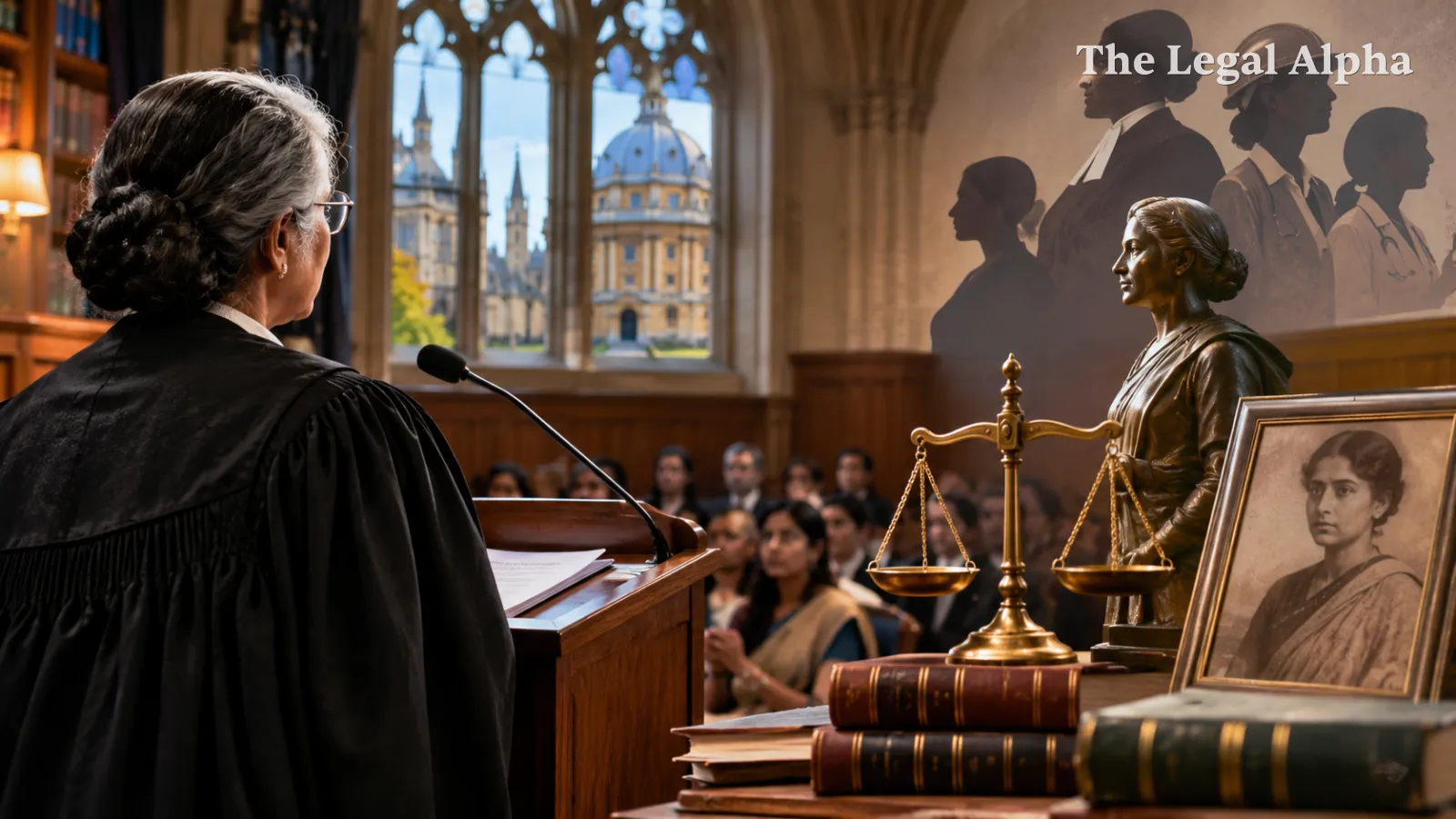
Supreme Court Justice B.V. Nagarathna has called attention to the continuing gap between constitutional guarantees of gender equality and the everyday challenges faced by women in India. Delivering the inaugural Cornelia Sorabji Memorial Lecture at Somerville College, University of Oxford, on November 18, 2026, she emphasised that the presence of women in senior public positions cannot, by itself, establish that equality has been achieved across society.
Titled “The Doors She Opened: Cornelia Sorabji and the Progress of Women’s Rights in India”, the lecture examined the historical development of women's legal rights, the contribution of constitutional institutions and the barriers that continue to restrict women's freedom and opportunities.
Justice Nagarathna highlighted that women continue to face obstacles in accessing education, employment, property rights and effective legal remedies. She also drew attention to the disproportionate burden of unpaid domestic and care responsibilities, which continues to influence women's economic independence and professional advancement.
Area of Law
Constitutional Law
Sub-topic: Gender Equality, Women's Rights, Substantive Equality and Constitutional Justice.
What Happened?
Justice B.V. Nagarathna delivered the inaugural Cornelia Sorabji Memorial Lecture at the University of Oxford, reflecting on India's journey towards gender equality and the contribution of women who challenged historical restrictions within educational, legal and public institutions.
She recalled the contribution of Cornelia Sorabji, recognised as India's first woman lawyer, whose professional journey demonstrated the difficulties women encountered when attempting to enter institutions traditionally dominated by men.
Sorabji reached Oxford in 1889 to study law but faced institutional restrictions despite successfully completing her examinations. Her professional opportunities in India were also restricted until the enactment of the Legal Practitioners (Women) Act, 1923, which removed the legal barrier preventing women from entering the profession.
Justice Nagarathna used this historical experience to explain how individual achievements must be supported by broader institutional and constitutional changes to secure equality for women.
Cornelia Sorabji's Contribution to Women's Legal Rights
Justice Nagarathna highlighted Cornelia Sorabji's pioneering role in challenging gender-based restrictions in education and the legal profession.
She also referred to the 1916 decision in In Re Regina Guha, where a five-judge Bench of the Calcutta High Court rejected Regina Guha's application for enrolment as a pleader under the Legal Practitioners Act, 1879.
The position subsequently changed through the Legal Practitioners (Women) Act, 1923, which enabled women to enter the legal profession.
Sorabji also provided legal assistance to women, particularly those living under the purdah system, who often faced difficulties protecting their property and legal interests because of restricted access to legal knowledge and institutions.
Justice Nagarathna observed that while pioneering individuals could challenge existing restrictions, achieving equality for women as a whole required structural legal and constitutional protection.
Constitutional Equality Must Go Beyond Formal Recognition
A central theme of the lecture was the distinction between formal equality and substantive equality.
Justice Nagarathna explained that treating everyone identically does not necessarily produce equal outcomes when women continue to experience unequal social, economic and institutional conditions.
She referred to the constitutional framework, particularly Articles 14 and 21, alongside the Directive Principles of State Policy, as essential foundations for addressing gender discrimination.
She also acknowledged the contribution of the fifteen women members of the Constituent Assembly, including Hansa Mehta, Rajkumari Amrit Kaur, Durgabai Deshmukh, Dakshayani Velayudhan and Sarojini Naidu.
Their contributions helped shape the constitutional vision of equal citizenship, political participation, social justice and opportunities for women.
Important Supreme Court Judgments on Women's Rights
Justice Nagarathna referred to several landmark decisions demonstrating how constitutional interpretation has progressively strengthened women's legal rights.
- Vineeta Sharma v. Rakesh Sharma (2020): The Supreme Court recognised that daughters acquire coparcenary rights by birth under the Hindu Succession Act, 1956, irrespective of whether their father was alive when the 2005 amendment came into force.
- Mohd. Ahmed Khan v. Shah Bano Begum (1985): The Court recognised the entitlement of a divorced Muslim woman to claim maintenance under Section 125 of the Code of Criminal Procedure, 1973.
- Danial Latifi v. Union of India (2001): The Supreme Court interpreted the Muslim Women (Protection of Rights on Divorce) Act, 1986, to ensure meaningful financial protection for divorced Muslim women.
- Vishaka v. State of Rajasthan (1997): The Court established guidelines addressing sexual harassment at workplaces in the absence of specific legislation, eventually paving the way for the 2013 workplace sexual harassment law.
- Anuj Garg v. Hotel Association of India (2008): The judgment challenged protective paternalism and recognised that restrictions imposed in the name of protecting women cannot justify discrimination or limit their freedom.
- Association of Old Settlers of Sikkim v. Union of India (2023): The Supreme Court rejected discriminatory treatment under which a Sikkimese woman's entitlement to a tax exemption depended upon whom she married.
- Prabha Tyagi v. Kamlesh Devi (2022): The Court clarified the scope of protection under the Protection of Women from Domestic Violence Act, 2005, holding that a woman need not be residing with the respondent when seeking relief.
Justice Nagarathna also discussed decisions concerning maternity rights, equal remuneration and women's participation in the armed forces, including Babita Puniya, Annie Nagaraja and Lt. Col. Nitisha.
Representation of Women in the Legal Profession
Justice Nagarathna emphasised that gender equality must extend beyond allowing women to enter professional institutions. It must also ensure opportunities for advancement, leadership and meaningful participation in decision-making.
Referring to the constitutional framework providing reservations for women in local government institutions and legislatures, she advocated one-third reservation for women lawyers on government panels.
Her proposal also covered legal representation for public sector undertakings and participation in legal aid services.
She stressed that professional equality must extend throughout the institutional structure, including recruitment, training, promotion and leadership.
The discussion also highlighted the significance of the 73rd and 74th Constitutional Amendments, which introduced reservation for women in Panchayats and Municipalities, and the Constitution (106th Amendment) Act, 2023, concerning women's reservation in the Lok Sabha and State Legislative Assemblies.
Core Legal Issue
The central legal question addressed in the lecture was whether constitutional guarantees of equality are sufficient when women continue to encounter structural discrimination, unequal opportunities and practical barriers to accessing justice.
The discussion focused on the difference between recognising rights through legislation and ensuring that women can actually exercise those rights without discrimination, economic dependence, social pressure or institutional obstacles.
Justice Nagarathna's observations also highlighted the importance of understanding that women's experiences are not uniform. Caste, class, disability, religion, geographical background and economic circumstances can create different forms of disadvantage.
Why Does It Matter?
Justice Nagarathna's observations underline that the constitutional promise of gender equality cannot be measured solely through legislation or the appointment of women to influential positions.
Her emphasis on substantive equality is particularly significant for public institutions, employers, legal professionals and policymakers responsible for ensuring equal opportunities.
The discussion also raises important questions about women's economic independence. Although legal protections exist concerning equal remuneration, maternity benefits and workplace participation, unpaid domestic and care responsibilities continue to restrict women's professional choices.
Her suggestion of one-third representation for women lawyers on government panels also brings attention to the need for greater participation of women in institutional legal work.
The lecture further reinforces the importance of ensuring that constitutional rights translate into accessible remedies, particularly for women who face financial insecurity, social stigma or difficulties approaching legal institutions.
Legal Takeaway
Justice B.V. Nagarathna's address reinforces that constitutional equality must translate into meaningful opportunities and independent choices for women. Articles 14 and 15 acquire practical significance when women can exercise their rights without structural discrimination, economic restrictions or social barriers.
The progress of women's rights therefore requires more than legal recognition; it demands institutions and social conditions that allow every woman to participate equally in public and private life.
Sources
Primary Source: Justice B.V. Nagarathna's inaugural Cornelia Sorabji Memorial Lecture, The Doors She Opened: Cornelia Sorabji and the Progress of Women's Rights in India, Somerville College, University of Oxford, November 18, 2026.
Additional Sources: