J&K High Court Orders Police Picket to Protect Raika Judicial Complex Land, Summons Jammu Deputy Commissioner
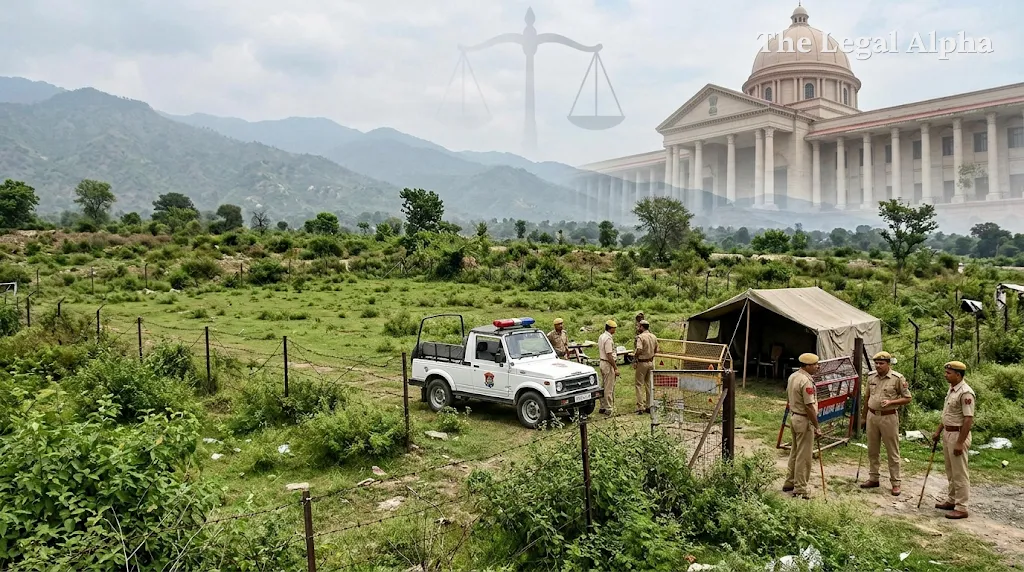
The High Court of Jammu & Kashmir and Ladakh has stepped in to safeguard public land reserved for its upcoming Jammu Wing complex at Raika after official filings revealed widespread illegal occupation on the site. During a recent hearing in an ongoing Public Interest Litigation (PIL) filed by advocate Arjun Gandotra, a Division Bench of Justice Rajnesh Oswal and Justice Mohd Yousuf Wani reviewed a status report submitted by the High Court's Registrar Judicial. The report disclosed that roughly 111 kanals of the designated judicial land had been encroached upon.
To halt further trespassing, the Bench ordered the Senior Superintendent of Police (SSP), Jammu, to deploy a security picket at the site. Simultaneously, the court summoned the Deputy Commissioner (DC), Jammu, to appear in person and account for why a substantial stretch of the perimeter remained unfenced. The intervention is significant because it highlights administrative lapses in securing prime state land allocated for major public justice infrastructure—land that was already supposed to be under official custody.
Legal Topic
Area of Law: Constitutional and Administrative Law
Sub-topic: Public Interest Litigation / Protection of Public Land and Judicial Infrastructure
Core Legal Issue
The core issue before the Division Bench was how to enforce executive accountability and prevent the continued dissipation of state land earmarked for public judicial infrastructure when administrative agencies fail to maintain physical boundaries and reconcile revenue records.
Specifically, the court had to address the disconnect between formal possession and ground reality: although the High Court registry confirmed that physical possession had been transferred to the judiciary, official revenue records (Khasra Girdawari for Rabi 2026) still listed the Department of Law, Justice and Parliamentary Affairs as the possessor, while an unguarded gap in perimeter fencing left the property exposed to encroachment.
What Did the Court / Authority Decide?
The Division Bench passed interim directions aimed at immediately securing the property and fixing administrative responsibility:
-
Police Deployment: The Bench directed the SSP, Jammu, to establish a permanent security picket directly on the Raika site to prevent any fresh encroachment.
-
Personal Appearance: The court ordered the Deputy Commissioner, Jammu, to remain personally present at the next hearing to explain why barbed-wire fencing had not been installed along the exposed boundary.
-
Record Discrepancy Noted: The judges took judicial notice of the mismatch between the Registrar General's reply—which stated that possession had already been handed over to the High Court—and the Rabi 2026 Khasra Girdawari, which continued to reflect possession under the Law Department.
These orders are interim protective measures within the revived PIL (WP(C) PIL No. 13/2025), which primarily seeks the release of funds and timely execution of the Raika High Court complex project. Substantive compliance regarding the removal of existing encroachments and the overall construction timeline remains pending before the Bench.
Key Legal Points
-
Judicial Monitoring of Public Assets: Under its writ jurisdiction, a High Court can issue direct operational orders to law enforcement and district officials to preserve public land designated for essential infrastructure when routine administrative safeguards fail.
-
Alignment of Revenue Records with Possession: Discrepancies in land revenue entries—such as the Khasra Girdawari reflecting an executive department rather than the actual transferee—can blur institutional responsibility for site maintenance and security.
-
Personal Accountability of District Authorities: Summoning a District Magistrate/Deputy Commissioner in person signals judicial dissatisfaction with unexplained delays in basic protective measures like perimeter fencing.
-
Preventive Policing for State Property: Ordering a dedicated police picket demonstrates that courts may treat active encroachment on earmarked public infrastructure sites as an immediate law-and-order and asset-protection priority rather than leaving it solely to slow civil eviction processes.
Relevant Law
-
Article 226 of the Constitution of India: Empowers High Courts to issue writs, orders, or directions to any person or authority within their jurisdiction to enforce fundamental rights and protect public interest, including issuing continuing mandamus in PILs.
-
Jammu and Kashmir Land Revenue Act, Svt. 1996 (1939 A.D.): Governs the maintenance of revenue records, including the Khasra Girdawari (harvest/possession inspection register), which records actual physical possession and changes in land status.
-
Jammu and Kashmir Public Premises (Eviction of Unauthorised Occupants) Act, 1988: Provides the statutory framework for estate officers and district authorities to identify and evict unauthorized occupants from public and government-allocated premises.
Arguments of the Parties
Petitioner
Represented by Senior Advocate Sunil Sethi alongside Advocate Navyug Sethi, petitioner Arjun Gandotra contended that the district administration had failed to adequately protect land reserved for a vital judicial infrastructure project. Counsel highlighted that over 100 metres of the plot lacked barbed-wire fencing, leaving the perimeter open and directly enabling unauthorized occupation.
Respondents
The Union Territory administration and central authorities were represented by Senior Additional Advocate General Monika Kohli, Advocate Monika Thakur, Deputy Solicitor General of India Vishal Sharma, and Advocate Karan Sharma. The proceedings relied heavily on the court registry's own status reports—specifically the Registrar Judicial's assessment of the 111-kanal encroachment and the Registrar General's submission regarding the formal handover of possession to the High Court.
Why Does It Matter?
This order underscores a recurring governance bottleneck in large public infrastructure projects across India: delays between land allocation and physical construction frequently create a vacuum that invites illegal occupation. Even when a project involves the judiciary itself, fragmented coordination between revenue officials, law departments, and district police can leave public land vulnerable.
For government departments and public agencies, the ruling serves as a reminder that formal paper transfers of land are insufficient without immediate physical demarcation, updated revenue mutations, and active security. For citizens and litigants, the court's assertive monitoring in this PIL reinforces that judicial oversight can be used to prevent public funds and land meant for justice delivery from being eroded before construction even begins.
Legal Takeaway
Transferring land on paper does not protect public property unless revenue records are updated and physical boundaries are secured on the ground. When administrative inaction leaves state-allocated project land exposed to encroachment, High Courts can compel immediate police protection and hold senior district officials personally accountable.
Sources
Primary Source:
Interim Order of the Division Bench (Justice Rajnesh Oswal and Justice Mohd Yousuf Wani), High Court of Jammu & Kashmir and Ladakh at Jammu, in Arjun Gandotra v. UT of J&K and Others, WP(C) PIL No. 13/2025 (Order dated November 20, 2026, and earlier revival order dated August 14, 2026).
Additional Sources:
-
Status Report of the Registrar Judicial and Reply of the Registrar General, High Court of Jammu & Kashmir and Ladakh (as recorded in court proceedings).
-
Regional legal and news reporting from Jammu (November 20–22, 2026).