High Court Rejects Plea Challenging Vikarabad Court Site, Warns Against Factional Disputes Stalling Judicial Infrastructure
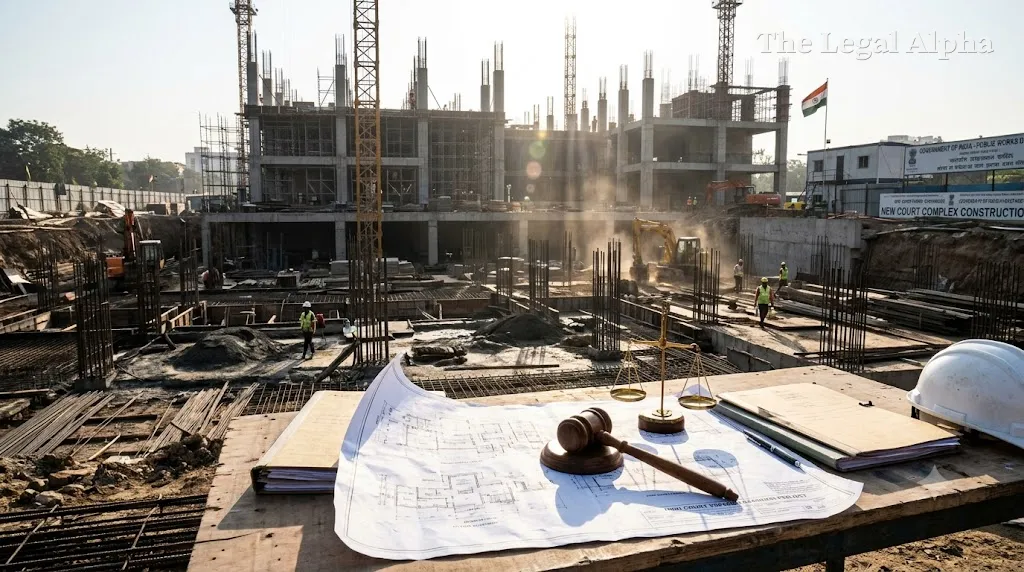
The Telangana High Court dismissed a public interest litigation petition brought by a group of local advocates challenging the official site chosen for the upcoming Vikarabad District Court Complex. A Division Bench led by Acting Chief Justice P. Sam Koshy and Justice Suddala Chalapathi Rao refused to interfere in the government’s land allotment, holding that internal divisions within the legal fraternity over site selections do not amount to genuine public interest and serve primarily to stall essential public infrastructure.
Legal Topic
Area of Law: Constitutional Law / Administrative Law
Sub-topic: Maintainability of Public Interest Litigation / Judicial Review of Infrastructure Allotments
Core Legal Issue
The core legal question was whether disputes raised by a section of advocates concerning the geographic and topographical suitability of land allotted for a district court complex qualify as matters of genuine public interest warranting judicial intervention under Article 226 of the Constitution, or whether such challenges constitute an administrative matter outside the scope of public interest litigation.
What Did the Court Decide?
The Division Bench dismissed the petition outright, finding no ground for judicial interference.
The Court observed that site allotment for institutional infrastructure belongs within administrative decision-making in the larger public interest. The Bench firmly disapproved of a recurring pattern where competing factions of the legal profession actively oppose or support government land parcels, noting that entertaining such fractional disagreements only creates prolonged delays in establishing necessary judicial infrastructure.
Key Legal Points
-
Public interest litigation cannot be deployed as a vehicle to air sectional disagreements or personal conveniences regarding public construction sites.
-
Site suitability and land allotment for public facilities, including court buildings, fall within administrative domain unless tainted by manifest illegality or arbitrary executive abuse.
-
Factional divisions within the bar do not satisfy the legal threshold of bona fide public injury under Article 226 of the Constitution.
-
Judicial review will not be exercised in a manner that obstructs or unnecessarily stalls critical judicial infrastructure projects.
Relevant Law
-
Constitution of India, Article 226: Power of High Courts to issue certain writs, invoked under public interest jurisdiction.
-
Established Principles of Public Interest Litigation: The doctrine barring the misuse of PIL jurisdiction for private grievances, sectional bar rivalries, or non-justiciable administrative decisions.
Arguments of the Parties
Petitioners
The petitioners, comprising local advocates led by Bandi Narayana, argued that:
-
The proposed site at Billadakla/Mekalagandi consists of low-lying, rocky poramboke land previously treated as unfeasible by former principal district and sessions judges.
-
Constructing the judicial complex at the chosen location was arbitrary and would inconvenience litigants, advocates, and judicial staff.
-
The state government ought to assess feasibility objectively and select previously considered alternatives, such as land at the Yennepally Horticulture Centre or an alternative parcel at Shivareddypet.
The Court's Assessment
The Bench questioned how the executive's choice of land adversely affects the general public in a manner requiring constitutional intervention, drawing an analogy to the ongoing construction of the High Court complex at Budwel:
-
The Court noted that whenever land is sanctioned, one faction of lawyers routinely endorses the site while another mobilises against it.
-
Such internal conflicts fail to articulate a broader public injury and directly delay judicial facilities meant to serve society at large.
Why Does It Matter?
The decision reinforces an important limit on public interest litigation: courts will not allow the docket to become an arena for internal bar politics or localized zoning disagreements. Across the country, judicial infrastructure upgrades often face substantial procedural friction when bar members split along geographic or factional lines. By declining to micromanage site selection, the High Court has affirmed that modernising court infrastructure takes precedence over sectional preferences, setting a deterrent against using the writ jurisdiction to delay administrative planning.
Legal Takeaway
Public interest litigation requires a demonstrable violation of public rights or the rule of law; it cannot be invoked to resolve internal professional differences or challenge executive decisions on facility locations. Where no broad public injury exists, courts will prioritise the timely execution of judicial infrastructure over sectional convenience.
Sources
Primary Source:
-
Division Bench Order of the High Court for the State of Telangana, coram Acting Chief Justice P. Sam Koshy and Justice Suddala Chalapathi Rao, dismissing the PIL challenging the Vikarabad District Court Complex site selection.
Additional Sources:
-
High Court Proceedings and Case Reporting, Vikarabad District Bar Association PIL matter.