Gujarat High Court Detains Oil Tanker at Vadinar Port Over $2.9 Million Sanctions-Linked Charter Dispute
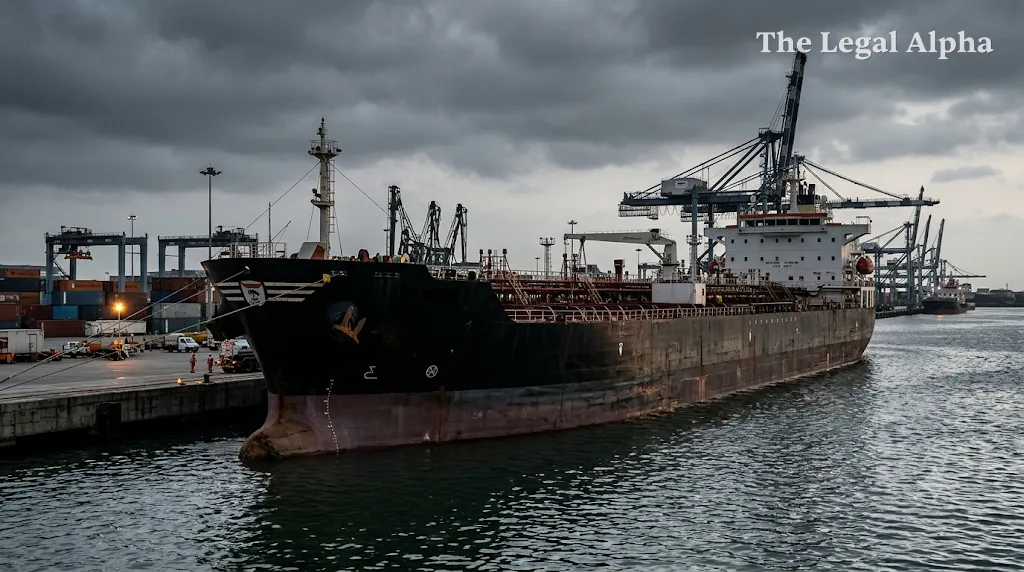
The Gujarat High Court has ordered the interim arrest of a Cameroon-flagged oil tanker, MT ONEIROI, currently anchored at Vadinar Port. The order stems from a commercial maritime dispute brought by charterer APCOR Shipping Ltd against the vessel's registered owner, Marshall Islands-based Golden Dorado Co.
APCOR Shipping Ltd approached the court seeking to recover $2.9 million (approximately ₹27.1 crore) after terminating a time-charter agreement. According to the charterer's filings, it agreed on June 5 to hire the tanker at $52,000 per day and paid $3.12 million upfront for a 60-day period. While the ship was delivered at Vadinar on June 18, the United Kingdom had already placed the vessel under sanctions two days earlier, on June 16, under the Russia (Sanctions) (EU Exit) Regulations, 2019.
Upon learning of the designation—which the owners allegedly failed to disclose—APCOR terminated the contract and treated the vessel as redelivered at Port Said, Egypt. With the vessel situated within Indian territorial waters at Vadinar, APCOR sought urgent judicial intervention to detain the ship as security for its financial claims before it could sail away.
Legal Topic
Area of Law: Admiralty and Maritime Law
Sub-topic: Ship Arrest / Charterparty Disputes & International Sanctions
Core Legal Issue
The central legal question before the Gujarat High Court at this preliminary stage was whether the charterer had established a prima facie maritime claim against the vessel and its registered owner sufficient to justify an ex-parte ad-interim arrest under Indian admiralty law. Specifically, the court had to assess whether a dispute arising from the premature termination of a charterparty due to undisclosed foreign sanctions satisfies the statutory requirements for detaining a foreign-flagged vessel in an Indian port to secure a pending monetary claim.
What Did the Court / Authority Decide?
Justice P. M. Raval granted ad-interim relief in favour of APCOR Shipping Ltd:
-
Order of Arrest: The court directed port and customs authorities at Vadinar to immediately arrest and detain the MT ONEIROI.
-
Conditions for Release: The detention will remain in effect unless the vessel's owners deposit $2.9 million with the court, furnish a security undertaking acceptable to the plaintiff, or obtain further orders from the bench.
-
Preliminary Observation: The bench noted that, strictly for the limited purpose of granting ad-interim relief, the plaintiff had demonstrated a prima facie case that Golden Dorado Co owned the vessel when the claim arose and continued to own it on the date of arrest.
-
Next Steps: This is an interim protective measure rather than a final ruling on the merits of the breach-of-contract allegations. The court has scheduled the matter for further hearing on November 30, where the vessel's owners will have the opportunity to contest the arrest or seek modification of the order.
Key Legal Points
-
Jurisdiction in Rem: Under Indian admiralty jurisdiction, a foreign vessel entering Indian waters can be arrested as a security measure to ensure that a maritime claimant is not left with a paper decree if the ship departs the jurisdiction.
-
Continuity of Ownership: To sustain an action against a ship for an owner's personal liability under Section 5 of the Admiralty Act, the claimant must show that the party liable when the cause of action arose remains the owner when the arrest is executed.
-
Impact of Foreign Sanctions on Charterparties: While UK sanctions do not apply directly as domestic law in India, their imposition on a vessel can frustrate commercial operations, trigger contractual termination rights, and give rise to enforceable maritime claims in Indian courts.
-
Interim Threshold: At the ad-interim stage, Indian courts evaluate whether a triable issue and a prima facie maritime claim exist, deferring detailed evidentiary disputes over contractual breach and damages to subsequent hearings.
Relevant Law
-
The Admiralty (Jurisdiction and Settlement of Maritime Claims) Act, 2017: Specifically Section 4 (which enumerates maritime claims, including those arising out of agreements relating to the use or hire of a ship) and Section 5 (governing the arrest of a vessel in rem where the owner is liable for the maritime claim).
-
Russia (Sanctions) (EU Exit) Regulations, 2019 (United Kingdom): Referenced in the underlying dispute as the regulatory instrument under which the tanker was designated.
Arguments of the Parties
Plaintiff (APCOR Shipping Ltd)
The charterer submitted that it paid $3.12 million in advance hire without knowing that the tanker had been sanctioned by UK authorities two days prior to delivery. APCOR contended that the owners' failure to disclose the sanctions status invalidated the commercial viability of the charter, entitling it to terminate the agreement immediately. It demanded roughly $1.6 million in refunded advance hire for nearly 31 unused days, $860,000 for remaining fuel bunkers on board, plus 18% interest and legal costs, totalling $2.9 million. APCOR urged immediate detention on the ground that the ship could leave Indian waters at any moment, frustrating recovery.
Respondent (Golden Dorado Co / Owners of MT ONEIROI)
As the order was passed at the ad-interim stage to prevent the vessel from sailing away, the registered owners had not yet placed their formal defence on record. They will have the opportunity to respond and challenge the plaintiff's claims when the matter returns to court on November 30.
Why Does It Matter?
This order highlights how geopolitical sanctions regimes create ripple effects across international shipping lanes and domestic courts far removed from the sanctioning jurisdiction. Even though India does not enforce unilateral Western sanctions, Indian ports serve as major global energy hubs where commercial disputes triggered by those sanctions frequently land.
For shipowners, charterers, and maritime insurers, the case underscores the operational and financial risks of vessel designations. Failure to disclose regulatory restrictions prior to vessel delivery can rapidly escalate into high-value ship arrests, halting vessel movements and locking up millions of dollars in security deposits. It also reinforces the readiness of Indian High Courts to exercise swift admiralty jurisdiction to protect maritime claimants against the risk of vessels fleeing local waters.
Legal Takeaway
Foreign geopolitical sanctions can directly disrupt private shipping contracts and trigger enforceable maritime claims in Indian courts. Shipowners and charterers must conduct rigorous sanctions due diligence and maintain strict disclosure standards prior to vessel delivery, as Indian admiralty courts will readily detain vessels in local ports to secure disputed charter refunds.
Sources
Primary Source:
Interim Order of the Gujarat High Court (Coram: Justice P. M. Raval) in the admiralty suit filed by APCOR Shipping Ltd against MT ONEIROI.
Additional Sources:
The Times of India report on the Gujarat High Court proceedings regarding MT ONEIROI at Vadinar Port (November 21, 2026).