Glorifying Crime on Social Media Precludes Bail: Madras High Court Rejects Plea in Extortion Case
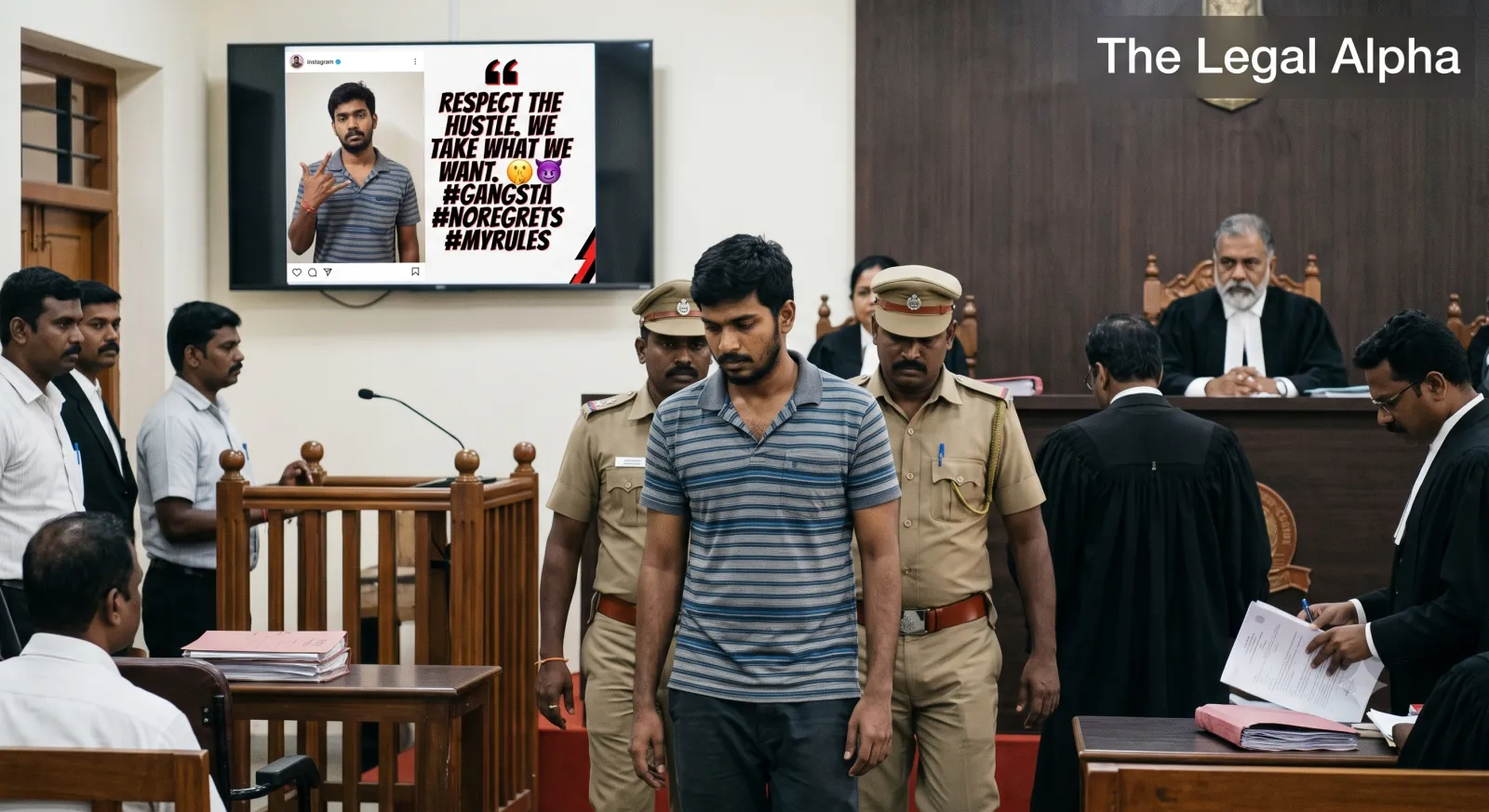
The Madras High Court dismissed the bail petition of an accused involved in an extortion racket after taking strong exception to a provocative Instagram post uploaded by him.
The petitioner, who was arrested on charges of demanding money through threats and intimidation, had sought regular bail to secure his release from judicial custody. However, the prosecution brought to the court’s attention that the accused had circulated content on social media that glorified his illicit conduct, threatened the complainant, and mocked the police. Finding such behaviour entirely incompatible with the grant of judicial discretion, the High Court declined to release him.
Legal Topic
-
Area of Law: Criminal Law & Procedure
-
Sub-topic: Bail Jurisprudence / Impact of Post-Arrest Conduct on Personal Liberty
Core Legal Issue
The central question before the court was whether an accused person's public conduct on social media—particularly posts that boast of criminal activities or seek to intimidate witnesses and the administration of justice—disentitles them from regular bail under criminal procedure.
The court examined whether digital defiance and online intimidation demonstrate a credible risk of witness tampering and recidivism, overriding the general presumption favouring liberty.
What Did the Court Decide?
The High Court rejected the bail petition, ruling that the accused was not fit for release given his open defiance of the law.
The court noted that granting bail is an exercise of judicial discretion that requires an assessment of whether the applicant will respect legal boundaries while out on bail. The judge remarked that an individual who uses social media platforms to project a culture of fear, taunt law enforcement, and flaunt an underworld persona poses an active hazard to public order and the complainant’s security. Consequently, the bail application was dismissed, leaving the petitioner in judicial custody.
Key Legal Points
-
Post-Offence Conduct as a Material Bail Consideration: The court affirmed that an applicant's conduct following the registration of an FIR, including digital behaviour, is directly relevant to assessing the likelihood of witness tampering or reoffending.
-
Misuse of Freedom on Social Platforms: Social media cannot be converted into an instrument to intimidate victims or project impunity while simultaneously pleading for equitable relief in a court of law.
-
Protection of Witnesses and Public Order: Personal liberty under criminal jurisprudence must be balanced against the duty to protect witnesses from overt and covert harassment.
-
Discretionary Threshold: Relief under statutory bail provisions requires a bona fide demonstration of respect for the judicial system, which was contradicted by the accused’s digital bravado.
Relevant Law
-
Sections 384 and 387 of the Indian Penal Code, 1860: Pertaining to extortion and putting a person in fear of death or grievous hurt in order to commit extortion.
-
Section 439 of the Code of Criminal Procedure, 1973: Governing the discretionary powers of the High Court to grant regular bail.
-
Established Judicial Precedents on Bail Factors: Principles established in landmark rulings (such as State of U.P. v. Amarmani Tripathi), which mandate that courts evaluate the character, behaviour, and potential of the accused to tamper with witnesses.
Arguments of the Parties
The Applicant
Counsel for the petitioner argued that:
-
The petitioner had been falsely implicated in the case due to personal enmity and had already undergone sufficient custody.
-
The investigation had largely concluded, meaning custodial interrogation was no longer required.
-
The controversial social media content was either misunderstood, posted without malicious intent, or not directly managed by the petitioner, and he was willing to abide by stringent conditions if released.
The State
The prosecution opposed the application and contended that:
-
The accused was part of an organised attempt to extort money from local businessmen and individuals by creating terror.
-
The controversial Instagram upload was a deliberate attempt to silence the complainant, boast of his criminal connections, and deter witnesses from cooperating with the police.
-
Releasing the accused would immediately imperil the safety of the victim and derail the upcoming trial.
Why Does It Matter?
This ruling highlights the increasing judicial scrutiny applied to an accused person's digital footprint. In an era where social media feeds frequently serve as extensions of real-world intimidation, courts are no longer evaluating bail purely on the formal charges listed in the charge sheet.
By holding that inflammatory reels and posts reflect a genuine danger to witnesses, the order serves as a clear warning to individuals attempting to build online clout through criminal intimidation. It also reinforces the principle that while personal liberty is a fundamental right, courts will not extend discretionary relief to applicants who demonstrate contempt for the justice process.
Legal Takeaway
An accused person’s online presence and digital conduct directly influence the court’s decision to grant bail. Using social media platforms to glorify crime or intimidate complainants demonstrates a tangible threat to the administration of justice and will justify the denial of personal liberty.
Sources
-
Primary Source: Madras High Court Order, Criminal Original Petition (Bail Application).
-
Additional Sources: The Code of Criminal Procedure, 1973; The Indian Penal Code, 1860.