Fresh Plea in Supreme Court Seeks Ground Verification of Ram Temple Site Against 2019 Ayodhya Verdict
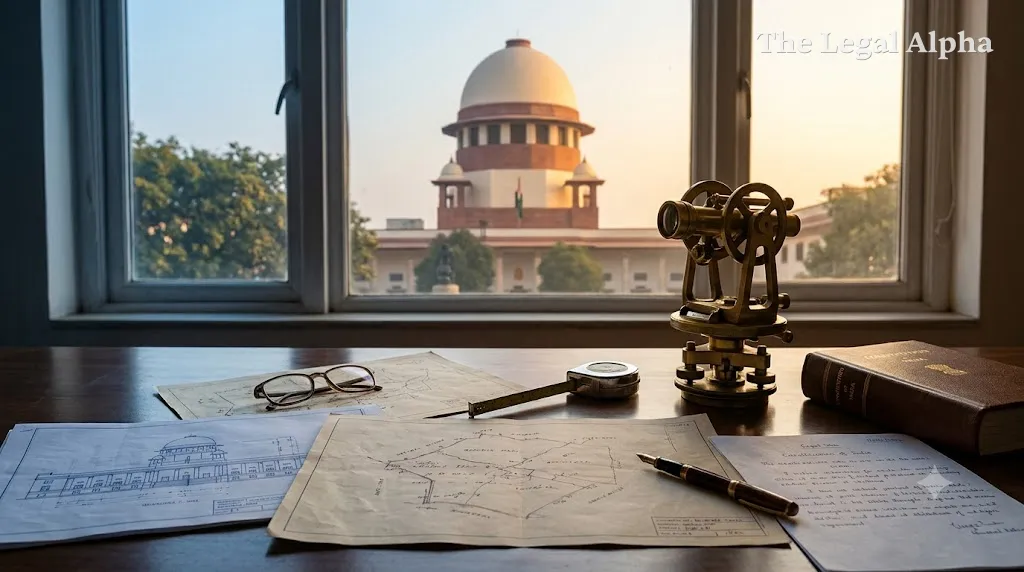
A petition has been moved before the Supreme Court of India seeking an independent technical verification to confirm whether the newly constructed Ram Temple in Ayodhya stands precisely within the boundaries of the disputed 2.77-acre site adjudicated by the Constitution Bench in 2019.
The petitioner has urged the apex court to constitute an independent committee or commission of experts to conduct a formal boundary survey and physical demarcation. The plea highlights that such verification is essential to verify complete alignment with the landmark judgment, alongside prayers demanding administrative transparency, judicial production of original revenue and layout plans, and independent financial audits of temple offerings.
Legal Topic
Area of Law: Constitutional Law & Civil Procedure
Sub-topic: Decree Implementation, Public Trusts, and Judicial Oversight
Core Legal Issue
The fundamental legal question centers on the execution, spatial demarcation, and faithful enforcement of a Constitution Bench decree. The petition raises whether the physical footprint and perimeter of the constructed temple strictly adhere to the exact disputed territory awarded to the deity’s trust under the court's 2019 judgment, or whether execution deviated across revenue boundaries.
Additionally, the matter invokes questions regarding judicial authority to inspect administrative compliance, the custody and production of statutory revenue and development records, and whether public trust offerings at places of monumental religious significance warrant mandated external audit under constitutional oversight bodies.
What Did the Court / Authority Decide?
The petition has been recently instituted and remains pending consideration before the Supreme Court.
The top court has not yet adjudicated on the merits or issued notices in this specific plea. A hearing is expected in due course to examine whether the petition raises a maintainable question concerning the implementation of its earlier decree or whether it constitutes an impermissible attempt to reopen settled civil litigation.
Key Legal Points
-
Decree Demarcation and Boundary Verification: The plea requests a court-mandated survey to align the on-ground construction coordinates with the 2.77-acre parcel determined in the title dispute.
-
Custody and Production of Public Records: The petitioner seeks peremptory directions requiring the Shri Ram Janmbhoomi Teerth Kshetra Trust and regional development authorities to submit all primary surveys, revenue maps, demarcations, and approval layouts before the court.
-
Public Trust Accountability: The plea urges the introduction of automated, continuous digital tracking of all public donations and offerings, supplemented by an annual audit conducted by the Comptroller and Auditor General of India (CAG).
-
Implementation Remedies: The court has been asked to formulate corrective directions if any material geographical divergence is discovered between the adjudicated site and the completed development.
Relevant Law
-
Article 32 & Article 142 of the Constitution of India: Pertaining to the extraordinary writ jurisdiction of the Supreme Court and its plenary power to pass orders necessary for doing complete justice and enforcing its own decrees.
-
Order XXVI, Rule 9 of the Code of Civil Procedure, 1908 (CPC): Governing court powers to appoint commissions for local investigation and spot inspection to elucidate matters in dispute.
-
Comptroller and Auditor-General’s (Duties, Powers and Conditions of Service) Act, 1971: Relevant to the petitioner's request for statutory audits of funds handled by public and quasi-public entities.
-
M. Siddiq (D) Through LRs v. Mahant Suresh Das & Ors. (2019): The five-judge Constitution Bench decision settling title over the 2.77-acre parcel and providing guidelines for trust formulation and land allocation.
Arguments of the Parties
Petitioner / Applicant The petitioner contends that the judicial sanctity of the 2019 Ayodhya verdict requires verifiable assurance that the physical construction corresponds precisely to the adjudicated boundary lines. It is argued that transparency cannot be presumed without an independent boundary demarcation by court-appointed experts, supported by the official production of revenue records, site logs, and sanctioned architectural layouts. The petitioner further asserts that because the temple trust manages significant public donations from domestic and international pilgrims, fiduciary accountability demands daily digital tracking and statutory CAG audits.
Respondent / Opposing Side The trust and concerned state authorities have not yet formally filed counter-affidavits in this newly listed proceeding. In analogous challenges, respondents have historically maintained that the trust's execution and campus planning fully respect all sanctioned revenue boundaries under local master plans and the supreme court's directions, cautioning against frivolous interventions intended to prolong or re-litigate conclusively resolved property disputes.
Why Does It Matter?
This litigation tests the limits between final decree implementation and the post-judgment administration of landmark verdicts. While the substantive title dispute was conclusively closed by the five-judge bench in 2019, questions over ground execution, property demarcation, and public trust governance highlight the enduring administrative challenges that follow historic land title litigations.
The court's approach to the petition will provide guidance on whether collateral petitions seeking on-site inspections and external financial audits are admissible after a constitution bench has issued a final judgment.
Legal Takeaway
The petition underscores that even when monumental title litigation reaches finality, legal scrutiny can resurface regarding the spatial execution of the decree and the financial transparency of the executing public trust. The outcome will determine whether the Supreme Court exercises continuous oversight under Article 142 over the demarcation and accounting of court-mandated religious trusts.
Sources
Primary Source:
-
Supreme Court of India, M. Siddiq (D) Through LRs v. Mahant Suresh Das & Ors. (2019) 1 SCC 1.
Additional Sources:
-
High Court of Judicature at Allahabad, Land Title Dispute Record (2010).
-
Press Trust of India (PTI) and National Law Reporting Services, Supreme Court Registry Filings.