Delhi High Court Moved by Connaught Place Restaurateur Demanding Protest Loss Assessment and Compensation Mechanism
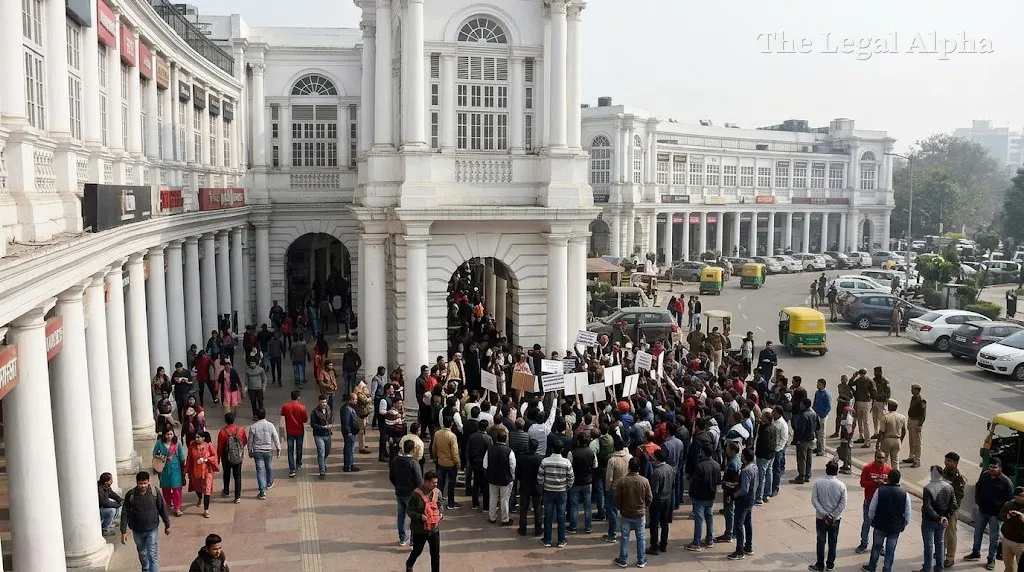
A hospitality operator in New Delhi’s central commercial district has petitioned the Delhi High Court seeking legal accountability and financial recovery for business disruptions caused by unauthorized political gatherings. The petitioner, Aayush Chopra—who operates Minar Restaurant in Connaught Place—filed a writ petition seeking urgent court intervention against rallies called by the Cockroach Janta Party (CJP).
The petition arose after an unpermitted assembly on October 10 triggered market-wide shutdowns, alongside subsequent calls urging supporters to gather at Connaught Place’s Central Park. Pointing to heavy revenue losses during the critical festive shopping corridor between Navratri and Diwali, the plea urges the High Court to halt non-designated demonstrations in central commercial zones and institute an official claim mechanism to assess and recover trade losses directly from political organizers.
Legal Topic
Area of Law: Constitutional and Administrative Law
Sub-topic: Right to Protest vs. Right to Livelihood / Assessment of Damages for Public Agitations
Core Legal Issue
The controversy centers on balancing two fundamental rights guaranteed under the Constitution of India: the collective freedom to assemble peacefully under Article 19(1)(b) versus an individual's right to carry on trade, business, and livelihood under Article 19(1)(g).
Beyond this balancing test, the petition directly invokes the principle of civil restitution in public law: whether a constitutional court can establish an independent claims commission to quantify financial injuries suffered by third-party commercial establishments during unauthorized protests, and hold political organisers and individual participants jointly liable for those operational losses.
What Did the Court / Authority Decide?
The matter was mentioned before a Division Bench comprising Acting Chief Justice Nitin Vasudev Sambre and Justice Sanjay Sharma.
The Bench declined to issue immediate ex-parte restraining orders on the spot; instead, it directed that the writ petition be tagged and listed alongside other connected matters concerning protest regulations and business disruption in central Delhi. The legal issues surrounding financial liability and the restriction of gathering venues remain pending for detailed hearing.
Key Legal Points
-
Demarcation of Designated Protest Zones: Demonstrations cannot be held unrestricted across public thoroughfares; they are confined to officially notified sites under prevailing regulatory frameworks.
-
Jurisprudence on Public Disruption: The Supreme Court’s rulings emphasize that the right to assemble is not absolute in terms of time and venue, and must not extinguish the public's right to passage and commerce.
-
Liability of Organizers for Economic Loss: Established guidelines permit constitutional courts to set up assessment bodies to quantify property and commercial damage caused by unruly or unpermitted agitations, fixing financial liability on leaders and organizers.
-
Enforceability of Prohibitory Orders: The operation of preventive bans under Section 163 of the Bharatiya Nagarik Suraksha Sanhita (BNSS) restricts mass assemblies where potential public disorder or economic distress is established.
Relevant Law
-
Article 19(1)(b) & Article 19(1)(g), Constitution of India: Freedom of peaceful assembly balanced against the protection of commercial enterprise and trade.
-
Section 163, Bharatiya Nagarik Suraksha Sanhita, 2023 (BNSS): Power of executive authorities to issue urgent prohibitory orders to prevent public obstruction or nuisance.
-
Destruction of Public and Private Properties v. State of A.P. (2009) 5 SCC 212 & Kodungallur Film Society (2018): Leading Supreme Court precedents mandating the recovery of damages from political protest organizers.
-
Amit Sahni v. Commissioner of Police (Shaheen Bagh Case, 2020): Affirmation that public ways and spaces cannot be occupied indeterminately for agitations.
Arguments of the Parties
Petitioner
-
The petitioner submitted that Central Park in Connaught Place has never been designated as an approved demonstration site, especially following administrative measures that redirected protests away from adjacent areas like Jantar Mantar to specified alternative zones.
-
The counsel argued that unauthorized rallies violate the traders' fundamental right to carry on business unhindered under Article 19(1)(g), particularly when market associations reported massive daily transactional losses.
-
Relying on Supreme Court precedents on public demonstrations, the petitioner maintained that traders have no alternative legal forum to recover quantified losses and therefore the High Court must constitute a dedicated mechanism to assess damages and compel reimbursement from the organizers.
Respondent / State
-
While the Division Bench tagged the matter for collective consideration, administrative authorities pointed to the existing imposition of prohibitory orders under Section 163 BNSS as part of ongoing efforts to maintain public order and deter illegal congregation in high-security commercial precincts.
Why Does It Matter?
This litigation highlights a recurrent operational friction in major commercial hubs: the vulnerability of local business ecosystems to abrupt political mobilizations. Typically, legal discourse around protests addresses physical damage or criminal acts. This petition highlights pure economic interruption—lost footfall, shuttered shops, and disrupted inventory turnover during peak trade periods.
If the High Court implements a structured damages-assessment framework for trade disruption, it will reinforce accountability for political entities, compelling them to adhere to designated protest venues or risk significant civil damages.
Legal Takeaway
While the right to peaceful assembly remains a core constitutional safeguard, it does not provide an unfettered entitlement to hold unpermitted demonstrations in prime commercial zones. Organizers calling unauthorized public gatherings can face direct financial accountability through court-mandated mechanisms to compensate businesses for resulting commercial losses.
Sources
Primary Source:
-
Proceedings before the High Court of Delhi (Division Bench of Acting Chief Justice Nitin Vasudev Sambre & Justice Sanjay Sharma, October 16, 2026), in Aayush Chopra v. State & Ors.
Additional Sources:
-
High Court Listing and Mentioning Record, October 16, 2026; trade impact submissions by the New Delhi Traders Association and Chamber of Trade and Industry.
-
In Re: Destruction of Public and Private Properties (2009) 5 SCC 212.