Delhi High Court Declines Interim Stay on Release of Sports Drama ‘Doosra’ Amid Sourav Ganguly’s Personality Rights Suit
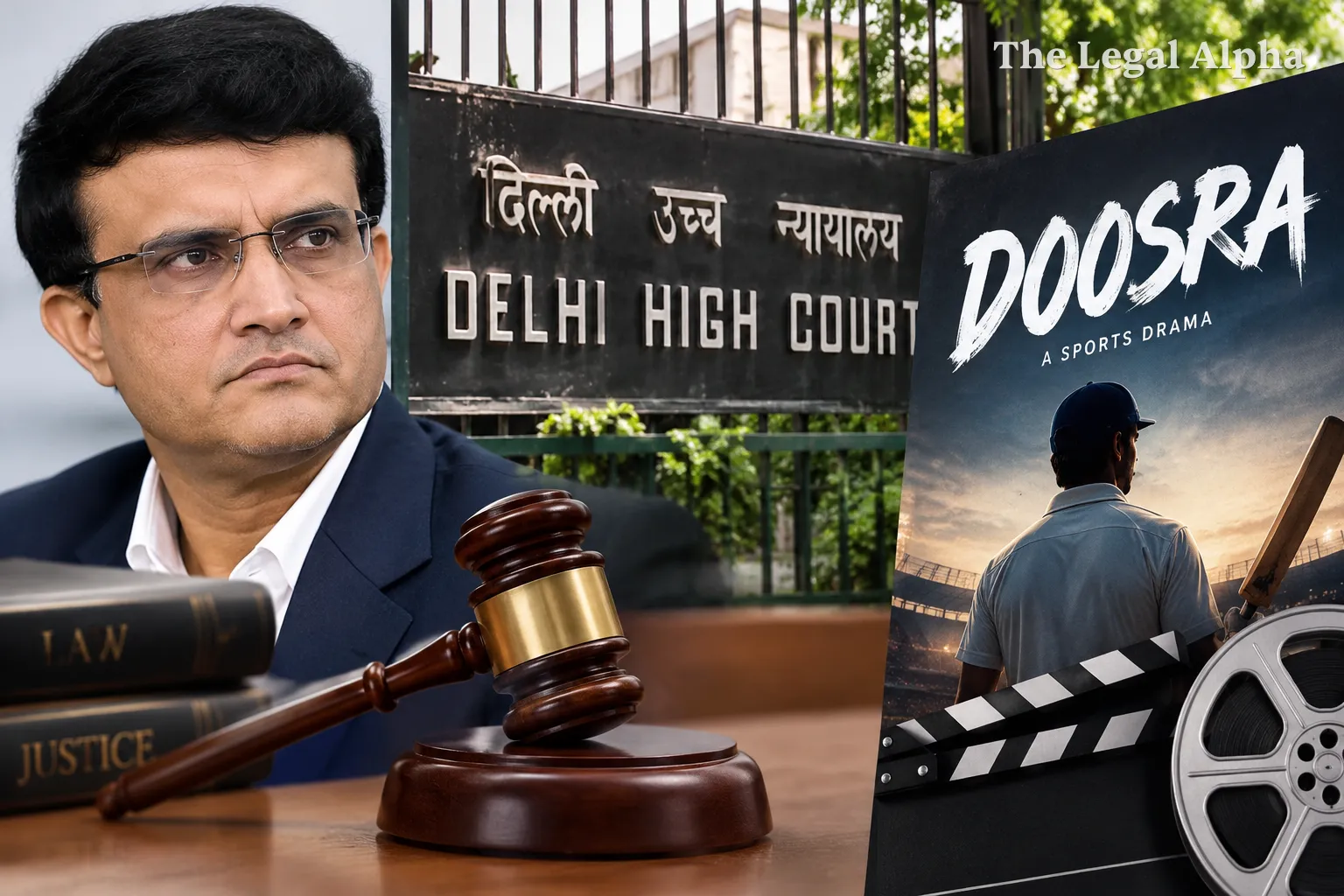
The Delhi High Court declined to grant an urgent ex-parte injunction staying the theatrical release of the film Doosra: India’s Other Freedom Struggle, directed by Abhinay Deo.
Former Indian cricket captain Sourav Ganguly approached the High Court alongside production house Luv Films, alleging that the producers commercially exploited his identity, public persona, and renowned career moments—notably his celebration from the Lord’s balcony during the 2002 NatWest Series final—without obtaining his consent or endorsement licence. Despite the eleventh-hour legal challenge filed on the eve of the movie's premiere, the court allowed the scheduled screening to proceed while keeping the substantive legal challenge open for immediate consideration.
Legal Topic
-
Area of Law: Intellectual Property & Entertainment Law
-
Sub-topic: Celebrity Personality Rights / Right of Publicity and Public Domain Archival Footage
Core Legal Issue
The controversy centres on the conflict between a celebrity's right to control the commercial exploitation of their likeness and persona (personality/publicity rights) versus an artist’s creative freedom to depict real-life historical events and public broadcast footage licensed from governing sports bodies.
The legal question before the High Court is whether an individual sportsperson holds an enforceable proprietary claim over publicly broadcast archival match footage and culturally iconic sporting moments, and whether weaving such public milestones into a fictional narrative infringes personality rights when the film itself is not an authorised biopic.
What Did the Court Decide?
Justice Dinesh Bhatt refused to grant an interim injunction against the distribution and exhibition of the film, remarking that the release would not be stayed simply because an application was brought right before theatrical rollout.
The court directed that the theatrical release could move forward as planned while scheduling the matter for continued hearing the very next day. Consequently, no findings on the substantive merits or damages have been concluded; the court only determined the balance of convenience regarding urgent pre-release injunctions.
Key Legal Points
-
Balance of Convenience in Last-Minute Injunctions: Courts remain hesitant to restrain commercial film releases at the eleventh hour when significant third-party cinema commitments and distribution costs have already been incurred.
-
Ownership of Match Footage vs. Player Persona: The defence established that third-party licensors (such as the BCCI) hold broadcast rights over match archives, meaning athletes do not automatically possess an absolute right to prohibit licensed use of on-field historical events.
-
Inspiration vs. Biopic: Using historical sporting milestones as a thematic backdrop or narrative inspiration for a fictional character is distinct from producing an unauthorised life-story biography.
-
No Presumption of Irreparable Harm: Mere anticipation of personality dilution without viewing the completed film does not readily displace the financial prejudice suffered by filmmakers facing release blockages.
Relevant Law
-
Right of Publicity / Personality Rights: Rooted in the common law tort of passing off, unjust enrichment, and the fundamental right to privacy under Article 21 of the Constitution of India.
-
The Copyright Act, 1957: Specifically provisions under Section 37 (Broadcast Reproduction Rights) and general principles governing cinematograph films, fair dealing, and archival licensing.
-
Code of Civil Procedure, 1908 (CPC): Order XXXIX Rules 1 and 2 (governing temporary and interim injunctions, prima facie case, balance of convenience, and irreparable injury).
Arguments of the Parties
The Plaintiffs (Sourav Ganguly & Luv Films)
-
Counsel for Ganguly contended that the movie extensively markets itself using the cricketer's persona, life events, and iconic celebratory moments without any consent or licence agreement.
-
They asserted that Ganguly is portrayed as the central draw of the film, creating commercial confusion and unfairly pre-empting an officially licensed biopic that is currently under separate production.
-
Ganguly offered to deposit funds to cover advance ticket booking expenses to secure a temporary postponement of the release until the suit was decided.
The Defendants (Filmmakers & Producers)
-
Counsel for the filmmakers submitted that Doosra is a fictional coming-of-age drama about a young girl from Rajasthan who draws personal courage from India's 2002 victory, rather than a biographical depiction of Ganguly.
-
They argued that all archival match clippings were lawfully acquired through licensing arrangements with the Board of Control for Cricket in India (BCCI), negating any intellectual property infringement.
-
The producers maintained that players do not retain individual commercial vetoes over public cricket broadcast footage, and that halting release when hundreds of screens were booked would cause severe financial distress.
Why Does It Matter?
This dispute adds an important dimension to India's rapidly developing jurisprudence around personality and publicity rights. While celebrities regularly seek omnibus protection against deepfakes, commercial merchandising, and unapproved merchandise, applying personality rights to public sporting broadcasts presents significant legal friction.
If players were granted unilateral veto power over the re-broadcasting or dramatic contextualisation of public games, documentarians and sports dramatists would face unprecedented clearance barriers. Furthermore, the ruling reaffirms judicial resistance to last-minute injunction tactics that risk commercial damage to cinema exhibitors when objections could have been agitated well in advance.
Legal Takeaway
Public figures cannot automatically invoke personality rights to block the dramatisation of historic sports moments, particularly where third-party archival footage is lawfully licensed from governing bodies. To secure an urgent pre-release injunction, plaintiffs must establish explicit unauthorised biographical exploitation rather than mere contextual storytelling inspired by public events.
Sources
Primary Source:
-
Delhi High Court Proceedings: Sourav Ganguly & Anr. v. Abhinay Deo & Ors. (Interim Order dated October 22, 2026, Single Judge Bench of Justice Dinesh Bhatt).
Additional Sources:
-
High Court hearing reports and submissions documented by ANI, Times Now, and Bar & Bench.