Delhi Court Grants Bail in Drone Smuggling Case, Holds Prolonged Pre-Arrest Detention Violated Fundamental Rights
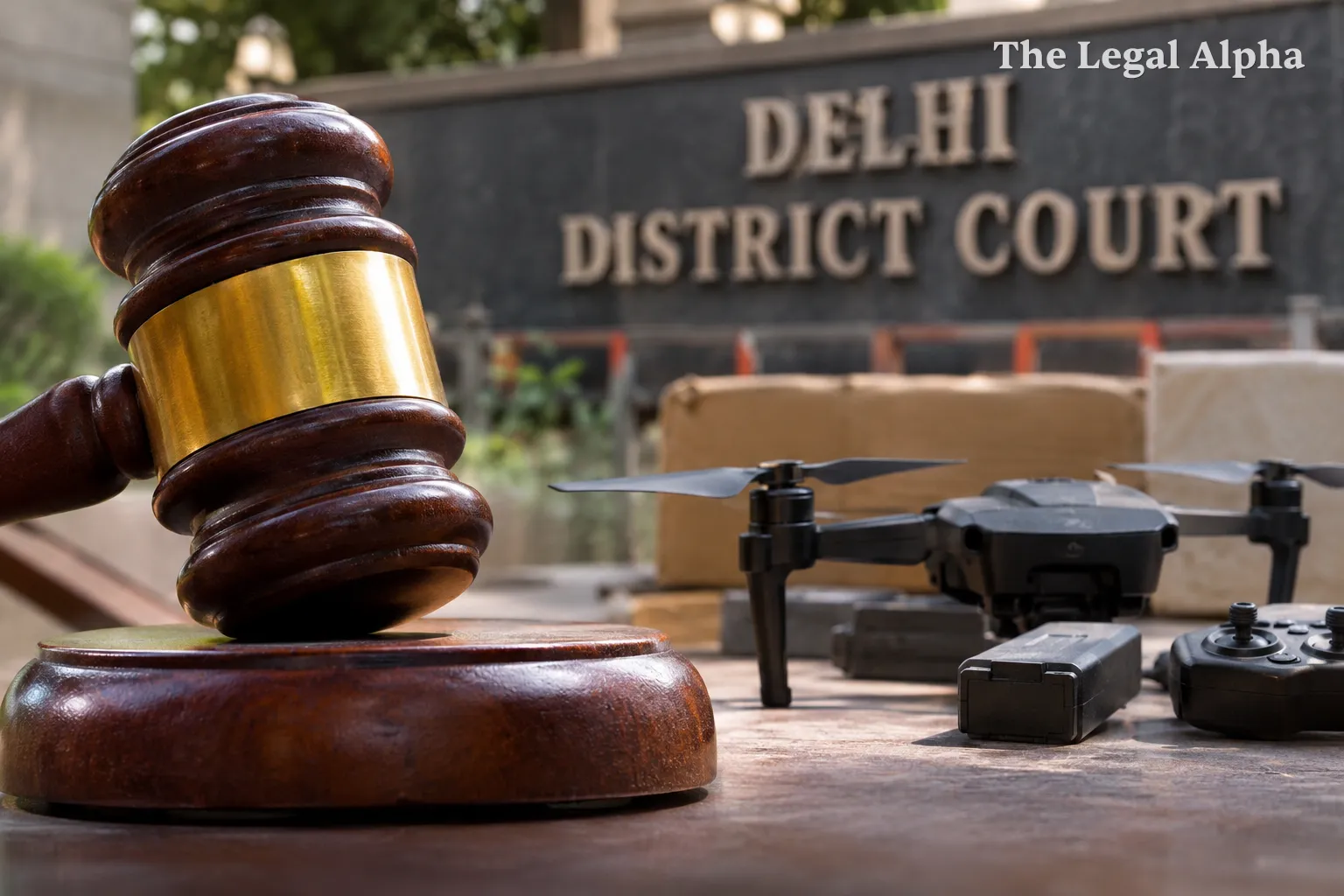
A Delhi court has granted regular bail to Shoaib Nawab Khan, who was arrested in connection with an alleged ₹1.03 crore drone-smuggling operation, after finding that Customs authorities had kept him under restraint for more than 24 hours before formally recording his arrest.
Additional Sessions Judge Saurabh Partap Singh Laler passed the bail order on November 18, 2026. The court observed that constitutional safeguards protecting personal liberty cannot be avoided by delaying the formal recording of an arrest while an individual remains under the effective control of investigating authorities.
The case arose after Customs officials intercepted Khan and two other passengers at Indira Gandhi International Airport, Delhi, following their arrival from Hong Kong via Vietnam. The department alleged that drone components worth more than ₹1 crore had been brought into India in violation of import restrictions.
The court's decision highlights an important constitutional question: whether investigating authorities can keep a person in prolonged custody without formally arresting them and thereby postpone the legal protections available to that individual.
Legal Topic
Area of Law: Constitutional Law and Criminal Law
Sub-topic: Personal Liberty, Unlawful Detention, Arrest Procedures and Customs Investigation
Core Legal Issue
The central legal question was whether Customs authorities could keep an individual under restraint for more than 24 hours without formally recording his arrest and producing him before a magistrate within the constitutionally prescribed period.
The court examined the relationship between Article 21, which protects life and personal liberty, and Article 22(2), which requires an arrested person to be produced before the nearest magistrate within 24 hours, excluding the time necessary for the journey.
The issue was also whether a person could be treated as having voluntarily consented to prolonged detention merely because he had allegedly signed a written request to remain at the Customs office overnight.
What Did the Court Decide?
The Sessions Court allowed Khan's successive bail application, holding that keeping him under prolonged restraint before formally recording his arrest violated the constitutional protections guaranteed under Articles 21 and 22.
The court distinguished between permissible initial detention for baggage inspection and routine airport formalities and prolonged detention that effectively deprives an individual of personal liberty.
It observed that constitutional safeguards begin operating when a person's liberty is actually curtailed, rather than only when authorities complete the formal arrest documentation.
The Customs Department had argued that Khan had requested permission to rest at its office and join the proceedings the following morning. However, the court rejected this justification, observing that even a signed request could not amount to a voluntary waiver of fundamental rights or legitimise prolonged restraint.
The court further observed that if the authorities did not have sufficient grounds to arrest Khan after the initial examination, they should have released him and proceeded with an arrest later if the investigation justified it.
Khan was granted bail subject to the following conditions:
-
Furnishing a personal bond of ₹1 lakh with one surety of the same amount.
-
Not leaving India without prior permission from the trial court.
-
Cooperating with the ongoing investigation.
-
Appearing before the court on every scheduled hearing date.
The court clarified that its observations were tentative and confined to the bail application. It did not determine whether the seized drone components were prohibited military-grade equipment or whether the alleged smuggling operation had been established.
Key Legal Points
- Protection under Article 21: Investigating authorities cannot unnecessarily restrict an individual's personal liberty without lawful justification.
- Article 22(2) safeguards: The constitutional requirement of producing an arrested person before a magistrate within 24 hours cannot be circumvented by delaying formal arrest documentation.
- Actual restraint matters: Constitutional protections are triggered by the actual curtailment of liberty, not merely by the formal recording of arrest.
- Consent cannot override fundamental rights: A written request to remain at an investigating agency's premises does not automatically establish a voluntary waiver of constitutional protections.
- Limits on investigative detention: Authorities must follow lawful arrest procedures rather than keeping individuals under prolonged restraint in the name of investigation.
Relevant Law
Article 21 of the Constitution of India
Article 21 guarantees that no person shall be deprived of life or personal liberty except according to a procedure established by law. It provides constitutional protection against arbitrary deprivation of personal freedom.
Article 22(2) of the Constitution of India
This provision requires authorities to produce an arrested person before the nearest magistrate within 24 hours of arrest, excluding the time necessary for the journey from the place of arrest to the magistrate's court.
Section 104 of the Customs Act, 1962
Section 104 deals with the power of Customs officers to arrest individuals in circumstances specified under the Act. The court referred to the statutory requirements governing the exercise of this power while examining the legality of the detention.
Arguments of the Parties
Applicant – Shoaib Nawab Khan
Khan's defence argued that he had been kept at the Customs premises from the night of September 25 until the morning of September 27, even though his formal arrest was recorded only on September 27.
His lawyers contended that this prolonged restraint violated Articles 21 and 22 of the Constitution. They also challenged the Customs Department's reliance on the alleged written request to remain at its office, arguing that such a document could not amount to a waiver of fundamental rights.
Respondent – Customs Department
The Customs Department opposed the bail application, alleging that Khan and two other passengers were involved in a coordinated operation to bring restricted drone components into India.
The prosecution claimed that the components recovered from Khan's baggage were complementary to drone bodies allegedly carried by another passenger. It also relied on the argument that Khan had requested permission to rest at the Customs office and participate in the proceedings the following morning.
The court did not accept this explanation as sufficient justification for the prolonged restraint.
Why Does It Matter?
The decision reinforces an important constitutional principle: investigating agencies cannot avoid procedural safeguards simply by postponing the formal recording of an arrest.
For law enforcement authorities, the ruling highlights the importance of maintaining a clear distinction between temporary questioning, permissible detention for investigation and actual custody. The manner in which an individual's liberty is restricted can have significant legal consequences.
For individuals facing investigation under the Customs Act or other criminal laws, the decision underscores that constitutional protections remain applicable even during preliminary investigative proceedings.
The ruling also highlights that a person's fundamental rights cannot be treated as surrendered merely because authorities obtain a written statement or request during an investigation.
However, the order should not be interpreted as an acquittal or a final determination of the alleged smuggling offences. The allegations concerning the drone components and their import restrictions remain subject to further proceedings.
Legal Takeaway
The Delhi court's decision reiterates that constitutional safeguards against unlawful detention cannot be bypassed by delaying formal arrest. The actual restriction of personal liberty, rather than the date recorded in arrest documents, is central to determining when these protections become applicable. The bail order provides an important reminder that investigative powers must operate within constitutional boundaries.
Sources
Primary Source: Delhi Sessions Court order dated November 18, 2026. The full text of the order was not independently available for verification.
Additional Sources: