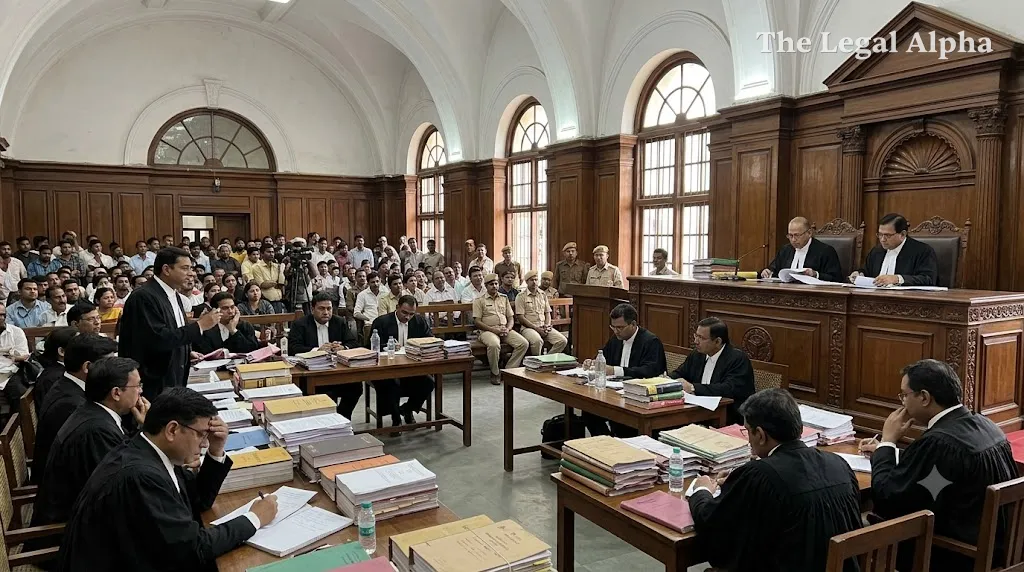
Daughter’s Right to Inherit Cannot Be Dismissed on Speculative Pleas of Limitation, Rules J&K and Ladakh High Court

The High Court of Jammu & Kashmir and Ladakh brought an end to a 44-year-old property dispute by restoring a woman's inheritance rights over her deceased father's ancestral land. Ruling on a second appeal, Justice Shahzad Azeem set aside a 2012 appellate court decision that had earlier rejected the daughter's lawsuit as time-barred and doubtful regarding parentage.
The litigation originated in September 1982 when the claimant, Mst. Themu, filed a suit claiming a half share in 58 kanals and 11 marlas of land in Machail village, Padder. Her father passed away around 1963, when she was merely six or seven years old. Years later, revenue mutation entries made during her minority excluded her and mutated the land exclusively in favour of another party. While the trial court initially upheld her share in 2004, the first appellate court dismissed her claim on technical grounds of limitation and questioned her paternity. Overturning that reversal, the High Court held that limitation periods cannot be calculated through guesswork and presumptions, especially when dealing with the legal entitlements of minors.
Legal Topic
Area of Law: Property Law / Civil Procedure
Sub-topic: Inheritance Rights, Minority Protection, and Law of Limitation
Core Legal Issue
The High Court addressed two interconnected questions of law:
-
Whether an adverse entry or contest raised during revenue mutation proceedings while an heir is a minor constitutes an unequivocal and immediate threat to title that triggers the statutory limitation clock.
-
Whether the first appellate court erred in computing the period of limitation and dismissing proof of legal relationship under Section 50 of the Evidence Act based on conjectures regarding age and the non-examination of the biological mother.
What Did the Court Decide?
Justice Shahzad Azeem allowed the Civil Second Appeal filed by the daughter and set aside the judgment and decree dated November 7, 2012, passed by the District Judge, Kishtwar.
The Court formally reinstated the original trial court decree dated March 9, 2004, which had recognized Themu's right to her half share in the suit property. The Bench held that the appellate court had erroneously assessed the date of accrual of the cause of action on pure conjecture without requiring the contesting respondents to prove precisely when an unequivocal denial of her right had taken place. The judgment conclusively disposed of the long-standing civil suits, ordering the parties to bear their own costs.
Key Legal Points
-
Protection of Minor Heirs: Courts are mandated to evaluate statutory protections available to minors against limitation under Section 6 of the Limitation Act before concluding that a suit for declaration of title is time-barred.
-
Limitation Requires an Unequivocal Threat: An entry or objection in mutation proceedings does not automatically amount to an open and hostile denial of title sufficient to trigger the limitation period against a co-heir.
-
No Speculation on Cause of Action: The defense of limitation cannot rest on assumptions; the burden lies on the contesting party to establish the specific date when the claimant’s title was clearly and unequivocally repudiated.
-
Proving Relationships under Section 50: Opinion and testimony regarding relationship under Section 50 of the Evidence Act are not limited to blood relations; community members or neighbors possessing special knowledge through long familiarity are competent witnesses.
-
Non-Examination of Mother Not Fatal: Where contemporaneous revenue documents and independent witnesses reliably substantiate parentage, the failure to examine the mother alone cannot defeat a lawful inheritance claim.
Relevant Law
-
Section 6 of the Limitation Act, 1963: Extends limitation periods in cases where a person entitled to institute a suit is a minor at the time the right accrues.
-
Section 50 of the Indian Evidence Act, 1872: Pertains to the relevance of opinions and conduct expressing existence of a family relationship by persons having special means of knowledge.
-
Section 100 of the Code of Civil Procedure, 1908 (CPC): Governs the High Court's jurisdiction to determine substantial questions of law in second appeals.
Arguments of the Parties
Appellant (Daughter)
Counsel for the appellant argued that the first appellate court disregarded substantial oral and documentary records that firmly demonstrated her relationship with her deceased father. It was submitted that the lower court had misapplied Section 50 of the Evidence Act by discounting reliable local testimony and wrongly penalized the plaintiff for her mother’s non-examination. Crucially, the appellant maintained that the appellate court completely ignored her minority at the time of the initial mutation and failed to apply the statutory protections outlined under Section 6 of the Limitation Act.
Respondents
Counsel appearing for the contesting respondents supported the judgment of the District Judge, Kishtwar. They contended that the suit, filed decades after the initial mutation of 1966, was barred by time. It was further urged that the claimant had not satisfactorily established her paternity through direct maternal evidence, rendering the first appellate court's dismissal of the suit sound and appropriate.
Why Does It Matter?
This ruling underscores a fundamental safeguard for women and disadvantaged heirs in property disputes. Inheritance battles in rural areas frequently extend over decades, and female co-heirs are often bypassed in revenue mutation records while still minors.
By clarifying that mutation entries do not automatically generate a clear denial of title and that limitation cannot be based on loose conjectures regarding age, the High Court prevents adversaries from weaponizing procedural delays against rightful heirs. The decision also provides valuable guidance on family lineage evidence, reinforcing that neighborhood witnesses with direct personal knowledge are fully competent to prove kinship.
Legal Takeaway
A daughter's lawful claim to her parents' estate cannot be extinguished by mechanical application of limitation laws, especially when the cause of action arose during her minority. Contesting parties must demonstrate a clear and unequivocal denial of title, and courts cannot substitute conjectural timelines for concrete proof.
Sources
-
Primary Source: High Court of Jammu & Kashmir and Ladakh, Civil Second Appeal judgment in Mst. Themu v. Shib Devi & Ors. (Pronounced on October 23, 2026, by Justice Shahzad Azeem).
-
Additional Sources: Certified records from Sub Judge, Kishtwar (Decree dated March 9, 2004) and District Judge, Kishtwar (Judgment dated November 7, 2012).