CUSAT Staff Suspension Dispute: Kerala High Court’s Reconsideration Order Faces Compliance Questions
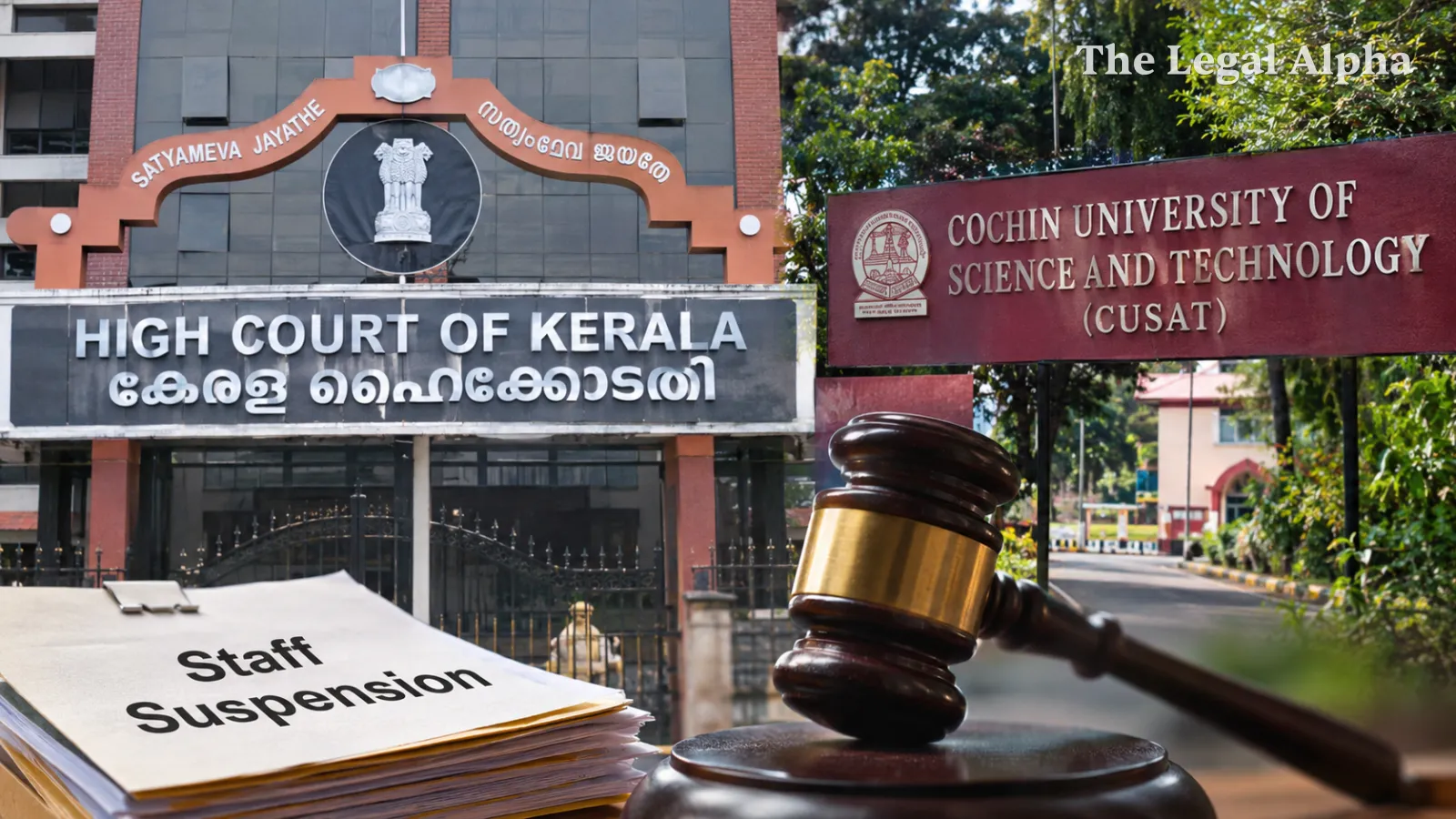
The Cochin University of Science and Technology (CUSAT) is facing allegations from the Cochin University Employees Association (CUEA) that its Syndicate failed to properly implement a Kerala High Court direction concerning the suspension of four university employees.
The controversy centres on the university's decision to keep the employees under suspension following allegations of irregularities and possible misappropriation in the recruitment process for sweeper-cum-cleaner posts.
The association claims that the Syndicate did not independently reconsider whether the employees' continued suspension was justified, despite the High Court's November 16, 2026 order directing it to review the matter.
Legal Topic
Area of Law: Administrative Law and Service Law
Sub-topic: Suspension of University Employees, Judicial Directions and Disciplinary Proceedings
Core Legal Issue
The central legal question is whether a university's Syndicate can be considered to have complied with a judicial direction to reconsider an employee's suspension merely by relying on an earlier administrative decision, without undertaking the specific review required by the court.
The dispute also raises questions about the responsibility of public university authorities to follow judicial directions in substance and not merely through formal or procedural resolutions.
What Did the Court / Authority Decide?
In its order dated November 16, 2026, Justice P. Gopinath of the Kerala High Court directed the CUSAT Syndicate to reconsider the suspension of four employees.
The court indicated that if the employees submitted representations seeking reconsideration by November 18, the Syndicate meeting scheduled for November 21 would have to examine the matter and decide whether sufficient grounds existed to continue their suspension.
The association alleges that the Syndicate failed to undertake this specific exercise. According to CUEA, the university instead relied on its November 13 decision to appoint a retired judge as an inquiry commission and presented that decision as though it were a fresh resolution adopted on November 21.
The association has questioned whether this approach satisfies the High Court's direction.
Important distinction: The reported allegations of non-compliance have been made by the employees' association. They should not be treated as a judicial finding that the Syndicate violated the court's order.
Key Legal Points
-
Judicial directions must be meaningfully implemented: Administrative authorities are expected to address the specific exercise directed by the court.
-
Suspension requires justification: The continued suspension of employees was required to be reconsidered by the Syndicate.
-
Independent consideration is important: An earlier administrative resolution may not, by itself, establish that a fresh review has taken place.
-
Disciplinary proceedings remain relevant: The allegations concerning recruitment irregularities are part of the background to the suspension.
-
Judicial scrutiny continues: The High Court is examining the employees' challenge to their suspension and the developments following its interim direction.
Relevant Law
The reported development primarily concerns judicial oversight of administrative decisions and the exercise of disciplinary powers by a public university.
The relevant legal framework includes:
-
The Kerala High Court's interim order dated November 16, 2026.
-
The university's disciplinary and administrative procedures governing employee suspension.
-
Principles of administrative fairness, reasoned decision-making and compliance with judicial directions.
The available reports do not identify a specific statutory provision as the basis of the November 16 direction. Accordingly, no unverified statutory section is attributed to the court.
Arguments of the Parties
Employees' Association
The Cochin University Employees Association has alleged that the Syndicate failed to conduct the review required by the High Court.
It contends that the university relied on its November 13 decision to appoint a retired judge as an inquiry commission instead of independently examining whether the four employees should remain suspended.
The association has demanded compliance with the court's direction, revocation of the suspension orders and reinstatement of the employees.
University / Syndicate
The available reports do not provide a detailed response from CUSAT or its Syndicate to the association's allegations.
The university's decision to appoint a retired judge as an inquiry commission has been reported, but its justification for treating that decision as sufficient compliance with the High Court's direction has not been independently established.
Why Does It Matter?
The dispute highlights the importance of judicial oversight over administrative decisions taken by public educational institutions.
Suspension is an administrative measure that can have significant consequences for an employee's professional life and reputation. Although universities may exercise disciplinary powers to investigate alleged misconduct, the continuation of suspension must be considered in accordance with applicable rules and judicial directions.
The controversy also raises an important institutional question: whether public authorities can satisfy a judicial direction through a formal resolution without actually addressing the issue that the court required them to reconsider.
For universities and other public institutions, the development reinforces the importance of maintaining proper records, independently examining representations and ensuring that administrative decisions reflect genuine compliance with court orders.
The employees' association has also continued its agitation, which has reportedly entered its 46th day, making the dispute relevant to the functioning of the university and the interests of students and staff.
Legal Takeaway
A judicial direction to reconsider an employee's suspension requires the concerned authority to genuinely examine whether its continuation is justified. Merely relying on an earlier administrative decision may invite questions about compliance if the specific review directed by the court has not been undertaken.
The final legal position on the alleged non-compliance will depend on the High Court's consideration of the Syndicate's actions and the pending proceedings.
Sources
Primary Source:
- Kerala High Court interim order dated November 16, 2026 — full text not independently available in the sources reviewed.
Additional Sources: