Chhattisgarh High Court Rules Unregistered Relinquishment Deed Cannot Transfer Title: Quashes Revenue Mutation Based on Unregistered Hak-Tyag Patra
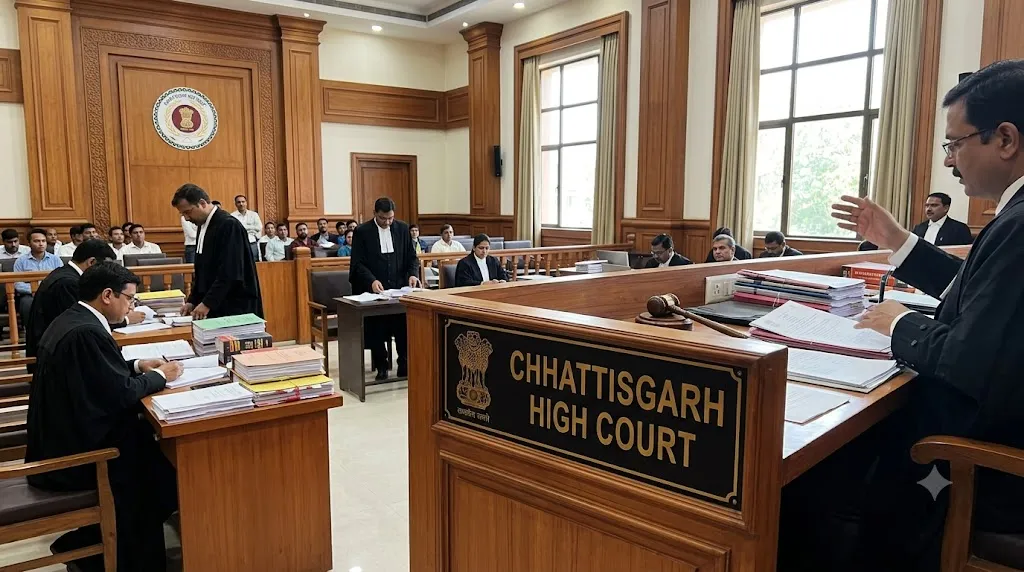
Court: High Court of Chhattisgarh at Bilaspur
Bench: Justice Ravindra Kumar Agrawal
Case Record: WP227 No. 1248 of 2026 | Citation: 2026 Supreme(Online)(Chh) 29775
Date of Pronouncement: September/October 2026 | Reported: October 03-05, 2026 (LiveLaw ID: 552925)
The litigation arises from ancestral agricultural and residential lands situated in Village Arang, Tahsil Arang, District Raipur, Chhattisgarh. The petitioners—93-year-old patriarch Narayan Soni and his sons Ramkumar Soni, Ramadhar Soni, and Rajesh Soni—claimed that one Buchi Bai (a family member and co-sharer in the property) had executed an unregistered document styled as a 'relinquishment deed' / 'Hak-Tyag Patra' in their favour. By virtue of this unregistered instrument, Buchi Bai purportedly relinquished and surrendered all her rights, title, and share in the ancestral land in the presence of two attesting witnesses.
Armed with this unregistered relinquishment deed, the petitioners approached the local Tahsildar, who proceeded to pass a revenue mutation order recording the petitioners as exclusive owners and deleting the name of Buchi Bai. Years later, the private respondents—Kumari Nirmala Soni, Gitadevi, Pushpadevi, and other legal heirs and co-sharers—discovered the mutation and challenged the Tahsildar’s order before the Sub-Divisional Officer (SDO) (Revenue), Raipur. The respondents contended that an unregistered relinquishment deed transferring immovable property valued well above ₹100 is a complete legal nullity under Section 17 of the Registration Act, 1908 and could not transfer title or form the basis of a valid revenue mutation.
The SDO (Revenue) condoned the delay in filing the appeal (an order later affirmed by the Board of Revenue in 2004) and set aside the mutation order. Aggrieved, the petitioners filed a revision before the Additional Commissioner, Raipur Division. The Additional Commissioner erroneously allowed the revision and restored the mutation, reasoning that a long period of time had elapsed and that the deed bore the signatures of two attesting witnesses. The respondents appealed to the Board of Revenue, Chhattisgarh. The Board of Revenue reversed the Additional Commissioner’s order and reinstated the SDO’s order, holding that under Section 17 of the Registration Act and the Transfer of Property Act, title to immovable property cannot transfer without registration. Challenging the Board of Revenue’s decision, Narayan Soni and his sons filed a supervisory writ petition under Article 227 of the Constitution (WP227 No. 1248 of 2026) before the High Court of Chhattisgarh at Bilaspur.
Legal Topic
Property Law & Revenue Jurisprudence – Section 17(1)(b) & Section 49 of the Registration Act, 1908; Sections 54, 59, 118, and 123 of the Transfer of Property Act, 1882; Chhattisgarh Land Revenue Code, 1959; Mandatory Registration of Relinquishment Deeds (Hak-Tyag Patra) Extinguishing Title in Immovable Property; Inoperability of Unregistered Deeds to Transfer Title or Sustain Revenue Mutations; Supervisory Powers under Article 227 of the Constitution.
Core Legal Issue
Whether an unregistered relinquishment deed (Hak-Tyag Patra) executed in the presence of two attesting witnesses can legally transfer title to immovable property valued over ₹100, and whether revenue authorities can effect mutation of land records on the basis of such an unregistered instrument.
What Did the Court / Authority Decide?
The High Court of Chhattisgarh at Bilaspur, through a Single Judge Bench comprising Justice Ravindra Kumar Agrawal, dismissed the writ petition (WP227 No. 1248 of 2026, Citation: 2026 Supreme(Online)(Chh) 29775), affirming the order of the Board of Revenue and holding that an unregistered relinquishment deed is legally incapable of transferring title.
Justice Ravindra Kumar Agrawal held that under Section 17(1)(b) of the Registration Act, 1908, any instrument that purports to operate to create, declare, assign, limit, or extinguish any right, title, or interest in immovable property valued at more than ₹100 must be compulsorily registered. The Court ruled that the presence of attesting witnesses or the lapse of decades cannot cure the fatal absence of statutory registration. Justice Agrawal observed: "...even after the long lapse of time, the requirement of law is that the relinquishment deed should be registered, as the title has been transferred by the said deed, and without there being any registered relinquishment deed, the title could not be transferred even if it was executed in the presence of two witnesses. Therefore, in the absence of any registered relinquishment deed, the Additional Commissioner, Raipur, ought not to have allowed the revision filed by the petitioners..." The High Court affirmed that revenue mutations do not create title and cannot be sustained on void unregistered instruments, dismissing the petition while leaving the petitioners at liberty to pursue appropriate substantive remedies before a civil court.
Key Legal Points
- Mandatory Registration of Relinquishment Deeds: Justice Ravindra Kumar Agrawal reaffirmed that a relinquishment deed by which a co-sharer gives up or extinguishes their right, title, and interest in immovable property falls squarely under Section 17(1)(b) of the Registration Act, 1908. Registration is a mandatory statutory condition precedent.
- Attesting Witnesses Cannot Cure Lack of Registration: The High Court held that the execution of a relinquishment deed in the presence of two or more attesting witnesses has zero legal consequence in overcoming the bar of non-registration. Attestation proves execution, but only registration confers validity and transfers title.
- Statutory Bar under Section 49 of the Registration Act: Under Section 49, an unregistered document that requires compulsory registration cannot affect any immovable property comprised therein or be received as evidence of any transaction affecting such property.
- Lapse of Time Cannot Validate a Void Document: The Court made it clear that passage of time or long-standing revenue entries cannot breathe legal life into an instrument that was void ab initio for want of registration.
- Revenue Mutation Follows Title, Not Vice Versa: The judgment reiterates the foundational principle that mutation in revenue records is solely for fiscal purposes (collection of land revenue) and does not confer, extinguish, or create title. Revenue officers possess no jurisdiction to mutate lands based on unregistered title documents.
Relevant Law
- Section 17(1)(b), Registration Act, 1908: Mandates compulsory registration for non-testamentary instruments which purport or operate to create, declare, assign, limit or extinguish any right, title or interest of the value of one hundred rupees and upwards to or in immovable property.
- Section 49, Registration Act, 1908: Provides that no document required by Section 17 to be registered shall affect any immovable property or be received as evidence of any transaction affecting such property unless it has been registered.
- Sections 54, 59, 118 & 123, Transfer of Property Act, 1882: Governs the transfer of immovable property by sale, mortgage, exchange, and gift, establishing that title can pass only through registered instruments.
- Section 109 & 110, Chhattisgarh Land Revenue Code, 1959: Governs the acquisition of rights and mutation of land records by revenue authorities.
- Yellapu Uma Maheswari v. Buddha Jagadheeswararao (2015) 16 SCC 787: Supreme Court precedent establishing that relinquishment of an interest in immovable property valued over ₹100 requires compulsory registration, failing which it cannot be admitted to prove title.
Arguments of the Parties
- Contentions of the Petitioners (Narayan Soni & Ors.):
- Represented by Advocate Alok Bakshi, the petitioners submitted that Buchi Bai had voluntarily executed the Hak-Tyag Patra (relinquishment deed) in the presence of two reputable village witnesses, completely surrendering her rights in the ancestral lands.
- Counsel argued that the transaction was acted upon for decades, that the petitioners had remained in uninterrupted possession, and that the Tahsildar had rightly mutated their names in the revenue records.
- It was contended that the Additional Commissioner, Raipur, correctly recognized the long lapse of time and attestation by witnesses, and that the Board of Revenue committed an error of jurisdiction by unsettling decades-old revenue entries.
- Contentions of the Respondents (Kumari Nirmala Soni & Ors.):
- Appearing through learned counsel, the respondents argued that the purported relinquishment deed was an unregistered, unstamped private paper that could never extinguish Buchi Bai’s legal share in the family properties.
- Counsel submitted that under Section 17 and Section 49 of the Registration Act, an unregistered document is legally inadmissible to prove transfer of title.
- It was emphasized that revenue authorities have no power to adjudicate title or mutate records on the basis of a document that is void in the eyes of law, and that the Board of Revenue rightly restored the SDO’s order.
Why Does It Matter?
Across rural and semi-urban India, family property disputes frequently revolve around informal, unregistered documents known variously as Hak-Tyag Patra, Razinama, Batwara Patra, or Samjhauta Patra. Family members often execute these documents on plain paper or notarized stamp papers in the presence of local panchayat witnesses, mistakenly assuming that witness signatures substitute for statutory registration. Local revenue officers routinely compound the problem by mutating land records on the basis of these informal papers, disinheriting female heirs and co-sharers.
This judgment by the Chhattisgarh High Court delivers an essential, uncompromising reaffirmation of property law. By declaring that neither the presence of witnesses nor decades of unchallenged revenue entries can validate an unregistered relinquishment deed, Justice Ravindra Kumar Agrawal safeguards the integrity of public land records. The ruling protects vulnerable co-sharers—especially daughters and widows—from being stripped of their statutory inheritance through unverified, unregistered family papers, reminding citizens and revenue officials that the law of registration cannot be bypassed by informal customs.
Legal Takeaway
A relinquishment deed (Hak-Tyag Patra) that transfers, assigns, or extinguishes right, title, or interest in immovable property valued at more than ₹100 is legally void and inoperative unless compulsorily registered under Section 17 of the Registration Act, 1908. The presence of attesting witnesses or the lapse of decades cannot cure the absence of registration, and revenue authorities have no jurisdiction to order mutation of land records on the basis of an unregistered relinquishment deed.
Sources (Primary & Additional)
- Primary Judicial Order: High Court of Chhattisgarh at Bilaspur, Narayan Soni & Ors. v. Kumari Nirmala Soni & Ors. [WP227 No. 1248 of 2026, Decided in September/October 2026], per Justice Ravindra Kumar Agrawal. Chhattisgarh High Court Judgment PDF Repository / LiveLaw PDF Upload.
- Authoritative Legal Reporting (LiveLaw): Saksham Vaishya, \"Unregistered Relinquishment Deed Cannot Transfer Title: Chhattisgarh High Court Dismisses Challenge To Revenue Board Order\" (Article ID: 552925, Published on October 03, 2026). LiveLaw Article.
- Judicial Decision Profile (SupremeToday): Legal Analytics Desk, \"Narayan Soni v. Kumari Nirmala Soni: Unregistered Relinquishment Deed Cannot Transfer Title\" (Citation: 2026 Supreme(Online)(Chh) 29775, Published on October 05, 2026). SupremeToday Case Profile.