Allahabad High Court Upholds Rejection of L&T's Bid for Jewar Link Expressway: Subsequent Abeyance of Debarment Cannot Retrospectively Cure Ineligibility on Bid Due Date
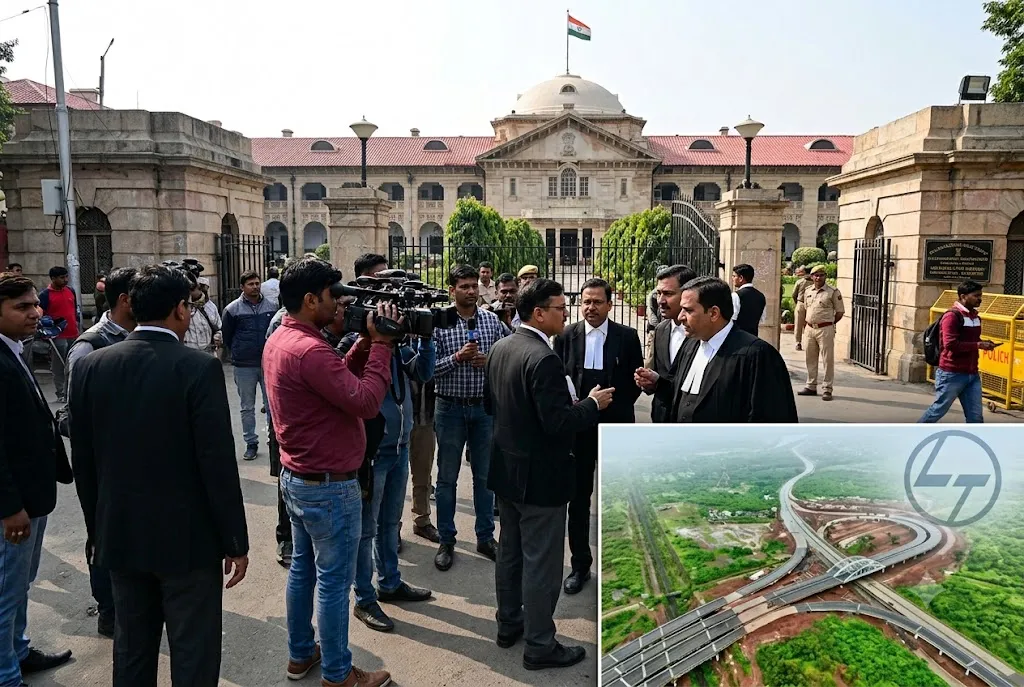
Court: High Court of Judicature at Allahabad (Lucknow Bench)
Case Record: WRIT - C No. 10822 of 2026
Date of Pronouncement: September/October 2026 | Reported: October 03-05, 2026 (LiveLaw ID: 552934)
On June 22, 2026, the Uttar Pradesh Expressways Industrial Development Authority (UPEIDA) floated an e-tender notice inviting bids on an EPC (Engineering, Procurement, and Construction) basis for the development of the Jewar Airport to Ganga Expressway via Bulandshahar Link Expressway (Package-I), spanning from Bhaipur Brahman (Gautam Buddha Nagar) to Bichaula (Bulandshahar). Pursuant to a subsequent corrigendum, the 'Bid Due Date' was formally fixed as September 7, 2026, and technical bids were scheduled for opening on September 8, 2026.
Engineering conglomerate Larsen & Toubro Limited (L&T) submitted its technical bid on the Bid Due Date. Crucially, Clause 2.1.18 of the Request for Proposal (RFP) specifically stipulated that any entity barred or debarred by the Central Government, a State Government, or any entity controlled by them from participating in any project, where the bar subsists as on the Bid Due Date, 'would not be eligible to submit the bid.' On September 7, 2026, a debarment order issued against L&T by the Jal Jeevan Mission, U.P. (State Water and Sanitation Mission) was actively in force. However, L&T failed to disclose this subsisting debarment in its bid documents, furnishing only a standard declaration regarding the absence of catastrophic structural failures in the preceding five years.
During technical evaluation, UPEIDA discovered the subsisting debarment in the public domain and issued a clarification notice to L&T on September 18, 2026. In response, L&T revealed that by a subsequent order dated September 14, 2026—a week after the Bid Due Date—the Jal Jeevan Mission had kept its debarment order in abeyance. L&T also disclosed another debarment order from Madhya Pradesh dated August 13, 2026, which was under challenge before the High Court of Madhya Pradesh. On September 25, 2026, UPEIDA’s Technical Evaluation Committee rejected L&T’s technical bid as 'non-responsive' on the ground that it was debarred by the Jal Jeevan Mission on the Bid Due Date. Aggrieved, L&T filed a writ petition under Article 226 before the High Court of Judicature at Allahabad (Lucknow Bench) [WRIT - C No. 10822 of 2026], seeking to quash the disqualification and compel the opening of its financial bid.
Legal Topic
Public Procurement & Government Contracts – Clause 2.1.18 of the Request for Proposal (RFP); Essential Eligibility Conditions vs. Curable Technical Lapses; Doctrine of Prospective Operation of Stays/Abeyance Orders (Shree Chamundi Mopeds Rule); Principle of Strict Compliance with Cut-off Dates in Public Tenders; Level Playing Field and Non-Discrimination under Article 14 of the Constitution; Judicial Restraint in Commercial Contracts under Article 226.
Core Legal Issue
Whether an administrative or judicial order keeping a governmental debarment in abeyance, passed after the bid due date, operates retrospectively to cure a bidder's threshold ineligibility on the bid due date, and whether a tendering authority or writ court can relax an essential eligibility condition on grounds of financial competitiveness.
What Did the Court / Authority Decide?
A Division Bench of the High Court of Judicature at Allahabad (Lucknow Bench) dismissed L&T's writ petition (WRIT - C No. 10822 of 2026), upholding UPEIDA's rejection of L&T's technical bid for the Jewar Link Expressway.
The High Court held that Clause 2.1.18 of the RFP is an essential, mandatory threshold eligibility condition that must be strictly satisfied on the Bid Due Date (September 7, 2026). Relying on the Supreme Court's landmark ruling in Shree Chamundi Mopeds Ltd. v. Church of South India Trust Association (1992) 3 SCC 1, the Court ruled that an order keeping a debarment in abeyance operates purely prospectively from the date it is made. Suspending an order does not wipe it out or render it non-existent for the prior period, and therefore the abeyance letter of September 14, 2026 could not relate back to erase L&T's ineligibility on September 7, 2026. The Court firmly rejected L&T's plea that its financial quote was more competitive, holding that price advantages are irrelevant when a bidder fails to cross the threshold eligibility gate. Furthermore, the Bench held that permitting an ineligible bidder to cure its status post-deadline would violate Article 14 by discriminating against prospective bidders who complied with the terms and refrained from bidding due to subsisting debarments.
Key Legal Points
- Eligibility Strictly Tested as on Bid Due Date: The Division Bench held that a bidder's eligibility must be determined strictly by the conditions existing on the cut-off date fixed in the tender. Bidders cannot rely on subsequent developments or post-deadline orders to alter their status.
- Stay or Abeyance Operates Prospectively Only: Applying Shree Chamundi Mopeds, the Court established that keeping a debarment order in abeyance merely stays its future enforcement; it does not obliterate the factum of debarment on past dates. The abeyance cannot retrospectively sanitize a bid that was void for ineligibility at the time of submission.
- Essential Conditions Cannot Be Waived or Cured: Citing Supreme Court precedents in Central Coalfields Ltd. and Bhatia International, the Bench held that essential eligibility conditions are sacrosanct. Neither the tendering authority nor the High Court under Article 226 possesses the jurisdiction to waive essential criteria or treat threshold ineligibility as a minor curable defect like an unsigned sheet.
- Price Competitiveness Does Not Override Eligibility: The Court established that financial bids are evaluated only for participants who successfully clear technical eligibility. A lower quote submitted by an ineligible bidder creates no legal right to demand consideration, and courts cannot compromise procurement integrity in the name of cost savings.
- Protection of the Level Playing Field: The Bench emphasized that diluting tender conditions post-submission severely prejudices all other entities who honestly assessed their ineligibility on the due date and abstained from bidding, which would introduce arbitrariness into public procurement.
Relevant Law
- Clause 2.1.18 & Clause 2.2.10, Request for Proposal (RFP), UPEIDA: Prohibits entities subject to governmental debarment on the Bid Due Date from participating in the tender.
- Article 14 & Article 19(1)(g), Constitution of India: Mandates fairness, equality of opportunity, and transparency in state action and public tenders.
- Article 226, Constitution of India: Limits judicial review in government contracts to assessing arbitrariness, mala fides, bias, or procedural illegality, preventing courts from sitting as appellate authorities over employer decisions.
- Shree Chamundi Mopeds Ltd. v. Church of South India Trust Association (1992) 3 SCC 1: Lays down the foundational distinction between quashing an order (which wipes it out ab initio) and staying/suspending an order (which operates only prospectively).
- Afcons Infrastructure Ltd. v. Nagpur Metro Rail Corporation Ltd. (2016) 16 SCC 818: Affirms that the author of a tender document is the best judge of its requirements, and courts must defer to the employer's reasonable interpretation.
- Tata Motors Ltd. v. BEST Undertaking (2023) 19 SCC 1: Reaffirms that High Courts must exercise extreme restraint in mega infrastructure tenders unless a clear-cut case of irrationality or bias is established.
Arguments of the Parties
- Contentions of the Petitioner (Larsen & Toubro Limited):
- Represented by Senior Advocate Mukul Rohatgi, L&T submitted that it is India’s foremost infrastructure major with proven technical capacity across high-speed rail, expressways, and mega projects.
- Counsel argued that the Jal Jeevan Mission debarment order was formally kept in abeyance on September 14, 2026, well before the Technical Evaluation Committee finalized its evaluation on September 25, 2026.
- It was contended that Clause 1.2.2 kept the bid valid and operative, and the evaluation committee was bound to consider the factual reality existing at the time of evaluation rather than hyper-technically freezing time on September 7, 2026.
- L&T argued that the defect was curable, that it was denied an opportunity to clarify given to other bidders, and that its commercial quote offered immense financial savings to the public exchequer.
- Contentions of the Respondents (UPEIDA & State of U.P.):
- Represented by learned Senior Counsel and standing counsel, UPEIDA argued that Clause 2.1.18 is a mandatory, non-negotiable threshold condition testing eligibility on the Bid Due Date.
- It was submitted that on September 7, 2026, L&T was indisputably under active debarment by a State agency and deliberately concealed that fact in its bid submission until confronted.
- Counsel emphasized that an order keeping a debarment in abeyance operates purely prospectively and cannot retrospectively cure ineligibility under the doctrine of Shree Chamundi Mopeds.
- UPEIDA pointed out that allowing L&T to participate would violate Article 14 and destroy the level playing field against other potential bidders who obeyed the RFP and chose not to bid due to subsisting bars.
Why Does It Matter?
This judgment addresses a recurring high-stakes maneuver in public procurement: large infrastructure corporations that face governmental blacklisting or debarment rush to obtain stay orders, abeyance letters, or political review meetings after tender submission deadlines, claiming that their subsequent reprieve entitles them to participate. If public authorities and courts allowed bidders to retroactively cure ineligibility through subsequent orders, tender cut-off dates would lose all legal certainty, inviting endless litigation and corrupt manipulations.
The Allahabad High Court’s ruling firmly closes this backdoor. By enforcing the strict cut-off rule and applying the prospective operation doctrine to abeyance orders, the Division Bench upholds commercial discipline and absolute equality of opportunity. It sends an unmistakable message to corporate conglomerates and public authorities alike: integrity, full disclosure, and strict adherence to tender deadlines cannot be bypassed, and not even the promise of a lower price quote can override the foundational Rule of Law in public contracting.
Legal Takeaway
In public tenders, eligibility must be strictly assessed as on the Bid Due Date. An administrative or judicial order keeping a governmental debarment in abeyance operates prospectively from the date of its issuance and cannot relate back to make an ineligible bidder eligible on the bid due date. Essential eligibility clauses cannot be waived, and a lower financial quote by an ineligible bidder confers no right to demand consideration.
Sources (Primary & Additional)
- Primary Judicial Order: High Court of Judicature at Allahabad (Lucknow Bench), Larsen & Toubro Limited v. State of U.P. and Others (UPEIDA) [WRIT - C No. 10822 of 2026, Decided in September/October 2026]. Allahabad High Court Judgment PDF Repository / LiveLaw PDF Upload.
- Authoritative Legal Reporting (LiveLaw): Upasna Agrawal, \"Subsequent Abeyance Of Debarment Can't Retrospectively Make Bidder Eligible On Bid Due Date: Allahabad High Court\" (Article ID: 552934, Published on October 03, 2026). LiveLaw Article.
- Infrastructure Procurement Analysis (Law Trend): Law Trend Editorial Desk, \"Subsequent Abeyance of Debarment Does Not Cure Ineligibility Existing on Bid Due Date: Allahabad High Court Upholds Rejection of L&T's Bid for Jewar Link Expressway\" (Published on October 04, 2026). Law Trend Analysis.
- Comparative Procurement Jurisprudence (SupremeToday): Legal Bureau, \"Can Subsequent Abeyance of Debarment Make Bidder Eligible? Allahabad HC Says No for L&T\" (Published on October 05, 2026). SupremeToday Legal Analysis.