Calcutta High Court Directs St. Xavier's University to Clear Law Student Despite Attendance Shortage: Delay in Medical Certificate Not Fatal to Genuine Illness
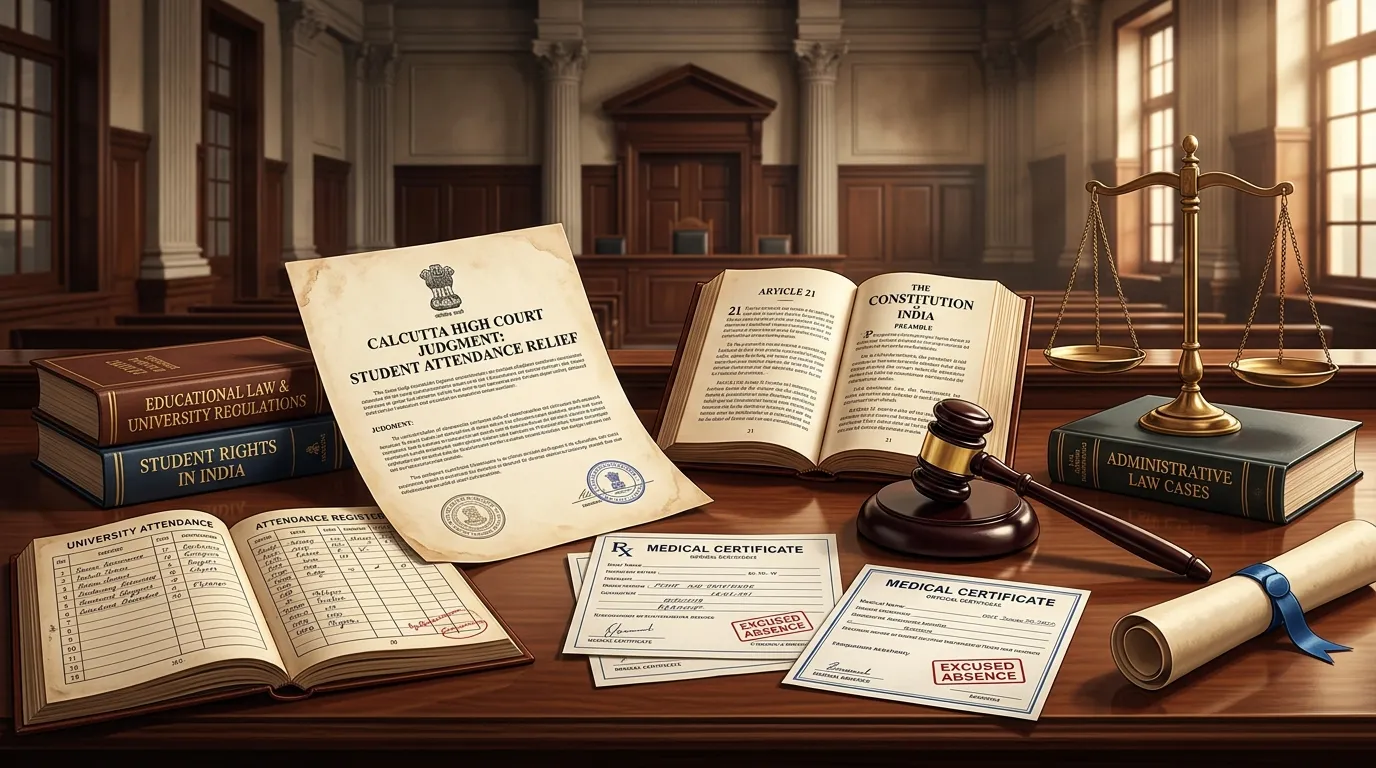
Court: High Court at Calcutta
Bench: Justice Jay Sengupta
Case Record: WPA No. 16324 of 2024
Date of Pronouncement: September 29, 2026 | Reported: October 06-07, 2026 (LiveLaw ID: 553279)
The petitioner, Rhine Ghosh, was enrolled in the integrated five-year B.Com LL.B. (Hons.) degree programme at St. Xavier's University, Kolkata. During the course of her academic semester, she contracted chickenpox (varicella), an acute, highly infectious viral disease. On February 6, 2024, a registered medical practitioner examined her, confirmed the infection, and issued an official medical certificate advising strict home isolation for a period of 14 days to prevent public contagion on campus and facilitate clinical recovery.
In accordance with medical advice and basic campus hygiene, the student isolated herself during her sickness. In addition, she had engaged in approved extracurricular commitments, including part-time acting assignments. However, under Regulation 3.4.2(a) of the St. Xavier's University Regulations, any student seeking condonation of absence on medical grounds is required to apply within three days of falling ill and submit a medical fitness certificate within 15 days of resuming classes. Due to administrative inadvertence and academic pressure, Rhine Ghosh submitted her medical certificate dated February 6, 2024 only on May 9, 2024—the very day admit cards for the end-semester examinations were being issued.
St. Xavier's University took an unbending, hyper-technical stance, rejecting the medical certificate solely on the ground of limitation under its internal regulations. Consequently, the University refused to adjust her attendance, declared her attendance deficient, withheld her semester examination results, debarred her from clearing the semester, and blocked her from moving forward into subsequent semesters. Aggrieved by the University's punitive action that threatened to derail her legal education and career, Rhine Ghosh approached the High Court at Calcutta by filing a writ petition under Article 226 of the Constitution (WPA No. 16324 of 2024).
Legal Topic
Education Law & Administrative Jurisprudence – Article 14 and Article 21 of the Constitution of India; Condonation of Attendance Shortage on Medical Grounds; Strict vs. Directory Interpretation of University Administrative Deadlines; Evidentiary Sanctity of Independent Medical Certificates; Balancing Institutional Discipline with Fundamental Fairness in Academic Institutions; Judicial Review of Discretionary Powers of Private and State Universities.
Core Legal Issue
Whether an academic institution can mechanically reject a student's genuine claim of illness and debar them from clearing a semester due to a procedural delay in submitting a medical certificate, and whether mandatory home isolation for a contagious illness warrants equitable attendance adjustment.
What Did the Court / Authority Decide?
The High Court at Calcutta, through a Single Judge Bench comprising Justice Jay Sengupta, allowed the writ petition (WPA No. 16324 of 2024), issuing mandatory directions against St. Xavier's University to grant full academic relief to the law student.
Justice Jay Sengupta held that procedural delay in submitting a medical certificate cannot be treated as fatal where the student has genuinely suffered from an incapacitating illness. The Court underscored that a medical certificate issued by an independent, registered medical practitioner carries presumptive sanctity and cannot be brushed aside on hyper-technicalities. Highlighting public health realities, Justice Sengupta observed: "If she had complied with such direction [isolation for chickenpox], it was not only beneficial to her health, but also good for the students and the teachers." The High Court ruled that the university authorities erred grievously in shutting their eyes to substantive medical realities. Consequently, the Court directed St. Xavier's University not to debar Rhine Ghosh from clearing the semester or advancing to the next semester, ordered the immediate evaluation and publication of all her withheld examination results, and directed that upon course completion, all degrees, mark sheets, and certificates be awarded to her without delay. The High Court summarily rejected the University's oral prayer seeking a stay on the operation of the judgment.
Key Legal Points
- Procedural Timelines Cannot Defeat Genuine Medical Necessity: Justice Jay Sengupta laid down that administrative timelines for submitting medical certificates (such as the 15-day rule) are directory and procedural, not mandatory traps that extinguish a student's genuine right to medical relief.
- Presumptive Sanctity of Independent Medical Evidence: The Court held that a certificate issued by an independent medical professional has inherent credibility and evidentiary value, which university administrations cannot arbitrarily disregard without forensic rebuttal.
- Public Health Compliance Deserves Institutional Protection: The Bench noted that following a doctor's advice for contagious disease isolation (such as chickenpox) protects the entire university community, including faculty and fellow students. Penalizing a student for protecting campus health is inherently contrary to justice and public policy.
- Extracurricular Pursuits Must Receive Fair Consideration: The High Court observed that modern universities must foster holistic student growth, and part-time acting assignments or creative pursuits should have been reasonably evaluated as extracurricular activities for attendance adjustments.
- Rejection of Unmerited Institutional Stays: Emphasizing that students' academic trajectories must not be held hostage to prolonged appellate ego, the High Court firmly rejected St. Xavier's University's oral plea for an interim stay on the judgment.
Relevant Law
- Article 14, Constitution of India: Prohibits arbitrary, irrational, and disproportionate administrative action by educational authorities, guaranteeing equal protection of the laws.
- Article 21, Constitution of India: Encompasses the right to education, professional livelihood, and human dignity, protecting students from unmerited academic deprivation.
- Regulation 3.4.2(a), St. Xavier's University Academic Regulations: Prescribes guidelines and timelines for condonation of student absences on medical grounds.
- Section 114, Indian Evidence Act, 1872 / Section 119, Bharatiya Sakshya Adhiniyam, 2023: Governs judicial presumptions regarding the regularity and bona fides of official and professional acts performed by qualified medical practitioners.
Arguments of the Parties
- Contentions of the Petitioner (Rhine Ghosh):
- Represented by Advocate Nilotpal Chatterjee assisted by Advocate Satyaki Banerjee, the petitioner submitted that her illness was acute, clinical, and uncontroverted, having contracted a highly contagious viral disease requiring 14 days of strict isolation.
- Counsel argued that debarring a meritorious law student from an entire semester solely because she submitted the medical certificate on the day of admit card issuance rather than within 15 days of recovery is grossly disproportionate, arbitrary, and violative of Article 14.
- It was pointed out that the University had exercised its discretionary powers of condonation inconsistently in other matters, creating an unequal and discriminatory regime.
- The petitioner prayed for directions to publish her results and allow her seamless academic progression without loss of academic years.
- Contentions of the Respondents (St. Xavier's University & Officials):
- Represented by Senior Advocate Partha Sarathi Sengupta along with a team of assisting advocates, the University vehemently opposed the writ petition, arguing that academic discipline and attendance regulations must be strictly enforced.
- Counsel submitted that Regulation 3.4.2(a) specifically requires medical intimations within three days and certificates within 15 days, which the petitioner failed to satisfy by submitting the document months later on May 9, 2024.
- The University highlighted discrepancies in digital attendance logs, claiming that the petitioner had marked attendance on certain days during the advised isolation window, thereby questioning the bona fides of the medical certificate.
- It was contended that High Courts exercising writ jurisdiction under Article 226 should not interfere with internal academic standards or substitute their judgment for university disciplinary decisions.
Why Does It Matter?
This ruling by the Calcutta High Court provides much-needed judicial protection to students across Indian universities and colleges who are routinely victimized by hyper-bureaucratic attendance regulations. While minimum attendance norms are essential to academic rigor, university administrations frequently transform procedural guidelines into punitive weapons, refusing to exercise equitable discretion even during severe medical emergencies, bereavement, or legitimate creative endeavors.
Justice Jay Sengupta’s judgment strikes a crucial blow against bureaucratic callousness in higher education. By ruling that procedural delays in furnishing medical paperwork cannot override genuine illnesses, the High Court reasserts that educational institutions exist to nurture students, not to derail their futures over paperwork deadlines. The decision establishes an authoritative precedent ensuring that compliance with public health precautions—such as isolating during contagious viral infections—is rewarded with institutional empathy rather than academic punishment.
Legal Takeaway
University attendance regulations governing the submission of medical certificates are procedural and directory in nature. When a student establishes genuine illness through an independent medical certificate, administrative delay in filing the paperwork cannot justify debarment from examinations or semesters. Educational authorities must prioritize substantive medical truth and public health over rigid bureaucratic deadlines.
Sources (Primary & Additional)
- Primary Judicial Order: High Court at Calcutta, Rhine Ghosh v. St. Xavier's University & Ors. (WPA No. 16324 of 2024, Decided on September 29, 2026), per Justice Jay Sengupta. Calcutta High Court Judgment PDF Repository.
- Authoritative Legal Reporting (LiveLaw): Srinjoy Das, \"Delay In Submitting Medical Certificate Not Grounds To Reject Genuine Illness Claim: Calcutta High Court Grants Relief To Law Student\" (Article ID: 553279, Published on October 06, 2026). LiveLaw Article.
- Comparative Legal Jurisprudence (LawChakra): LawChakra Editorial, \"Calcutta High Court: Delay In Medical Certificate Not Fatal, Student Entitled to Semester Relief\" (Published on October 07, 2026). LawChakra Analysis.