Gujarat High Court Refuses to Condone 7-Year Delay in Filing Civil Appeal: 'Non-Consensus Between Litigants & COVID-19 Cannot Justify Sheer Negligence'
Court: High Court of Gujarat at Ahmedabad
Bench: Justice Maulik J. Shelat
Case Record: R/Special Civil Application No. 14619 of 2025 | Citation: [2026 LiveLaw (Guj) 272]
Date of Pronouncement: October 01, 2026 | Reported: October 06, 2026 (LiveLaw ID: 553320)
The litigation traces back to a Regular Civil Suit contested between the petitioners—Vinodchandra Chandrakant Thaker and another co-plaintiff—and the respondent, Kiritkumar Parshottam Dhokai. In the year 2017, the competent Trial Court in Gujarat adjudicated the dispute on merits and pronounced a final judgment and decree dismissing the petitioners' civil claim. Under the law of civil procedure, the statutory period for filing a Regular Civil Appeal against the decree before the First Appellate Court was 30 to 90 days.
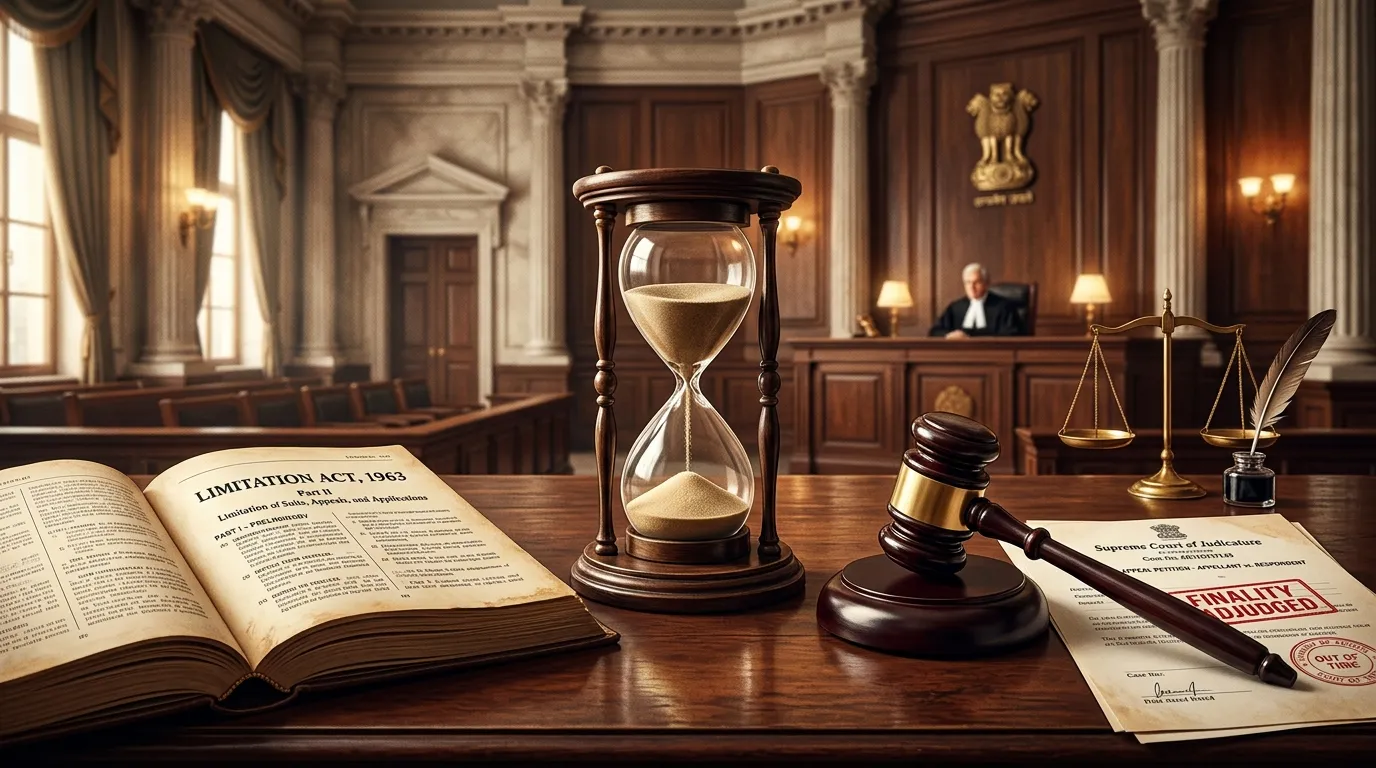
Remarkably, the petitioners sat completely tight over the judgment and decree for more than seven years. It was only in the year 2024 that the petitioners finally woke up and preferred a Regular Civil Appeal before the First Appellate Court, accompanied by an application under Section 5 of the Limitation Act, 1963, praying for the condonation of an enormous, inordinate delay of over 2,500 days (more than seven years). In their application, the petitioners advanced three main justifications: first, that there was a lack of consensus between the co-plaintiffs on whether to incur expenditure and prefer an appeal; second, that the son of Petitioner No. 2 tragically passed away on April 12, 2021; and third, that the COVID-19 pandemic and subsequent lockdown restrictions from March 2020 severely disrupted court functioning.
The First Appellate Court rejected the delay condonation application, observing that Petitioner No. 1 is himself an enrolled, practicing advocate who could easily have preferred the appeal alone by impleading the co-plaintiff as a proforma respondent, and held that internal disagreements cannot constitute sufficient cause. Aggrieved by the dismissal of their application, the petitioners approached the High Court of Gujarat at Ahmedabad by filing a supervisory writ petition under Article 227 of the Constitution (R/Special Civil Application No. 14619 of 2025).
Legal Topic
Civil Procedure & Law of Limitation – Section 5 of the Limitation Act, 1963 (Condonation of Delay and Interpretation of 'Sufficient Cause'); Order XLI Rules 1, 4 & 33 of the Code of Civil Procedure, 1908 (Powers of Single Plaintiff to Appeal Without Co-Plaintiffs); Doctrine of Finality of Litigation; Strict vs. Liberal Construction of Limitation Periods; Higher Standard of Diligence Expected from Practicing Advocates; Limits of COVID-19 Limitation Extensions.
Core Legal Issue
Whether a lack of consensus between joint plaintiffs, the death of a family member years after the expiry of the limitation period, or the subsequent outbreak of the COVID-19 pandemic can constitute 'sufficient cause' under Section 5 of the Limitation Act to condone an inordinate delay of over seven years in filing a civil appeal.
What Did the Court / Authority Decide?
The High Court of Gujarat, through a Single Judge Bench comprising Justice Maulik J. Shelat, dismissed the writ petition (Neutral Citation / Citation: [2026 LiveLaw (Guj) 272], R/SCA No. 14619 of 2025), upholding the First Appellate Court’s order and refusing to condone the seven-year delay.
Justice Maulik J. Shelat held that the petitioners failed to make out any plausible or sufficient cause to explain their seven-year slumber, finding that the delay was attributable entirely to 'sheer negligence.' The Court held that internal discord or lack of consensus between co-plaintiffs is a legally untenable excuse, particularly when Petitioner No. 1 is an advocate who possessed the legal knowledge to file an appeal independently. The High Court further held that events occurring years after the decree—such as the COVID-19 pandemic in 2020 or the tragic death of a family member in April 2021—cannot retroactively explain why no appeal was filed between 2017 and 2020. Emphasizing that the liberal approach under Section 5 cannot be converted into an instrument to destroy the statutory rights and finality accrued to successful litigants, the High Court declined to interfere with the appellate court's refusal to condone delay.
Key Legal Points
- Internal Non-Consensus is Not 'Sufficient Cause': Justice Maulik J. Shelat ruled that a lack of agreement among joint litigants regarding whether to file an appeal does not constitute a valid or sufficient cause under Section 5 of the Limitation Act. Any aggrieved party can appeal independently by joining others as proforma respondents.
- Higher Standard of Vigilance for Lawyer-Litigants: The Court underscored that since Petitioner No. 1 was an advocate, he had full professional awareness of procedural remedies and statutory limitation deadlines. His failure to act demonstrated deliberate indolence rather than innocent ignorance.
- Events Arising After Limitation Expiry Cannot Resurrect Dead Claims: The High Court clarified that the COVID-19 pandemic (2020) and a family bereavement (2021) occurred years after the 2017 decree had already attained finality. Subsequent external hardships cannot be invoked to explain pre-existing defaults.
- Balance of Justice Must Protect Decree-Holders: The Bench reiterated that the 'liberal approach' in condonation of delay cannot be stretched to extinguish the valuable rights that crystallize in favour of a decree-holder upon the expiry of limitation. Condoning a seven-year delay caused by pure neglect would subvert the legislative mandate of Parliament.
- Fanciful and Concocted Explanations Must Be Rejected: Citing established Supreme Court jurisprudence (Basawaraj, Esha Bhattacharjee, and Shivamma), the Court held that courts must remain vigilant against entertaining fanciful, concocted reasons designed to drag adversaries into vexatious, endless litigation.
Relevant Law
- Section 5, Limitation Act, 1963: Authorizes courts to admit an appeal or application after the expiration of the limitation period if the appellant satisfies the court that they had 'sufficient cause' for not preferring the appeal in time.
- Order XLI Rule 4, Code of Civil Procedure, 1908 (CPC): Permits one of several plaintiffs or defendants to appeal against the whole decree where the decree proceeds on any ground common to all.
- Article 227, Constitution of India: Confers supervisory jurisdiction on High Courts over all subordinate courts and tribunals, exercisable only to correct jurisdictional errors or perversity.
- Basawaraj & Anr. v. Special Land Acquisition Officer (2013) 14 SCC 81: Landmark Supreme Court ruling holding that 'sufficient cause' means an adequate and reasonable explanation for which the party could not be blamed; sheer negligence cannot be condoned.
- Esha Bhattacharjee v. Managing Committee of Raghunathpur Nafar Academy (2013) 12 SCC 649: Apex Court ruling laying down comprehensive guidelines governing applications for condonation of delay.
Arguments of the Parties
- Contentions of the Petitioners (Vinodchandra C. Thaker & Anr.):
- Appearing through Petitioner No. 1 in person, the petitioners submitted that the First Appellate Court adopted an excessively rigid and hyper-technical approach by dismissing the delay condonation application.
- Counsel argued that substantial justice must prevail over procedural technicalities, and courts should ordinarily adopt a liberal, justice-oriented approach to enable disputes to be resolved on merits.
- It was submitted that genuine personal hardships—including acute disagreements among the plaintiffs, the tragic demise of Petitioner No. 2's son on April 12, 2021, and the unprecedented national disruption caused by the COVID-19 pandemic—prevented them from approaching the appellate forum earlier.
- Contentions of the Respondent (Kiritkumar Parshottam Dhokai):
- Represented by Advocate Krishnan M. Ghavariya, the respondent vehemently opposed the petition, contending that the petitioners had not demonstrated any cause, let alone 'sufficient cause,' for sleeping over their rights for more than seven years.
- Counsel pointed out that the trial court passed its decree in 2017, whereas the appeal was filed only in 2024. Petitioner No. 1 is a practicing lawyer who sat tight for years, which demonstrated sheer, gross negligence.
- It was argued that the decree-holder had enjoyed the finality of the 2017 judgment for seven years and could not be subjected to renewed litigation based on contrived, post-facto excuses.
Why Does It Matter?
This ruling addresses a rampant tendency in Indian civil litigation: litigants who lose at trial choose to sleep on their rights for years, only to later resurrect stale claims using boilerplate excuses such as 'family disputes,' 'advocate communication gaps,' or the omnibus shield of the 'COVID-19 pandemic.' When appellate courts routinely condone multi-year delays under the guise of a 'liberal approach,' the concept of judicial finality is rendered meaningless, leaving successful litigants in eternal uncertainty.
Justice Maulik J. Shelat’s decision restores essential discipline to civil procedure. By holding that co-plaintiff disagreements and post-limitation events cannot justify a seven-year hiatus, the Gujarat High Court reinforces the fundamental principle interest reipublicae ut sit finis litium (it is in the interest of the State that there should be an end to litigation). The judgment makes it clear that while bona fide litigants with genuine hurdles will receive equitable relief, parties who exhibit gross indifference and sheer negligence—especially legal practitioners who are expected to know the law—cannot weaponize Section 5 of the Limitation Act to unsettle vested legal rights.
Legal Takeaway
Internal lack of consensus among joint litigants regarding whether to file an appeal does not constitute 'sufficient cause' under Section 5 of the Limitation Act. Where a decree was passed in 2017, subsequent events like the COVID-19 pandemic (2020) or family bereavement (2021) cannot explain an inordinate seven-year delay. When an appeal is delayed due to sheer negligence, the statutory right of finality accrued to the decree-holder must prevail over any liberal interpretation of limitation.
Sources (Primary & Additional)
- Primary Judicial Order: High Court of Gujarat at Ahmedabad, Vinodchandra Chandrakant Thaker & Anr. v. Kiritkumar Parshottam Dhokai [R/Special Civil Application No. 14619 of 2025, Citation: (2026 LiveLaw (Guj) 272), Case ID: GJHC240689792025, Decided on October 01, 2026], per Justice Maulik J. Shelat. Gujarat High Court Judgment PDF Repository / LiveLaw PDF Upload.
- Authoritative Legal Reporting (LiveLaw): LiveLaw News Network, \"Non-Consensus Between Parties Can't Justify 7-Year Delay In Filing Appeal: Gujarat High Court\" (Article ID: 553320, Published on October 06, 2026). LiveLaw Article.
- Civil Procedure Law Analysis (LiveLaw CPC Portal): Editorial Desk, \"Application of Section 5 Limitation Act to Inordinate Seven-Year Delays in Civil Appeals\" (Published on October 06, 2026). LiveLaw CPC Digest.