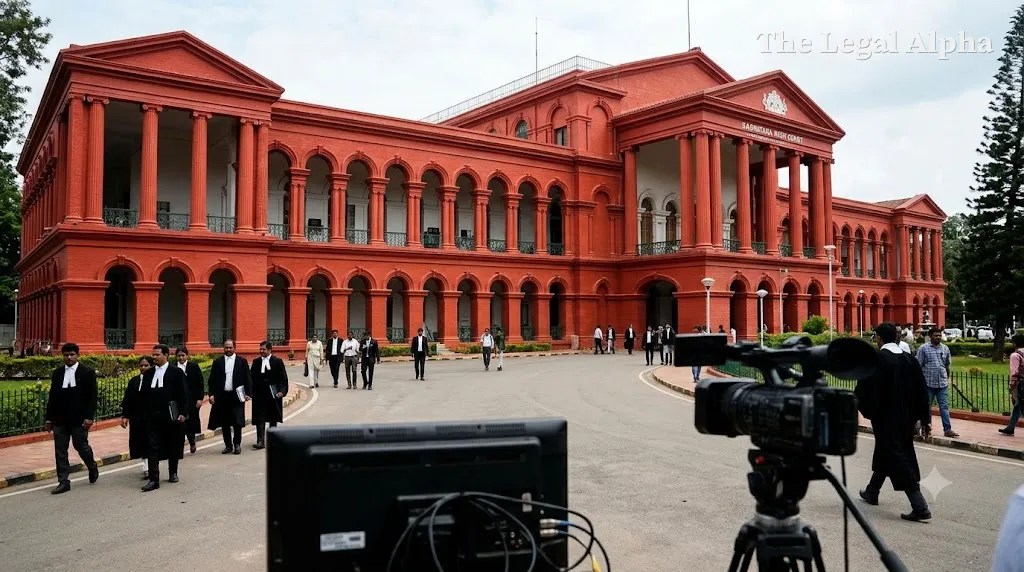
Bombay High Court Rejects ED Attachment of Avinash Bhosale’s Assets, Ruling Legitimate Commercial Transactions Cannot Be Termed 'Proceeds of Crime'

The Bombay High Court set aside the provisional attachment of real estate assets valued at ₹25 crore belonging to Pune-based developer Avinash Bhosale and his family entities. The properties, situated in Pune and Nagpur, had been seized by the Enforcement Directorate (ED) as part of its ongoing probe into the Yes Bank–DHFL money laundering controversy.
The ruling resolves cross-appeals arising from an earlier directive of the Appellate Tribunal under the Prevention of Money Laundering Act (PMLA). While the tribunal had previously lifted attachments on several other assets linked to Bhosale, it had sustained the restraint over these two specific parcels. The High Court ruled in favor of Bhosale and rejected the ED's appeal, concluding that the enforcement agency failed to demonstrate any nexus between the commercial dealings and the alleged predicate offense.
Legal Topic
Area of Law: Criminal Law / Financial Regulatory Law
Sub-topic: Prevention of Money Laundering / Provisional Attachment & Proceeds of Crime
Core Legal Issue
The fundamental legal question before the High Court was whether legitimate commercial remittances—executed through routine banking channels pursuant to pre-existing contracts or before the disbursement of an allegedly diverted loan—can be classified as "proceeds of crime" under Section 2(1)(u) of the Prevention of Money Laundering Act, 2002.
Specifically, the bench examined whether the ED possessed statutory authority under Section 5 of the PMLA to attach properties on mere assumption, absent any verifiable evidentiary link connecting the acquired assets to illegal gains from scheduled offenses.
What Did the Court Decide?
A Division Bench comprising Justice Ajey S. Gadkari and Justice Kamal Khata allowed Criminal Appeal No. 478 of 2026 filed by Avinash Bhosale, Gauri Bhosale, and Samit Realty Pvt. Ltd., while dismissing the ED's cross-appeal (Criminal Appeal No. 816 of 2026). The judgment, authored by Justice Khata, completely quashed the surviving provisional attachment over the ₹25 crore Pune and Nagpur properties.
The Court held that the agency's characterization of the transactions was "entirely baseless". The bench firmly observed that routine banking transactions conducted in the ordinary course of business between corporate entities cannot be presumed to be tainted money or transformed into money-laundering offenses without tangible proof of illegality.
Key Legal Points
-
Ordinary Banking Transactions are Not Inherently Proceeds of Crime: Official corporate transfers conducted via standard banking channels in the regular course of business cannot be arbitrarily labeled as proceeds of crime unless tainted origins are demonstrably established.
-
Temporal Disconnect Negates Criminal Nexus: Inflows received under contractual agreements—such as consultancy charges disbursed prior to the sanction of the questioned loan, or repayments under 2014–15 debenture subscription agreements—cannot be treated as proceeds of a later alleged offense.
-
Prohibition Against Presumptions in Property Attachment: The High Court reinforced that provisional attachment under Section 5 of the PMLA cannot rest on conjecture or speculative links; there must be clear, prima facie material demonstrating a direct derivation from criminal activity.
-
Independence of Corporate Transactions: Legitimate multi-party business dealings, such as past stake sales or dairy business transfers with defined consideration, retain independent validity unless direct illicit diversion is shown.
Relevant Law
-
Prevention of Money Laundering Act, 2002 (PMLA):
-
Section 2(1)(u): Definition of "Proceeds of Crime"
-
Section 3 & Section 4: Offence and punishment for money laundering
-
Section 5: Attachment of property involved in money laundering
-
Section 42: Appeals to High Court against orders of the Appellate Tribunal
-
Arguments of the Parties
The Appellants (Avinash Bhosale & Linked Entities):
-
The appellants contended that the attached properties were purchased through legal means and that the monetary transactions flagged by the ED represented genuine corporate repayments, contractual consultancy fees, and legitimate proceeds from the sale of business assets.
-
They submitted that the investments and debenture agreements dated back to 2014–2016, substantially predating the alleged Yes Bank loan disbursals in 2018, making it chronologically impossible for those funds to constitute proceeds from the alleged crime.
The Respondent (Enforcement Directorate):
-
The ED argued that funds diverted from Yes Bank to DHFL were routed through intermediary developers and entities linked to the ABIL Group as disguised kickbacks and illegitimate consultancy earnings.
-
The agency contended that the incoming transfers formed an integral part of the broader money-laundering conspiracy, justifying attachment under Section 5 to prevent the dissipation of tainted wealth.
Why Does It Matter?
This ruling establishes a crucial check against the overextension of attachment powers under the PMLA. By demanding a rigorous, evidence-backed nexus between the property attached and the underlying scheduled offense, the High Court reiterates that the ED cannot treat any standard corporate banking receipt as tainted merely because a transacting party is subsequently investigated.
For commercial enterprises, developers, and investors, the decision provides reassurance that past contracts, historical debt repayments, and bonafide advisory fees cannot be retroactively seized without concrete proof that the funds originated from illegal acts.
Legal Takeaway
A regulatory or investigating agency cannot attach commercial assets under the PMLA based on assumptions or chronological mismatches. Lawful, transparent banking transactions carried out in the usual course of corporate business cannot be characterized as proceeds of crime without definitive evidence linking them to the predicate offense.
Sources
-
Primary Source: Bombay High Court Judgment in Avinash N. Bhosale & Ors. v. Directorate of Enforcement (Criminal Appeal No. 478 of 2026 connected with Criminal Appeal No. 816 of 2026), decided on October 21, 2026 (Coram: Ajey S. Gadkari & Kamal Khata, JJ.).
-
Additional Sources: Orders of the Appellate Tribunal for PMLA (New Delhi); Reference reportage from MSN / The Daily Herald / The Indian Express.