Bombay High Court Affirms Sister’s One-Third Share in Ancestral Property, Rules Consent for Revenue Deletion Does Not Prove Relinquishment
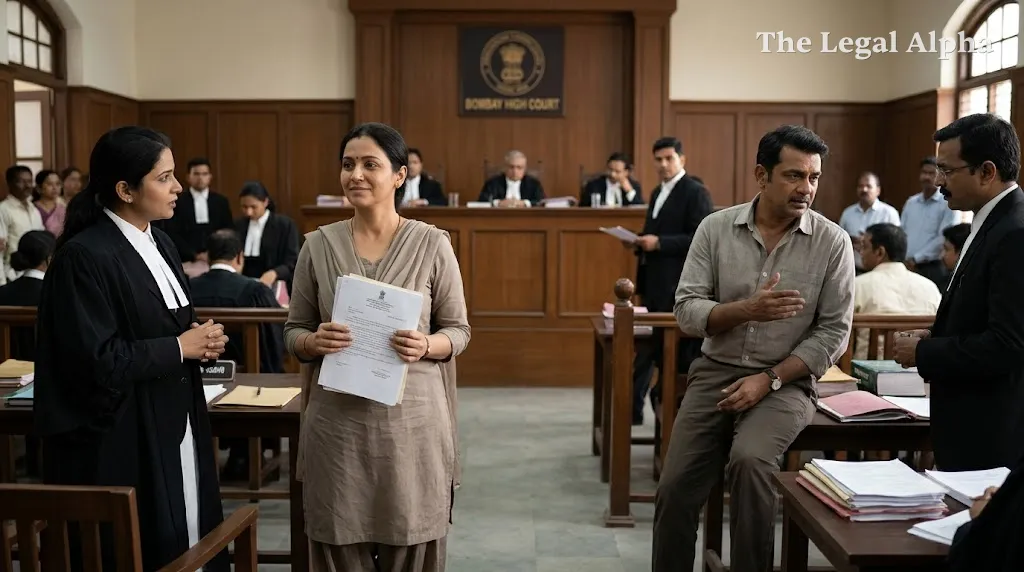
The Bombay High Court protected a woman’s proprietary interest in ancestral property against her brother’s attempt to claim exclusive ownership. The dispute arose within the family of late Shankar, whose estate included joint family agricultural land and a residential house. Following Shankar’s death, the properties devolved upon his widow Shakuntala, son Shekhar, and daughter Anita.
Shekhar refused to allocate any portion of the ancestral estate to his sister Anita, asserting that she had orally relinquished her interest decades earlier. In support, he pointed to an affidavit signed by Anita in 1991 consenting to remove her name from the land revenue records, as well as a registered deed executed by their mother in 2013 transferring the mother’s share to him. Anita approached the civil court seeking partition. The Bombay High Court rejected the brother’s claim of exclusive title and confirmed Anita’s entitlement to a one-third share in the property.
Legal Topic
Area of Law: Property Law / Family Law
Sub-topic: Partition of Ancestral Property / Relinquishment of Coparcenary Rights
Core Legal Issue
The primary legal controversy centered on whether an oral relinquishment of a coparcenary share can be presumed merely from a party’s consent to delete their name from revenue mutation records, alongside prolonged silence.
The High Court had to examine whether recognizing that oral relinquishment is legally permissible in Hindu joint family property is equivalent to proving that such an abandonment of rights actually transpired, and what standard of proof is required to extinguish proprietary ownership without a registered conveyance.
What Did the Court / Authority Decide?
Justice Sharmila U. Deshmukh of the Bombay High Court dismissed the Second Appeal filed by Shekhar and affirmed the First Appellate Court’s partition decree. The Court held that Anita is entitled to an undivided one-third share in the suit properties, while Shekhar holds the remaining two-thirds share.
The Court ruled that while oral relinquishment is legally recognized in joint family property, Shekhar completely failed to discharge the heavy evidentiary burden of proving it. The Court clarified that an affidavit executed purely for mutating or deleting names in village revenue registers cannot be equated with an abandonment of civil title. Simultaneously, the Court upheld the validity of the mother’s 2013 registered relinquishment deed, which validly transferred her own one-third interest to Shekhar, resulting in the final split of one-third for the sister and two-thirds for the brother.
Key Legal Points
-
Permissibility vs. Proof: While an oral relinquishment of rights in Hindu coparcenary or joint family property is legally valid without a compulsory registered instrument, recognizing its legal possibility is distinct from proving that it occurred; the burden of strict proof rests squarely on the person asserting it.
-
Revenue Entries Do Not Alter Title: Entries in revenue registers or a party’s consent to remove their name from mutation records do not create or extinguish proprietary rights in immovable property, nor do they signify an intention to surrender title.
-
Distinction in Family Arrangements: Concurring with an allotment of a separate property to another family member during a family arrangement does not mean an individual has abandoned their own share in the remaining joint properties.
-
Pleadings Must Be Precise: Allegations of oral surrender of ownership must contain specific material details—such as the exact date, time, venue, and witnesses present—and cannot stand on vague assertions and uncorroborated self-serving statements.
Relevant Law
-
Hindu Succession Act, 1956: Principles governing coparcenary partition and succession to ancestral estate among class-I legal heirs.
-
Indian Evidence Act, 1872: Section 101 and Section 102 relating to the burden of proof on a party pleading an affirmative defense of relinquishment.
-
Judicial Precedents: Mahadeo v. Pralhad Deorao (AIR 1965 Bom 74), which established that rights in joint family immovable property may be relinquished orally, distinguished on evidentiary grounds where factual proof was lacking.
Arguments of the Parties
The Brother (Shekhar / Appellant)
-
Maintained that Anita had orally relinquished all her rights in the joint family estate decades prior, leaving him and their mother as the surviving owners.
-
Relied on Anita’s 1991 affidavit requesting the deletion of her name from revenue records as conclusive proof of her abandonment of title.
-
Contended that Anita’s silence between 1991 and 2015, alongside her acquiescence to a separate partition arrangement involving family land (Gat No. 28) with a cousin, proved she had relinquished her interest in the remaining property (Gat No. 27).
The Sister (Anita / Respondent)
-
Argued that she never intended to forfeit or abandon her proprietary rights in the ancestral estate.
-
Submitted that the 1991 affidavit was signed solely for administrative convenience regarding family farming matters and fruit business dealings, without any declaration relinquishing ownership.
-
Maintained that revenue mutation records are strictly maintained for fiscal purposes and cannot operate as an extinguishment of coparcenary inheritance rights.
Why Does It Matter?
This ruling reinforces the evidentiary shield safeguarding women’s inheritance and coparcenary rights in family property disputes. Brothers or male co-sharers often cite old village land records, no-objection affidavits, or prolonged absence after marriage to argue that sisters gave up their ancestral inheritance.
By strictly delineating the boundary between fiscal revenue mutation and actual civil ownership, the High Court established that procedural paperwork before village or municipal revenue authorities cannot be turned into an informal surrender of title. Anyone seeking to defeat an heir’s legitimate succession share through a plea of an unwritten family arrangement must present clear, credible, and contemporaneous evidence of an unequivocal surrender of property rights.
Legal Takeaway
Removing one’s name from land revenue records does not mean relinquishing ownership of ancestral property. While an oral relinquishment of a joint family share is legally possible, it cannot be inferred from mere revenue deletions or passage of time; the party claiming it must prove the exact arrangement with clear and compelling evidence.
Sources
Primary Source:
-
Shekhar Shankar Mali & Ors. v. Anita & Ors., Second Appeal No. 70 of 2018 (Bombay High Court, Decided on August 20, 2026).
Additional Sources:
-
The Economic Times: Legal & Wealth Analysis Report, Brother refused to give sister her share; Bombay HC upholds her 1/3 property right after mother gave her share to son (October 23, 2026).
-
High Court Case Record and Judgment Digest, RawLaw Legal Repository (August 2026).