Bihar Minister’s Dual Appointment Raises Constitutional Questions Over Office of Profit
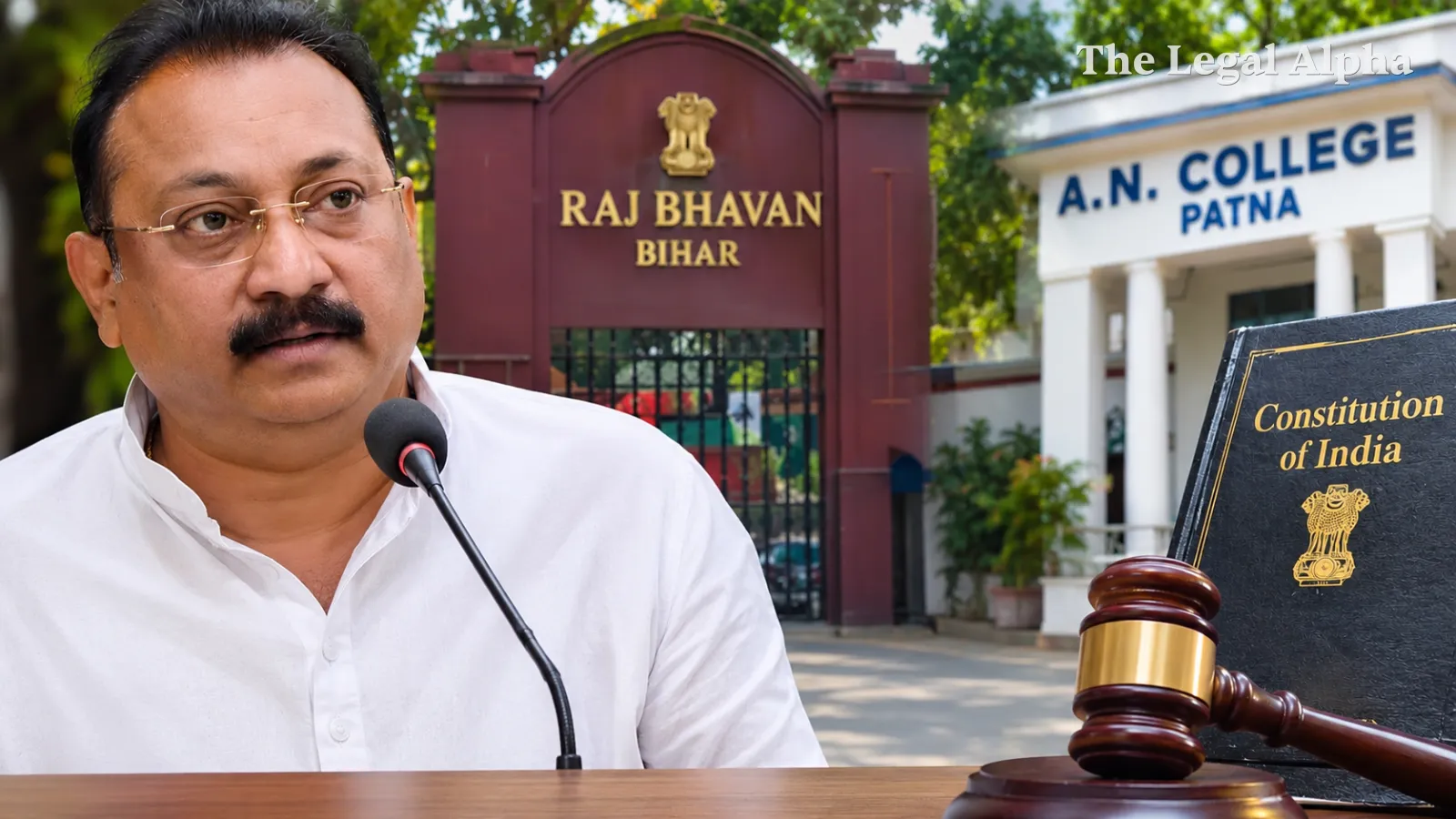
The constitutional restriction on legislators holding offices that provide financial benefits has come under scrutiny in Bihar after questions emerged over Minister Ashok Choudhary’s appointment as an Assistant Professor at A.N. College, Patna.
The controversy raises an important legal question: can an elected legislator accept a government-linked academic position without risking disqualification, particularly when the individual does not actually draw a salary?
The issue also brings attention to the distinction between holding an office that carries financial benefits and receiving money from that office.
What Happened?
Bihar Food and Consumer Protection Minister Ashok Choudhary reportedly joined A.N. College, Patna, as an Assistant Professor of Political Science in February 2026. He proceeded on leave the following day to continue serving as a Member of the Legislative Council (MLC) and a minister.
The matter reached the Governor’s Secretariat after the university's Vice-Chancellor sought clarification on whether Choudhary could retain a lien on the university position and whether the appointment could amount to holding an office of profit.
The Governor’s Secretariat examined the legality of the arrangement, particularly the implications of his probationary status and entitlement to financial benefits attached to the academic post.
Legal Topic
Area of Law: Constitutional Law
Sub-topic: Disqualification of Legislators – Office of Profit
Understanding the Constitutional Concept of Office of Profit
The expression office of profit is not expressly defined in the Constitution of India. Broadly, it refers to an office under the Central or State Government that carries financial advantages or benefits.
The restriction is intended to protect the independence of elected representatives and prevent situations in which government appointments or financial benefits could influence their legislative responsibilities.
Importantly, the question does not depend exclusively on whether an individual actually receives a salary. The nature of the position, its financial entitlements and the degree of government control are also relevant.
What Is the Dispute Over the University Appointment?
A significant part of the controversy concerns the concept of lien in service law.
Lien generally refers to an employee's right to retain a substantive position in a permanent post, subject to applicable service rules. It can allow an employee to return to the position after a period of absence.
The Governor’s Secretariat reportedly took the position that Choudhary could not claim such a right because he was still on probation.
The dispute also involves Section 68(2) of the relevant university legislation, which provides certain protections to university employees elected to State or Central legislatures.
The Governor’s Secretariat interpreted this protection as applying to individuals who are university employees before being elected to a legislature. Choudhary reportedly disputed this interpretation.
Another important question is whether the absence of actual salary payments would prevent the Assistant Professor's position from being classified as an office of profit.
Constitutional Provisions Governing Disqualification
Article 102(1)(a)
This provision deals with the disqualification of Members of Parliament for holding an office of profit under the Union or State Government, unless Parliament has exempted the particular office through legislation.
It also clarifies that a person is not disqualified merely because they hold the position of a minister.
Article 191(1)(a)
This provision establishes the corresponding restriction for members of State Legislatures. A person may face disqualification for holding an office of profit under the Union or State Government, subject to legally recognised exemptions.
Article 103
The President decides questions concerning the disqualification of Members of Parliament under Article 102(1), after obtaining the opinion of the Election Commission of India and acting according to that opinion.
Article 192
Questions concerning the disqualification of members of State Legislatures are decided by the Governor after obtaining the Election Commission's opinion and acting according to it.
Since Ashok Choudhary is an MLC, Article 192 provides the relevant constitutional procedure.
Supreme Court Principles for Identifying an Office of Profit
The Supreme Court has developed several tests to determine whether a particular position amounts to an office of profit.
In Guru Gobinda Basu v. Sankari Prasad Ghosal (1964), the Court explained that the relationship between the government and the office-holder must be examined through several factors, including:
-
Who has the authority to make the appointment?
-
Who can remove or dismiss the office-holder?
-
Who determines and pays the remuneration?
-
To what extent does the government exercise control over the position?
-
What functions does the office-holder perform?
In Shivamurthy Swami Inamdar v. Agadi Sanganna Andanappa (1971), the Supreme Court also considered appointment, removal, remuneration and government control as relevant factors.
The central principle is that an office may constitute an office of profit even when its holder voluntarily refuses to receive the financial benefits attached to it.
Important Judicial and Parliamentary Precedents
Jaya Bachchan v. Union of India (2006)
The Supreme Court examined the constitutional restriction on holding an office of profit and emphasised that the entitlement to financial benefits, rather than merely their actual receipt, is relevant when determining disqualification.
Anupam Hazra Case (2015)
The Parliamentary Joint Committee on Offices of Profit examined the position of Anupam Hazra, who was serving as an Assistant Professor at Visva-Bharati University while being a Member of Parliament.
The committee concluded that the academic position did not attract disqualification after considering the university's autonomous character, appointment arrangements and source of remuneration.
Manmohan Singh Case (2016)
The Parliamentary Committee also considered the appointment of former Prime Minister Manmohan Singh to the Jawaharlal Nehru Chair at Panjab University.
It concluded that he could accept the position without losing his Rajya Sabha membership, taking into account the nature of the appointment and the university's autonomous status.
These examples demonstrate that every academic appointment does not automatically amount to an office of profit. The circumstances and legal character of the particular position must be examined.
What Is the Position of the Parties?
Governor’s Secretariat
The Governor’s Secretariat questioned Choudhary’s entitlement to retain a lien while on probation. It also maintained that the Assistant Professor's position could constitute an office of profit because financial benefits attached to the post remained available even if he chose not to draw them.
Ashok Choudhary
Choudhary disputed the interpretation adopted by the Governor’s Secretariat. He reportedly referred to examples of university employees receiving lien during probation at other Bihar universities.
He also argued that Section 68(2) of the Bihar State Universities Act, 1976, should be interpreted in accordance with its legislative purpose and that the rules should be applied uniformly.
What Happens Next?
The Governor’s Secretariat has reportedly sought the Advocate General’s opinion on the legal questions surrounding the appointment.
The constitutional procedure under Article 192 requires the Governor to obtain the Election Commission of India's opinion and act according to it when deciding a question of disqualification under Article 191(1).
The Governor’s Secretariat's observations should not be confused with a final constitutional determination of Choudhary's disqualification.
The question of his membership of the Bihar Legislative Council therefore remains subject to the applicable constitutional procedure and any subsequent decision by the competent authority.
Why Does This Matter?
The controversy highlights the importance of maintaining a clear distinction between legislative responsibilities and positions that may provide financial benefits from government-linked institutions.
It also has wider implications for legislators who accept academic appointments, advisory positions or other public offices while continuing to hold elected positions.
For universities, the dispute raises questions about the interpretation of service rules, probationary appointments and the availability of lien to employees who enter public life.
Most importantly, the issue reinforces that refusing to draw a salary does not automatically remove the possibility of constitutional disqualification. The legal character of the office and the financial benefits attached to it remain significant considerations.
Legal Takeaway
The constitutional prohibition on holding an office of profit is concerned with the potential financial advantage attached to a position, not merely the money actually received by its holder.
Articles 191 and 192 provide the relevant framework for examining the disqualification of State legislators. However, whether a particular appointment attracts disqualification depends on the nature of the office, applicable exemptions and the constitutionally prescribed decision-making process.
Sources
Primary Sources:
-
Supreme Court judgment in Guru Gobinda Basu v. Sankari Prasad Ghosal (1964).
-
Supreme Court judgment in Jaya Bachchan v. Union of India (2006).
Additional Sources: