Automatic Service Charge Non-Compliant: CCPA Fines Shangri-La Eros’ Restaurant Mister Chai ₹1 Lakh
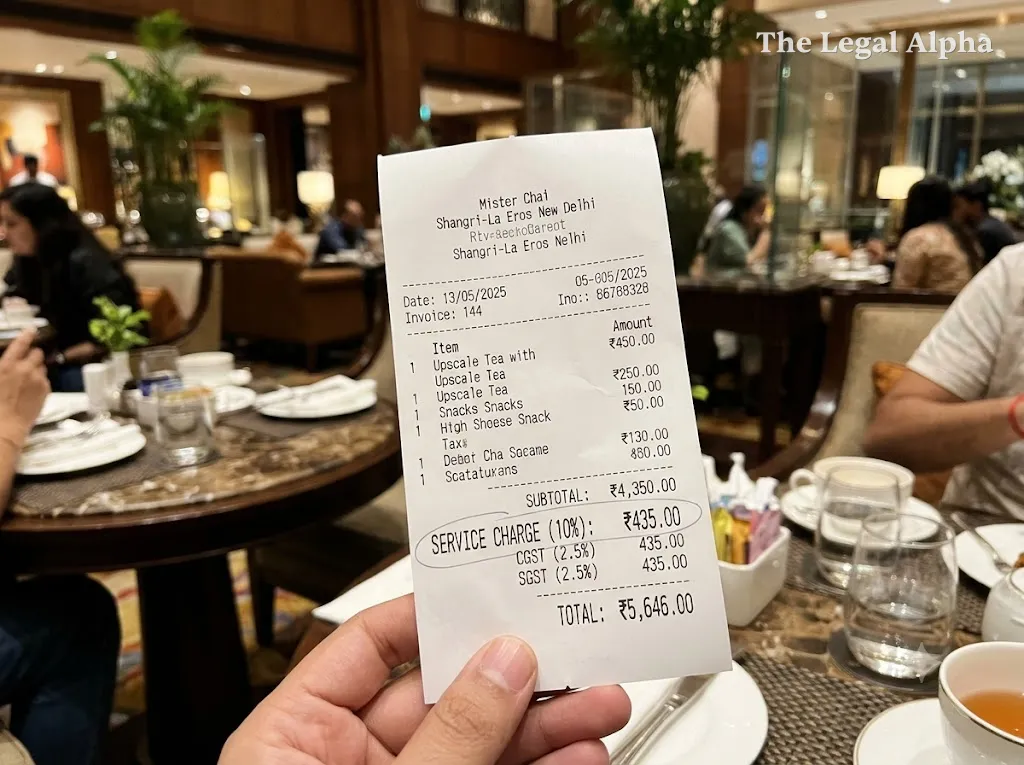
The Central Consumer Protection Authority has penalised Mister Chai, an upscale tea lounge and restaurant situated within the five-star Shangri-La Eros hotel in New Delhi, imposing a fine of ₹1 lakh for automatically tacking a 10% service charge onto dining bills.
The regulatory intervention was triggered by consumer grievances filed in mid-2025 where diners contested mandatory service additions—including instances where ₹435 and ₹125 were levied directly on their respective food checks without consent. The CCPA held that forcing patrons to affirmatively demand the removal of an added fee, or relabelling the fee under alternative terminology, constitutes an unfair trade practice and an infringement of statutory consumer rights.
Legal Topic
Area of Law: Consumer Protection Law
Sub-topic: Unfair Trade Practices / Misleading Billing / Restaurant Service Charges
Core Legal Issue
The dispute centres on whether an eatery can include a service levy on an invoice by default and require the patron to request its waiver, and whether rebranding that levy as a "voluntary contribution" remedies statutory non-compliance.
The regulator examined whether such default billing mechanisms violate informed consent and constitute an "unfair contract" or "unfair trade practice" under the Consumer Protection Act, 2019, read alongside regulatory guidelines restricting non-voluntary restaurant surcharges.
What Did the Authority Decide?
In its order dated October 22, 2026, the CCPA held the establishment liable for unfair trade practices and issued the following directives:
-
Imposed a penalty of ₹1 lakh on the establishment under Section 21(7) of the Consumer Protection Act, 2019.
-
Directed the restaurant to permanently discontinue levying default service charges or collecting equivalent amounts under alternate nomenclature.
-
Mandated the filing of a formal compliance report within 15 days of receiving the order.
-
Clarified that post-facto refunds of the disputed amounts to complainants do not expunge the statutory breach, as unlawful billing had continued for over 15 months following regulatory warnings and High Court scrutiny.
Key Legal Points
-
Pre-set consent is legally invalid: Consent to pay tips or gratuities must be voluntary, prior, and informed. Placing an automatic fee on the bill and requiring diners to request an opt-out subverts free consent.
-
Semantic rebranding is prohibited: Renaming a mandatory charge to "Charges for Voluntary Service Staff Contribution (optional)" violates Paragraph 7(ii) of the CCPA Guidelines, which forbids charging service fees under disguised names.
-
Post-hoc refunds do not cure widespread violations: Offering a refund after a consumer protests does not eliminate liability when a systemic billing mechanism prejudices consumers as a collective class.
-
Enforceability of regulatory guidelines: The CCPA’s 2022 guidelines remain enforceable administrative directions governing billing transparency and consumer exploitation prevention.
Relevant Law
-
Sections 2(9), 2(28), 2(46), and 2(47) of the Consumer Protection Act, 2019: Governing consumer rights, misleading advertisements, unfair contracts, and unfair trade practices.
-
Section 21(7) of the Consumer Protection Act, 2019: Power of the Central Authority to impose financial penalties for continuous or deliberate contraventions causing prejudice to the public.
-
CCPA Guidelines for Prevention of Unfair Trade Practices and Protection of Consumer Interest in relation to Levying of Service Charge in Hotels and Restaurants (July 4, 2022): Specifically Paragraph 7, prohibiting automatic levies and collections under any other name.
Arguments of the Parties
The Complainants & Regulator
The CCPA noted that diners were billed a 10% charge without being asked in advance whether they agreed to pay a gratuity. The authority observed that conditioning relief on a customer having to object or ask for a waiver creates an undue burden, turning what should be a voluntary gratuity into a presumptive default. The CCPA further stressed that despite judicial reminders and explicit 2022 regulatory instructions, the hotel continued the practice across extended billing cycles, harming consumer interests at large.
The Respondent Establishment
Shangri-La Eros’ establishment submitted that the charge was never meant to be compulsory and was clearly marked as removable upon a diner's request. The hotel pointed out that it later adjusted its invoice terminology to "Charges for Voluntary Service Staff Contribution (optional)" and promptly refunded the disputed sums alongside the corresponding Goods and Services Tax to the aggrieved consumers. The establishment also reported that it had comprehensively halted the levy across all operations effective October 1, 2026.
Why Does It Matter?
This ruling delivers a clear compliance warning to the hospitality sector, particularly luxury hotels and fine-dining chains that have continued to include service charges as an automated invoice line item.
Many establishments have relied on fine-print disclosures or modified terminology to maintain service charges, operating on the assumption that offering an on-demand waiver shields them from liability. The CCPA’s decision unequivocally rejects the "opt-out" approach, establishing that adding non-statutory charges by default without prior affirmative consent constitutes an unfair trade practice. This reinforces individual diner autonomy across India and establishes that regulatory authorities will penalise systemic defaults even when individual disputed sums are comparatively small or refunded after a complaint is lodged.
Legal Takeaway
Gratuities and service charges are strictly discretionary and cannot be included on a bill by default or collected under alternative names. A restaurant cannot place the burden on the consumer to identify and ask for the removal of a pre-added surcharge.
Sources
-
Central Consumer Protection Authority (CCPA) Order dated October 22, 2026 (In re: Mister Chai, Shangri-La Eros New Delhi).
-
Consumer Protection Act, 2019 (Act No. 35 of 2019).
-
CCPA Guidelines for Prevention of Unfair Trade Practices and Protection of Consumer Interest in relation to Levying of Service Charge in Hotels and Restaurants (July 4, 2022).