Allahabad High Court Seeks Explanation From UP Government Over Fresh FIRs Under Gangsters Act Following Supreme Court Ruling
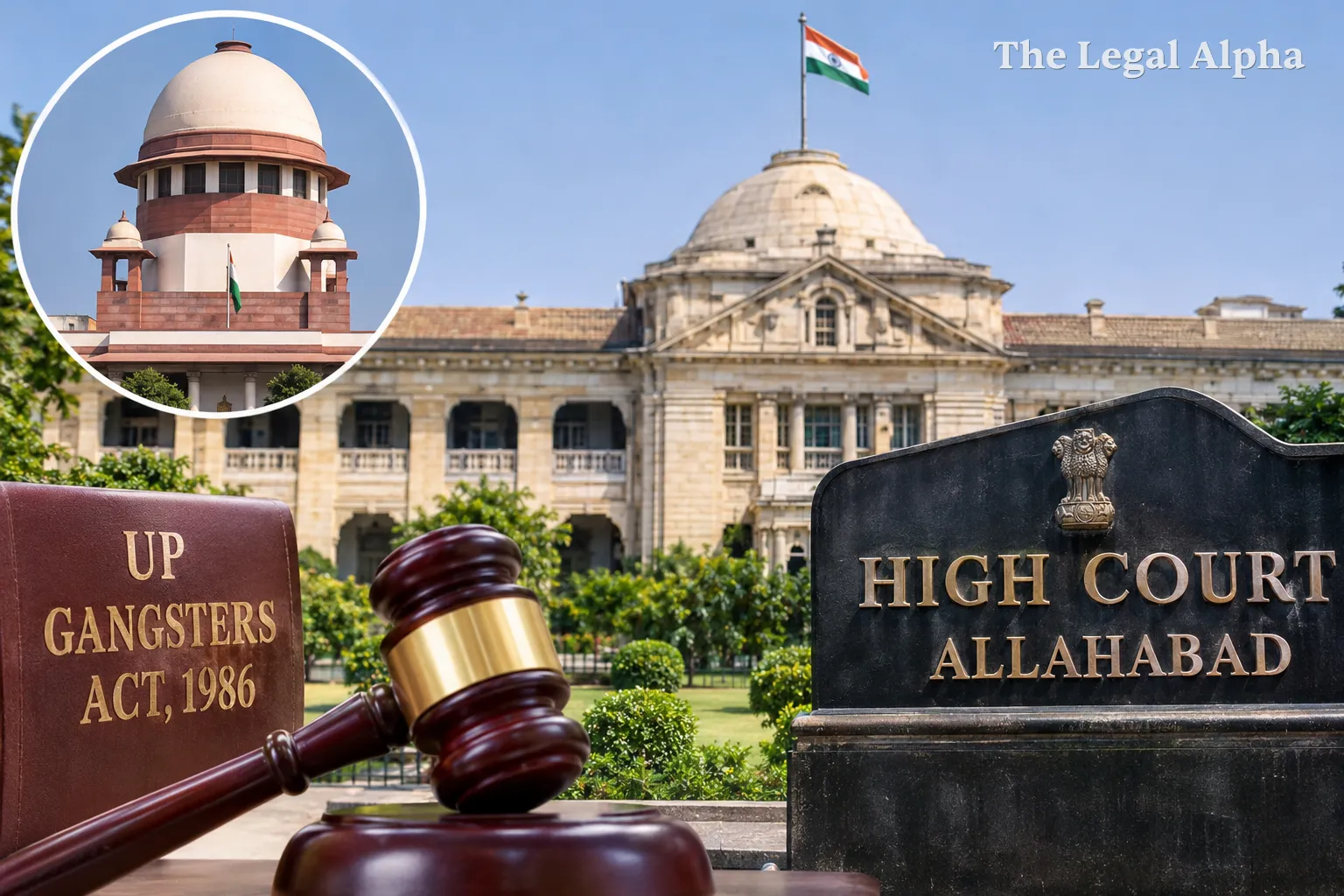
The Lucknow Bench of the Allahabad High Court has questioned the Uttar Pradesh government's continued registration of criminal cases under the Uttar Pradesh Gangsters and Anti-Social Activities (Prevention) Act, 1986, following a significant Supreme Court judgment concerning the legislation.
A Division Bench comprising Justice Abdul Moin and Justice Pramod Kumar Srivastava directed the Additional Chief Secretary (Home) to submit a personal affidavit explaining why police authorities continued invoking the Act despite the Supreme Court's observations in August 2026.
The High Court also stayed an FIR registered against a petitioner under the legislation and prohibited further proceedings arising from that FIR until further orders.
The matter is scheduled for further hearing on December 15, 2026.
Legal Topic
Area of Law: Criminal Law and Constitutional Law
Sub-topic: Validity of Penal Legislation, Registration of FIRs, Judicial Precedents and Administrative Accountability
Core Legal Issue: Can Police Continue Invoking a Law Questioned by the Supreme Court?
The central legal question concerns whether police authorities can continue registering criminal cases under legislation that the Supreme Court has described as legally defective.
In August 2026, the Supreme Court, while deciding Shiv Pratap Singh alias Chinu v. State of Uttar Pradesh and Others, described the Gangsters Act as "stillborn", raising questions about the statutory foundation for punishment under the legislation.
The issue involves the principle that criminal liability must have a clear legal basis. A person cannot be punished merely because an administrative classification has been applied unless the law properly establishes the relevant offence.
The controversy also raises questions about how government departments should implement Supreme Court judgments and whether police authorities can continue applying statutory provisions whose legal operation has been questioned.
Petition Challenging FIR Registered in Ambedkar Nagar
The proceedings arose from a writ petition filed by Brijesh Kumar, also known as Banty Verma.
The petitioner challenged an FIR registered on October 23, 2026, at Akbarpur Police Station in Ambedkar Nagar district under Section 3(1) of the Uttar Pradesh Gangsters Act.
His principal argument was that the Supreme Court's August 2026 judgment had already questioned the legal foundation of the legislation.
According to the petitioner, continuing an investigation under the Act was therefore legally unsustainable.
The State's counsel reportedly did not dispute the petitioner's submission concerning the Supreme Court judgment during the hearing.
What Did the Allahabad High Court Decide?
After considering the petitioner's submissions, the High Court stayed the operation of the challenged FIR.
The Bench directed that no further proceedings should be undertaken pursuant to that FIR until further orders.
The Court also sought an explanation from the Uttar Pradesh government regarding the continued registration of similar cases.
The Additional Chief Secretary (Home) was directed to file a personal affidavit within three weeks addressing the reasons behind such registrations.
The affidavit must also explain what action the government proposes against officials responsible for registering the FIRs and what corrective measures will be adopted.
The Court warned that failure to submit the affidavit would require the senior official to appear personally with the relevant records.
These directions are interim in nature. The Court has not finally disposed of the petition.
High Court Raises Concerns Over Administrative Compliance
The Bench expressed concern that authorities continued registering FIRs despite the Supreme Court's earlier judgment.
It observed that government departments should not require repeated judicial intervention to comply with binding legal principles.
The Court also highlighted the consequences for individuals compelled to approach constitutional courts to challenge criminal proceedings.
Such litigation places an additional burden on the judicial system and requires individuals to incur the time and expense of seeking legal remedies.
The Bench further noted that government advocates had previously drawn attention to the issue, but effective corrective measures did not appear to have followed.
Key Legal Points
- Binding judicial precedents: Article 141 of the Constitution requires courts across India to follow the law declared by the Supreme Court.
- Legality of criminal punishment: Article 20(1) protects individuals against conviction for conduct that did not constitute an offence under the law applicable when it occurred.
- Statutory foundation: Criminal proceedings must rest on legally enforceable provisions that establish the relevant offence and punishment.
- Administrative accountability: Senior government officials may be required to explain failures to implement binding judicial decisions.
- Interim judicial protection: Courts may stay challenged criminal proceedings while examining their legality.
Relevant Law and Judicial Precedents
Uttar Pradesh Gangsters and Anti-Social Activities (Prevention) Act, 1986
The legislation provides a framework for action against persons classified as gangsters based on activities specified under the Act.
Section 2 contains relevant definitions, while Section 3 prescribes punishment.
The legal controversy concerns whether the statutory framework adequately establishes an independent criminal offence capable of supporting punishment.
Article 20(1) of the Constitution of India
This provision reflects the principle that criminal punishment must have a lawful foundation. It prohibits retrospective criminalisation and the imposition of a greater penalty than was legally applicable when the offence occurred.
Article 141 of the Constitution of India
Article 141 establishes the binding nature of law declared by the Supreme Court upon courts throughout India.
Shiv Pratap Singh alias Chinu v. State of Uttar Pradesh and Others (2026)
The Supreme Court's observations concerning the statutory framework of the Gangsters Act form the central basis of the petitioner's challenge.
Ashok Kumar Dixit v. State of Uttar Pradesh (1989)
This earlier Full Bench decision of the Allahabad High Court upheld the legislation's validity. Its continuing relevance has become important because another Division Bench, on November 19, 2026, held that the Act remains operative and that the Supreme Court had not expressly declared it unconstitutional.
Arguments of the Parties
Petitioner
The petitioner argued that the Supreme Court's August 2026 decision had undermined the legal basis for continuing proceedings under the Gangsters Act.
He submitted that the FIR registered against him could not legally support further investigation in view of the Supreme Court's observations.
State of Uttar Pradesh
During the hearing, the State's counsel reportedly did not dispute the submission regarding the Supreme Court judgment.
However, the government's detailed explanation for the continued registration of FIRs remains awaited through the personal affidavit directed by the High Court.
The State's complete position should therefore not be treated as finally settled.
An Important Distinction: Is the Gangsters Act Still Operative?
The broader legal position requires careful attention.
Although the Supreme Court described the 1986 legislation as "stillborn", a separate Division Bench of the Allahabad High Court subsequently held on November 19, 2026, that the Act remains operative.
That Bench distinguished the Supreme Court's observations from an express declaration that the legislation was unconstitutional.
It also referred to the earlier Full Bench ruling upholding the Act's validity.
Consequently, it would be inaccurate to conclude that every FIR under the Gangsters Act has automatically become invalid or that the legislation has been conclusively struck down in its entirety.
The different judicial approaches highlight an ongoing legal question concerning the interpretation and effect of the Supreme Court's judgment.
Why Does This Development Matter?
The case has implications beyond the individual petitioner.
First, it highlights the importance of legal certainty in criminal law. Individuals should be able to understand the statutory basis on which they may face prosecution.
Second, it raises questions about administrative responsibility when judicial decisions affect established police practices.
Third, it illustrates the practical difficulties that can arise when courts interpret the consequences of a higher court's observations differently.
For investigating agencies, the controversy emphasises the need to examine current judicial rulings carefully before initiating proceedings under disputed statutory provisions.
For accused persons, the developments may provide grounds for challenging particular proceedings, depending on the facts, applicable legal provisions and judicial orders.
The case also underlines the importance of distinguishing between an interim stay in an individual matter and a final judicial declaration affecting an entire statute.
What Happens Next?
The Additional Chief Secretary (Home), Uttar Pradesh, must submit the affidavit directed by the High Court within the prescribed three-week period.
The government is expected to address the continued registration of FIRs, proposed action against responsible officials and measures intended to ensure compliance with applicable judicial decisions.
The matter is listed for December 15, 2026.
Until further orders, the FIR challenged by Brijesh Kumar remains stayed, along with proceedings arising from it.
Legal Takeaway
The Allahabad High Court's intervention reinforces the importance of administrative compliance with Supreme Court judgments and the requirement that criminal proceedings have a valid statutory foundation.
However, the continuing judicial debate over the legal status of the Uttar Pradesh Gangsters Act means that its wider application must be assessed in light of the relevant judgments rather than assuming that the legislation has been invalidated in its entirety.
Sources
Primary legal authorities:
-
Shiv Pratap Singh alias Chinu v. State of Uttar Pradesh and Others, Supreme Court of India, August 2026.
-
Allahabad High Court, Lucknow Bench, proceedings concerning Brijesh Kumar alias Banty Verma, November 2026.
-
Ashok Kumar Dixit v. State of Uttar Pradesh, Allahabad High Court Full Bench, 1989.
The complete text of the specific Lucknow Bench order was not independently examined for this article.
Additional sources used for verification: