Allahabad High Court Restricts Litigants From Carrying Mobile Phones Into Courtrooms Following Unauthorised Recording
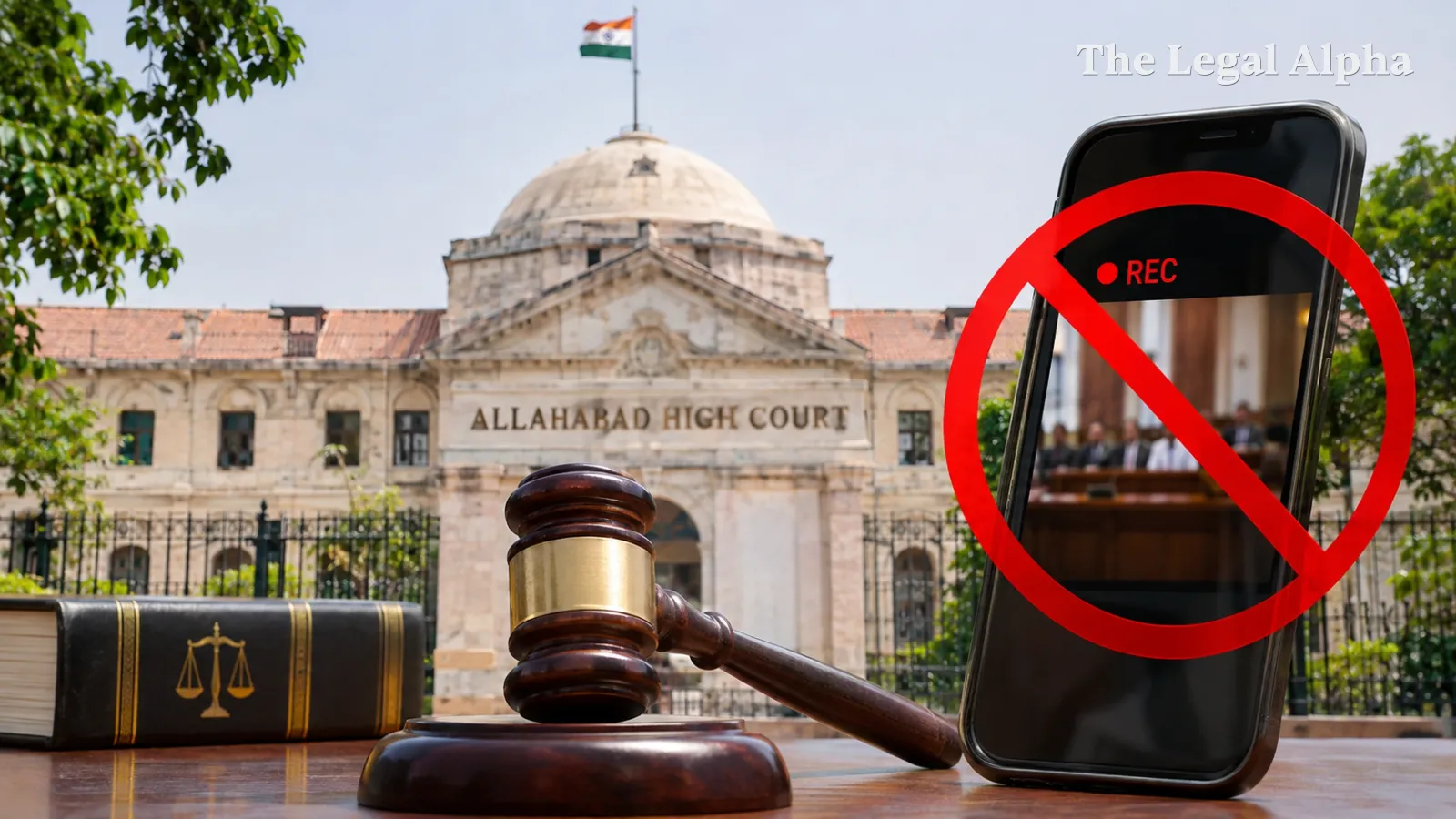
The Allahabad High Court has imposed restrictions on litigants carrying mobile phones inside courtrooms after a man was caught recording judicial proceedings without the Court's permission.
The order was passed by a Bench of Justice Vikram D. Chauhan on November 19, 2026, while hearing a petition under Article 227 of the Constitution in Kuldeep Batra v. State of Uttar Pradesh.
During the hearing, the Additional Government Advocate informed the Court that a person was recording the proceedings on his mobile phone. When questioned, the individual, identified as Raj Kulshrestha, admitted that he had recorded the hearing without authorisation.
The Court found that his phone contained recordings of the proceedings, although he had no matter listed before the Bench and possessed a pass that permitted access only to the Advocates' Chamber.
Legal Topic
Area of Law: Constitutional Law and Administration of Justice
Sub-topic: Courtroom Procedure, Open Justice and Unauthorised Recording of Judicial Proceedings
Core Legal Issue
The central legal question concerns whether the general principle of open justice allows individuals to record and circulate courtroom proceedings without obtaining permission from the Court.
The matter also raises concerns about courtroom security, confidentiality, the protection of litigants and victims, and the possibility of prejudicing ongoing judicial proceedings through unauthorised recordings on social media.
What Did the Court Decide?
The High Court issued directions to regulate the entry of litigants into courtrooms and prevent unauthorised recording of judicial proceedings.
The important directions include:
-
Restriction on mobile phones: Litigants will not be permitted to enter courtrooms carrying mobile phones.
-
Responsibility of advocates: If a litigant is found carrying a mobile phone inside the courtroom, the concerned advocate will be held responsible.
-
Entry regulations: The Registrar (Protocol) was directed to ensure that individuals without proper passes are not allowed inside courtrooms.
-
Notice at entry points: The Registrar General was instructed to display a notice at the pass counter informing visitors about the restriction.
-
Action against the individual: Raj Kulshrestha was directed to be taken into custody and produced before the Chief Judicial Magistrate, Prayagraj, after medical examination. The Court provided for his release on bail subject to specified conditions, including appearing before the High Court on November 20, 2026.
-
Explanation from advocates: Advocates Nitish Kumar Soni and Bhanu Pratap Seth were directed to appear and explain why proceedings for interference with the administration of justice should not be initiated against them.
The Court also directed that the mobile phone be kept in a sealed cover and produced before it.
Key Legal Points
-
The principle of open justice allows public access to judicial proceedings but does not automatically authorise individuals to record or broadcast hearings.
-
Unauthorised recordings may prejudice litigants and affect the fairness of ongoing proceedings.
-
Publishing sensitive information about victims, particularly in cases involving sexual offences, can expose them to social stigma.
-
Courtroom access and recording activities remain subject to the authority and directions of the presiding judge.
-
Advocates may face responsibility for ensuring that litigants comply with courtroom restrictions imposed by the Court.
Relevant Law
Constitution of India
- Article 227: Provides the High Courts with the power of superintendence over subordinate courts and tribunals within their territorial jurisdiction. The petition was being heard under this provision.
The reported order also concerns the Court's authority to regulate its proceedings, courtroom access and judicial decorum.
Note: The available reporting does not identify a specific statutory provision under which the recording itself was declared an offence. The Court's show-cause directions should not be treated as a final finding of contempt or guilt.
Arguments of the Parties
Court's Concerns and Observations
The Bench expressed concern that recordings of ongoing proceedings could circulate on social media before the Court had reached a final decision. Such circulation could expose litigants and victims to public scrutiny and potentially influence public perception of cases.
The Court also emphasised that judicial proceedings involve questions of individual liberty and legal rights, making unauthorised publication particularly problematic.
Submissions on Behalf of the Bar Association
Senior Advocate C.P. Upadhyaya, President of the Allahabad High Court Bar Association, informed the Bench that certain advocates were recording and uploading videos of court proceedings.
He referred to a Bar Association notice dated November 18, 2026, prohibiting videos, reels and photographs within the High Court premises. The notice also provided for a ₹5,000 penalty and possible disciplinary action against advocates violating the restriction.
The available reporting does not provide a detailed response from the advocates directed to explain their alleged involvement.
Why Does It Matter?
The development highlights an important distinction between public access to courts and the unrestricted publication of judicial proceedings.
Open justice is an essential feature of the judicial system because it promotes transparency and public confidence in the administration of justice. However, transparency does not necessarily mean that every individual attending a hearing can record and distribute its contents.
The restrictions are particularly significant in cases involving sexual offences, personal liberty and sensitive investigations, where premature circulation of information may affect the privacy and rights of individuals.
The order also places an additional compliance responsibility on advocates, who must ensure that their clients follow the Court's entry requirements.
For litigants, the immediate practical consequence is that they must comply with the mobile phone restriction when entering the Allahabad High Court courtrooms.
Legal Takeaway
Public access to judicial proceedings does not create an unrestricted right to record or broadcast court hearings. The Allahabad High Court has emphasised that judicial transparency must operate alongside courtroom discipline, litigants' privacy and the fair administration of justice.
Sources
Primary Source: The Allahabad High Court order dated November 19, 2026, in the Article 227 proceedings. The full official order could not be independently verified from the available material.
Additional Sources: