West Delhi Showroom Murder: Police Apprehend Suspect Following Fatal Attack on Employee
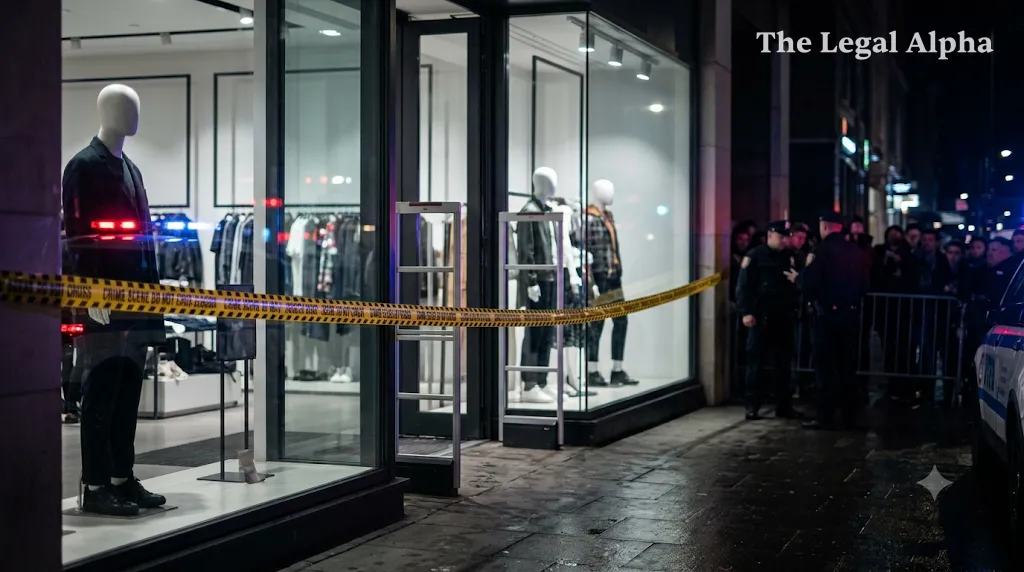
An 18-year-old saleswoman, identified as Shabnam, was found dead inside the trial room of a clothing showroom in West Delhi’s Moti Nagar area on Saturday evening, November 14, 2026. According to preliminary statements from the Delhi Police, the victim suffered fatal neck injuries inflicted by a sharp-edged weapon.
The incident came to light after the showroom owner noticed via remote CCTV monitoring that the sales counter was unattended. Upon alerting neighbouring shopkeepers and checking the premises, staff and witnesses discovered the victim lying inside the changing room, which had been latched from the outside. Following an immediate manhunt and review of local surveillance footage, Delhi Police apprehended the primary suspect, a 29-year-old man named Suraj, who is reportedly an acquaintance and extended relative of the victim.
Legal Topic
Area of Law: Criminal Law
Sub-topic: Homicide / Investigation and Pre-Trial Procedure under the Bharatiya Nyaya Sanhita (BNS) and Bharatiya Nagarik Suraksha Sanhita (BNSS)
Core Legal Issue
At this preliminary stage, the matter centers on criminal investigation and custodial procedures rather than a judicial verdict. The primary legal questions before the investigating authorities involve establishing the exact sequence of events, proving the mens rea (criminal intent) and actus reus (physical act) required to sustain a charge of murder, and verifying the victim's exact age—as conflicting early accounts have described her as both 18 years old and a minor, a distinction that carries critical statutory consequences regarding trial jurisdiction and applicable penal provisions.
What Did the Court / Authority Decide?
No court has issued a ruling in this matter yet, as the case is currently at the police investigation stage. The Delhi Police have taken the following official actions:
-
Crime Scene and Forensic Processing: Local police and forensic teams secured the Moti Nagar showroom, recovered a blood-stained knife near the body, and collected CCTV footage from inside the shop and surrounding areas to reconstruct the suspect's entry and escape.
-
Post-Mortem Examination: The victim's body was taken into police custody and sent for a medico-legal post-mortem examination to formally establish the cause and time of death.
-
Apprehension of Suspect: Following targeted raids and questioning of the suspect's family members and showroom staff, police apprehended the 29-year-old suspect, Suraj. Further interrogation, formal arrest procedures, and production before a Magistrate for police or judicial custody remain pending.
Key Legal Points
-
Standard of Proof at Investigation Stage: Police suspicion, initial witness accounts, and preliminary CCTV findings are grounds for investigation and arrest, not proof of guilt. Under Indian criminal jurisprudence, the accused remains presumed innocent until proven guilty beyond a reasonable doubt in a court of law.
-
Evidentiary Value of Digital and Forensic Records: Under the Bharatiya Sakshya Adhiniyam, 2023 (BSA), electronic records such as the showroom’s CCTV footage and mobile recordings from the scene must be accompanied by proper certification to be admissible as primary or secondary evidence during trial.
-
Significance of Age Verification: While most police statements identify the victim as 18 years old, at least one initial report cited her age as 16. Official verification of her date of birth through school or municipal records is legally essential, as offenses against a minor can trigger specialized statutory protections and distinct procedural mandates.
-
Motive as Corroborative Evidence: Investigators have pointed to a strained personal relationship and past disputes as a potential motive. While motive is not a mandatory statutory ingredient to prove murder when direct or strong circumstantial evidence exists, establishing it strengthens the prosecution's chain of circumstances.
Relevant Law
-
Bharatiya Nyaya Sanhita, 2023 (BNS): Governs substantive criminal offenses in India. Section 101 defines the offense of murder, and Section 103 prescribes the punishment for murder (death or imprisonment for life, and fine).
-
Bharatiya Nagarik Suraksha Sanhita, 2023 (BNSS): Governs the procedure for investigation, registration of the First Information Report (FIR), arrest without warrant in cognizable offenses, mandatory production of the accused before a Magistrate within 24 hours, and inquest/post-mortem procedures.
-
Bharatiya Sakshya Adhiniyam, 2023 (BSA): Governs the admissibility of forensic evidence, recovery of weapons under disclosure statements, and electronic evidence such as CCTV footage.
Arguments of the Parties
Because formal court proceedings have not yet commenced, no formal pleadings have been filed before a judge. However, the emerging positions of the investigating agency and the victim's family are as follows:
Investigating Agency (Delhi Police)
According to preliminary police statements, investigators suspect that the accused entered the showroom while the victim was alone, attacked her with a sharp-edged weapon inside the trial room, and fled after latching the door from the outside. Police indicated that strained personal relations over the past few months appear to be the underlying trigger.
Victim’s Family
Members of the victim's family have alleged that the suspect, who is related through marriage to the victim's elder sister, had previously assaulted her on two occasions.
The Accused
No formal statement or legal defense from the suspect or his legal counsel has been placed on record following his apprehension.
Why Does It Matter?
Beyond the immediate criminal investigation, this case highlights two critical legal and institutional issues in urban India: the role of private surveillance in criminal investigations and workplace safety for retail employees.
First, the rapid identification and apprehension of the suspect demonstrate how private CCTV networks—both remote live-monitoring by business owners and neighbourhood street cameras—increasingly serve as the primary backbone of modern criminal investigations in metropolitan areas. At the same time, it underscores the legal necessity for investigating agencies to strictly follow statutory protocols when seizing digital video recorders (DVRs) so that crucial evidence is not excluded on technical grounds during trial.
Second, the incident raises recurring questions regarding safety protocols in small commercial establishments and retail showrooms, particularly where lone employees manage storefronts during evening hours. While criminal liability rests solely with the perpetrator, employers face ongoing scrutiny regarding basic workplace security measures.
Legal Takeaway
An arrest and preliminary police findings mark only the beginning of the criminal justice process. For the prosecution to secure a conviction, investigators must now build a legally airtight chain of evidence—linking the recovered weapon, forensic reports, verified age records, and certified CCTV footage—while ensuring every constitutional safeguard is met during custodial interrogation and trial.
Sources
Primary Source:
Official preliminary statements and investigation briefings issued by the Delhi Police (West District / Moti Nagar Police Station) regarding the November 14, 2026 homicide investigation.
Additional Sources:
-
Reports by The Times of India, Hindustan Times, The Indian Express, and India Today detailing police briefings, eyewitness accounts, and the apprehension of the suspect (November 15, 2026).
-
Statutory provisions under the Bharatiya Nyaya Sanhita, 2023, Bharatiya Nagarik Suraksha Sanhita, 2023, and Bharatiya Sakshya Adhiniyam, 2023.