Telangana High Court Quashes FIR Against Former BJP Corporator Over Burning of Political Flexi Banner
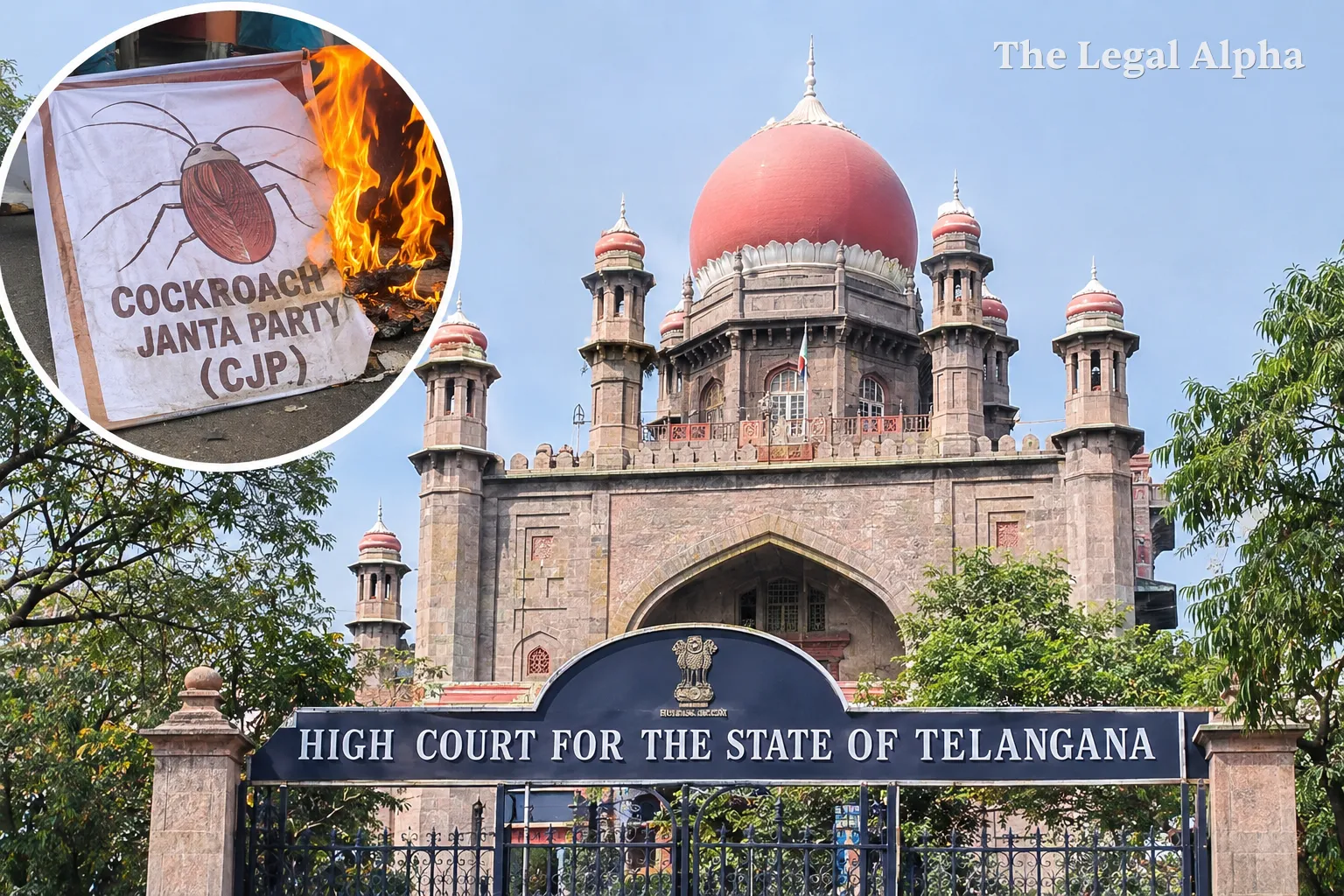
The Telangana High Court has quashed criminal proceedings against former BJP corporator Kodicherla Mahender in a case arising from the alleged burning of a Cockroach Janatha Party (CJP) flexi banner during a Ravana Dahanam programme in Hyderabad.
The Court found that the allegations in the complaint did not establish the necessary ingredients of the criminal offences invoked against him. The ruling provides relief to the petitioner by bringing the proceedings in the concerned criminal case to an end.
What Happened?
The case originated from an incident reported on October 20, 2026, during a Vijayadashami celebration near Chittaramma Temple in Moosapet, Hyderabad.
According to the police complaint, Kodicherla Mahender and his followers allegedly brought a flexi banner of the Cockroach Janatha Party, featuring images of Ravana's heads and crackers, and attempted to burn it in the fire used for Ravana Dahanam.
The complainant, a police official deployed for security arrangements, alleged that he intervened because burning the banner could create a public safety risk. He further alleged that Mahender and his associates pushed police personnel aside and obstructed them from performing their official duties.
Following the complaint, Kukatpally Police Station registered Crime No. 1392 of 2026 against Mahender.
Legal Topic
Area of Law: Criminal Law
Sub-topic: Quashing of Criminal Proceedings and Abuse of Process of Law
Core Legal Issue
The principal question before the Telangana High Court was whether the allegations made in the police complaint disclosed the essential ingredients of the offences registered against the former corporator.
The Court examined whether the alleged conduct amounted to obstruction of public servants, acts endangering public safety or other criminal offences under the Bharatiya Nyaya Sanhita, 2023.
What Did the Court Decide?
Justice J. Sreenivas Rao, while hearing Criminal Petition No. 18653 of 2026, allowed Mahender's petition on November 11, 2026.
The Court held that the complaint did not contain specific allegations sufficient to attract the offences registered under Sections 223, 125 and 132 read with Section 3(5) of the BNS.
In particular, the Court observed that the complaint did not describe any specific act of physical violence, assault or use of criminal force against the police officials.
Relying on the Supreme Court's decision in B.N. John v. State of Uttar Pradesh, the High Court reiterated that an offence under Section 132 of the BNS requires an allegation of assault or use of criminal force against a public servant in connection with the discharge of official duties.
The Court consequently invoked Section 528 of the Bharatiya Nagarik Suraksha Sanhita, 2023, and quashed the criminal proceedings against Mahender.
Key Legal Points
-
Specific allegations are necessary: Criminal proceedings must disclose the essential ingredients of the offences invoked against an accused.
-
Obstruction and criminal force are distinct: Mere obstruction or verbal altercation does not automatically establish an offence involving assault or criminal force against a public servant.
-
Protection of public servants: Section 132 of the BNS requires the necessary elements of assault or criminal force to be established.
-
Inherent powers of the High Court: Section 528 of the BNSS empowers the High Court to quash criminal proceedings where appropriate.
-
Allegations must be legally sustainable: The existence of an FIR alone does not justify continuing proceedings when the alleged facts fail to disclose the ingredients of the offences charged.
Relevant Law
Bharatiya Nyaya Sanhita, 2023
-
Section 223: Disobedience to an order duly promulgated by a public servant.
-
Section 125: Acts endangering the life or personal safety of others.
-
Section 132: Assault or criminal force to deter a public servant from discharge of duty.
-
Section 3(5): Liability for criminal acts committed by several persons in furtherance of their common intention.
Bharatiya Nagarik Suraksha Sanhita, 2023
- Section 528: Inherent powers of the High Court to give effect to orders under the Sanhita, prevent abuse of the process of any court and secure the ends of justice.
Judicial Precedent
- B.N. John v. State of Uttar Pradesh (2025 SCC OnLine SC 7): The Supreme Court explained the requirements for establishing assault or criminal force against a public servant under Section 353 of the IPC and its corresponding provision, Section 132 of the BNS.
Arguments of the Parties
Petitioner – Kodicherla Mahender
The petitioner's counsel argued that the FIR was based on vague and general allegations and that no offence was made out under the provisions invoked by the police.
It was further submitted that Mahender had merely participated in the Ravana Dahanam programme, that no one had sustained injuries and that the complaint did not establish any specific act of obstruction or physical force against the police officials.
The petitioner also contended that the criminal proceedings amounted to an abuse of the process of law.
Respondent – State of Telangana
The Assistant Public Prosecutor opposed the petition, arguing that specific allegations had been made against Mahender regarding obstruction of a police official performing his official duties and failure to comply with the official's directions.
The State maintained that the investigation was still in progress and that the petitioner should not be granted relief by quashing the proceedings at that stage.
Why Does It Matter?
The decision highlights the importance of distinguishing between alleged obstruction of public officials and conduct that legally amounts to assault or criminal force.
The ruling is particularly relevant to cases involving public gatherings, political activities and interactions between citizens and police personnel. It reinforces that criminal charges must satisfy the statutory requirements of the offences alleged.
The judgment also demonstrates that the High Court can intervene under its inherent jurisdiction when the material in a criminal complaint does not disclose the essential ingredients of the offences invoked.
However, the decision is based on the allegations and material in this particular case and does not create a general exemption from criminal liability for conduct during public celebrations.
Legal Takeaway
The Telangana High Court's decision reinforces that criminal proceedings cannot be sustained merely on general allegations of obstruction when the essential ingredients of the offences charged are missing. In particular, Section 132 of the BNS requires allegations establishing assault or criminal force against a public servant in the circumstances covered by the provision.
Sources
Primary Source:
Kodicherla Mahender v. State of Telangana, Criminal Petition No. 18653 of 2026, order dated November 11, 2026, Telangana High Court, Justice J. Sreenivas Rao.
Additional Source:
B.N. John v. State of Uttar Pradesh, 2025 SCC OnLine SC 7.