Supreme Court Leaves UPI MDR Framework in Place, Seeks Answers From Centre, RBI and NPCI
The Supreme Court has declined to stay the new UPI MDR framework for specified merchant transactions above ₹2,000 while seeking responses from the Centre, RBI and NPCI on the legal challenge.
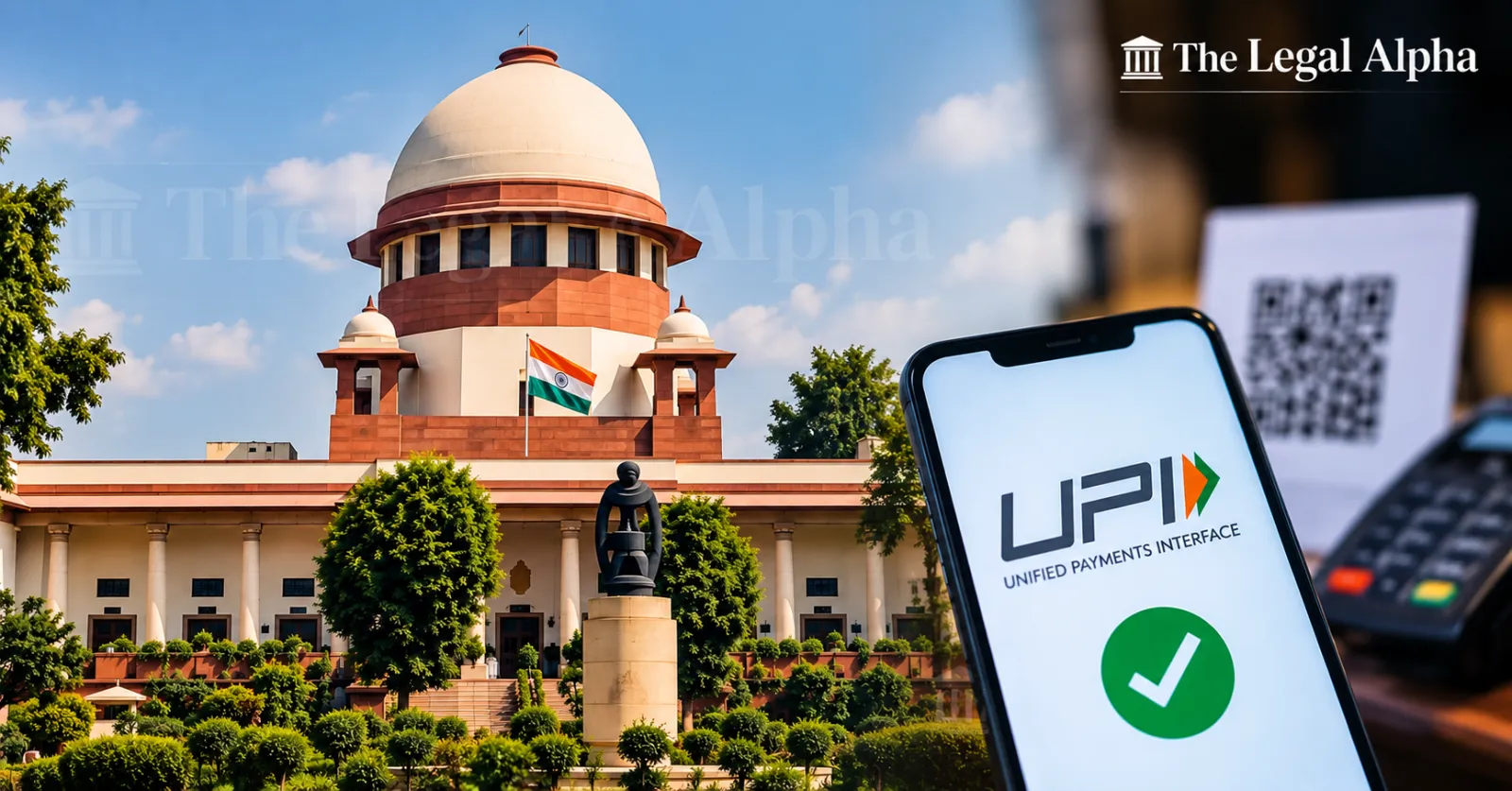
New Delhi, September 28, 2026: The Supreme Court has declined to put a temporary hold on the Centre’s new Merchant Discount Rate (MDR) framework for certain UPI merchant payments above ₹2,000, while agreeing to examine the legal challenge against it.
A three-judge Bench headed by Chief Justice of India Surya Kant, along with Justices Joymalya Bagchi and V. Mohana, issued notices to the Centre, the Reserve Bank of India (RBI) and the National Payments Corporation of India (NPCI). The respondents have been asked to file their responses within four weeks.
The immediate consequence is clear: the October 15 implementation of the new MDR framework has not been stayed. The larger question of whether the framework has a sufficient statutory and regulatory basis, however, remains open.
What Is the Dispute About?
UPI has operated for years without MDR on most merchant transactions. That position is now changing for a specified category of higher-value merchant payments.
Under the new framework, a 0.4% MDR will apply to specified person-to-merchant (P2M) UPI transactions above ₹2,000, subject to a maximum charge of ₹300 per transaction. The framework is scheduled to come into effect on October 15, 2026.
The change does not introduce a general charge on people sending money through UPI.
Person-to-person transactions remain outside the MDR regime, while UPI merchant payments up to ₹2,000 also remain outside the charge. Certain small merchants are also covered by zero-MDR arrangements.
The legal challenge before the Supreme Court is therefore not simply about whether UPI payments should remain free. The central question is whether the new charging mechanism has been introduced within the legal authority available to the government and the institutions operating the payment system.
The Legal Question Before the Supreme Court
The petition challenges the Centre’s September notifications and the subsequent MDR framework for specified UPI merchant transactions.
A key provision in the background is Section 10A of the Payment and Settlement Systems Act, 2007. A September 14 notification subsequently provided that charges could not be imposed on specified electronic payment modes, including UPI transactions up to ₹2,000.
The Court is now examining the legal basis for the charge applicable to transactions above that threshold and the legal character of the MDR itself.
That distinction became important during the hearing.
What Did the Supreme Court Decide?
The Court did not grant the interim stay sought by the petitioner.
At the same time, the Bench sought responses from the Centre, RBI and NPCI and asked the authorities to place the relevant details before the Court on affidavit.
One of the questions raised during the hearing concerns the nature of MDR and whether it should be understood as a tax, a fee or a charge operating within the payment system.
The Centre's position is that MDR is neither a tax nor a government fee. Additional Solicitor General N. Venkataraman told the Court that the money would not be collected by the government and that the charge operates as a settlement fee within the payment ecosystem between participating entities.
The Court has not, at this stage, accepted or rejected that position.
That distinction is important because the Supreme Court has not delivered a final ruling on the legality of the MDR framework. The existing framework remains in place while the Court seeks the respondents' answers.
What Will Change Under the MDR Framework?
For specified merchant transactions, the framework provides:
- 0.4% MDR on general P2M UPI transactions above ₹2,000.
- A ₹300 maximum MDR for transactions of ₹75,000 or more.
- A ₹5 flat MDR for specified essential and thin-margin sectors, including railways, telecommunications, insurance and fuel.
- A lower 0.02% MDR for specified capital-market transactions, subject to the applicable cap.
- No MDR on person-to-person UPI transactions.
- No MDR on merchant transactions up to ₹2,000.
- Certain small merchants receiving up to ₹1 lakh a month through eligible UPI QR arrangements continue to receive zero-MDR treatment.
The government has also said that customers should not be charged separately for these MDR amounts. The charge is structured on the merchant and payment-ecosystem side rather than as a transaction fee payable by the individual UPI user.
What Are the Parties Saying?
The Petitioner's Challenge
The petition challenges the legal and regulatory basis of the new MDR framework. It questions the manner in which charges have been introduced for commercial UPI transactions and raises concerns relating to statutory authority, safeguards and the potential effect on merchants.
The petitioner sought interim protection from implementation of the framework. The Supreme Court has declined that request for now.
The Centre's Position
The Centre has defended the framework as a mechanism intended to support the financial sustainability of the UPI ecosystem.
Its position before the Court is that MDR is not a tax imposed by the government. Instead, it is a charge within the payment network, with the proceeds distributed among relevant participants in the ecosystem.
The Court has now asked the Centre and the other respondents to formally place their position on record.
Why This Case Matters
The case goes beyond the question of whether a merchant should pay 0.4% on a particular UPI transaction.
At a broader level, it puts the regulatory framework governing India's digital payments system under judicial examination.
For merchants, the immediate issue is practical. Unless the Court changes its position, the MDR framework is scheduled to begin on October 15.
For the payment industry, however, the larger question is how charges can be created and allocated within a payment system that is regulated by statute and public authorities.
The distinction between a government levy and a payment-system charge could become particularly important. If the charge is not a tax or statutory fee, the Court will still have to consider the legal source from which the authority to impose or facilitate that charge arises.
The proceedings may therefore provide greater clarity on the respective roles of the Centre, RBI and NPCI in determining the economic terms on which UPI operates.
What Happens Next?
The Centre, RBI and NPCI have been given four weeks to respond.
The Supreme Court will then have the benefit of their affidavits before considering the challenge further. Until another order is passed, the refusal to grant an interim stay means that the October 15 rollout remains unaffected by the present proceedings.
The Court has not yet ruled on whether the MDR framework is legally valid.
That question remains to be decided.
Legal Takeaway
The Supreme Court has allowed the new UPI MDR framework to remain in place for now, while putting its legal basis under scrutiny by seeking responses from the Centre, RBI and NPCI.
For the moment, the key distinction is between implementation and legality: the October 15 rollout has not been stopped, but the Court has not given the framework a final judicial approval either.
Sources
Primary Sources:
- Ministry of Finance / Government of India: September 2026 notifications and official material concerning the amended Payment and Settlement Systems Act framework and UPI MDR structure. (Press Information Bureau)
Additional Sources:
- The Economic Times : Supreme Court proceedings on the challenge to UPI MDR. (The Economic Times)
- LiveMint : Supreme Court questions the legal basis and character of the UPI MDR. (mint)
- Moneycontrol : Details of the 0.4% MDR and ₹300 cap. (Moneycontrol)
- Indian Express : Explanation of the October 15 UPI charging framework. (The Indian Express)
This article is based on developments available as of September 28, 2026. The proceedings before the Supreme Court are ongoing.