Supreme Court Questions Financial Settlements for Rape Under Customary Law, Issues Notice to Tripura and TTAADC
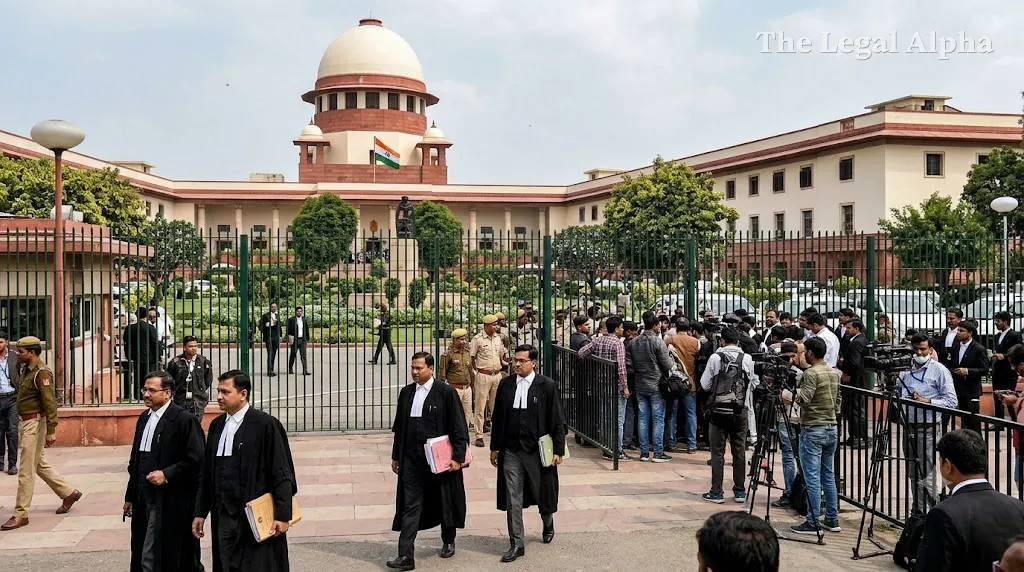
The Supreme Court of India issued formal notices to the Tripura state government and the Tripura Tribal Areas Autonomous District Council (TTAADC) on a Public Interest Litigation (PIL) questioning the constitutional validity of Section 143 of the Jamatia Customary Law Act, 2017.
The petition, moved by petitioner Madhumita Bhattacharya, contends that the codified customary provision allows individuals accused of grave sexual offences—specifically the enticement and rape of women—to evade statutory criminal liability through monetary compensation and community penalties. A three-judge Bench headed by Chief Justice of India Surya Kant and comprising Justices Joymalya Bagchi and V. Mohana sought responses from the administration and tagged the challenge with an aligned pending matter.
Legal Topic
-
Area of Law: Constitutional Law / Criminal Jurisprudence
-
Sub-topic: Sixth Schedule Legislative Competence / Customary Law versus Statutory Criminal Justice
Core Legal Issue
Can autonomous district councils, exercising delegated legislative authority under the Sixth Schedule of the Constitution, codify customary dispute-resolution mechanisms that substitute statutory criminal prosecution for heinous offences—such as rape—with monetary penalties or community-level dispute settlements?
The controversy highlights the tension between preserving tribal self-governance and customary dispute adjudication on one hand, and upholding non-negotiable fundamental rights to bodily autonomy, equality, and state-mandated criminal justice under the Indian Penal Code (now Bharatiya Nyaya Sanhita) on the other.
What Did the Court Decide?
The Supreme Court did not strike down or stay the operation of Section 143 at this preliminary stage.
Instead, the Bench formally entertained the writ petition and issued notices to both the State of Tripura and the TTAADC, calling for their replies. The Court additionally directed that the case be tagged alongside related pending matters exploring customary practices and directed the transmission of official records concerning the passage and legislative formulation of the 2017 Act.
Key Legal Points
-
Constitutional Primacy Over Custom: The petition challenges whether customary practices, once codified into formal tribal council legislation, remain subject to the tests of Part III fundamental rights—particularly Articles 14 and 21.
-
Non-Compoundable Nature of Heinous Offences: Criminal jurisprudence in India firmly classifies rape as a non-compoundable public wrong against society, precluding financial restitution, compromise, or customary quashing.
-
Scope of Sixth Schedule Powers: The case brings under scrutiny paragraph 3 of the Sixth Schedule to the Constitution, testing the limits of an Autonomous District Council’s powers to codify social customs when they intersect with central penal codes.
-
Judicial Review of Traditional Forums: The court will evaluate the statutory role of the Hoda Okra (traditional Jamatia spiritual and adjudicatory leaders) and whether community-level determinations can bypass statutory law-enforcement machinery.
Relevant Law
-
Section 143 of the Jamatia Customary Law Act, 2017: The impugned provision prescribing customary monetary penalties and settlement procedures for offences involving the enticement and rape of a woman.
-
Sixth Schedule, Constitution of India: Provisions empowering Autonomous District Councils in Northeast states to make laws concerning tribal inheritance, marriage, social customs, and customary dispute resolution.
-
Articles 14 and 21, Constitution of India: Guarantees of equality before the law, equal protection of laws, and the fundamental right to life, dignity, and personal liberty.
-
Code of Criminal Procedure, 1973 / Bharatiya Nagarik Suraksha Sanhita, 2023 (Section 320 / Section 359): Statutory provisions declaring offences of sexual assault strictly non-compoundable.
Arguments of the Parties
Petitioner
Represented through Advocate Shoumendu Mukherji, the petitioner argued that Section 143 is unconstitutional, discriminatory, and ultra vires fundamental constitutional protections. Mukherji submitted that permitting sexual offences against women to be settled through fiscal compensation under customary practices creates a parallel, regressive legal framework that effectively deprives tribal women of the standard criminal justice system and shields perpetrators from statutory penal accountability.
State & Autonomous District Council
The respondents, having only just been issued notices by the Bench, are yet to file their formal affidavits. However, the institutional foundation behind the 2017 legislation rests on the constitutional mandate of the Sixth Schedule, which recognizes indigenous customs and provides forums through traditional headmen (Okras) to resolve inter-community social and family disputes without protracted civil litigation.
Why Does It Matter?
This litigation addresses a longstanding constitutional dilemma in Indian jurisprudence: where does regional tribal autonomy end and universal human rights law begin?
While the Constitution grants special protections to indigenous customs to preserve cultural diversity and autonomy, modern constitutional law has consistently held that personal and customary laws cannot violate the fundamental rights of women. If the Supreme Court ultimately rules that autonomous district councils cannot create compromise mechanisms for serious crimes, the judgment will set a vital precedent across Sixth Schedule jurisdictions in the Northeast, reinforcing that heinous offences against women cannot be compromised or commercialized under the guise of tradition.
Legal Takeaway
Customary legal protections under the Sixth Schedule cannot serve as a constitutional shield to dilute the criminal prosecution of serious sexual offences. The Supreme Court's intervention signals that customary codifications must satisfy basic constitutional standards of gender justice, dignity, and non-compoundability.
Sources
-
Primary Source: Supreme Court of India, Proceedings before the Bench of CJI Surya Kant, Justice Joymalya Bagchi, and Justice V. Mohana in the PIL filed by Madhumita Bhattacharya (Jamatia Customary Law Act, 2017 Challenge).
-
Additional Sources: The Jamatia Customary Law Act, 2017 (enacted by the Tripura Tribal Areas Autonomous District Council); Sixth Schedule to the Constitution of India.